

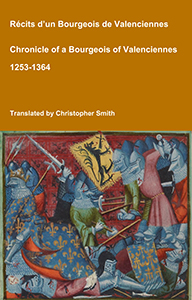
Chronicle of a Bourgeois of Valenciennes
Récits d’un bourgeois de Valenciennes aka The Chronicle of a Bourgeois of Valenciennes is a vivid 14th-century vernacular chronicle written by an anonymous urban chronicler from Valenciennes in the County of Hainaut. It survives in a manuscript that describes local and regional history from about 1253 to 1366, blending chronology, narrative episodes, and eyewitness-style accounts of political, military, and social events in medieval France, Flanders, and the Low Countries. The work begins with a chronological framework of events affecting Valenciennes and its region under rulers such as King Philip VI of France and the shifting allegiances of local nobility. It includes accounts of conflicts, sieges, diplomatic manoeuvres, and the impact of broader struggles like the Hundred Years’ War on urban life in Hainaut. Written from the perspective of a burgher (bourgeois) rather than a monastery or royal court, the chronicle offers a rare lay viewpoint on high politics and warfare, reflecting how merchants, townspeople, and civic institutions experienced the turbulence of the 13th and 14th centuries. Its narrative style combines straightforward reporting of events with moral and civic observations, making it a valuable source for readers interested in medieval urban society, regional politics, and the lived experience of war and governance in pre-modern Europe.
Available at Amazon in eBook and Paperback format.
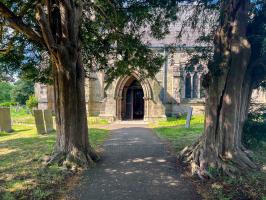
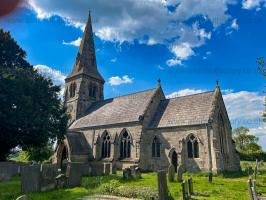
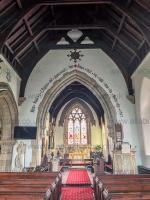
St Michael's Church, Sutton-on-the-Hill is in Sutton-on-the-Hill, Derbyshire, Churches in Derbyshire.
St Michael's Church, Sutton-on-the-Hill [Map] dates from the 14th century, but with the exception of the chancel, was very heavily rebuilt in 1863 by the architects Giles and Brookhouse of Derby.
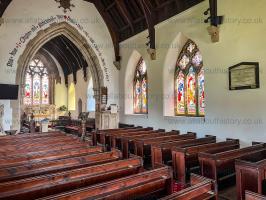
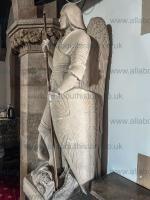
Monument at St Michael's Church, Sutton-on-the-Hill [Map] to Samuel Sleigh of Ash and Etwall, his first wife Judith Boys and a number of their children. The translations of te inscriptions taken from a sheet in the church.
Judith Boys: Before 16th September 1634 Samuel Sleigh of Ash and Etwall and she were married.
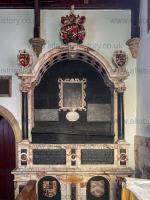
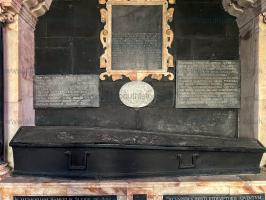
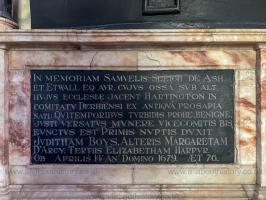
Bottom left: To the memory of Samuel Sleigh of Ash and Etwall, Knight, whose bones lie unde the altar of this church. He was born from an old family in Hartington, Derbyshire. In troubled times he behaved honourably, kindly and justly, and was twice made sheriff. His first wife was Judith Boys, second Margaret D'Arcy, third Elizabeth Harpur. He died 14th April in the year of our Lord 1679, aged 76.
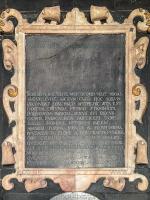
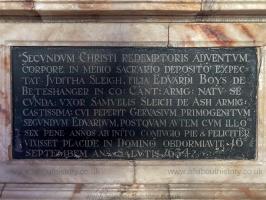
Top Middle: Traveller, if you ask about this sad monument of death, what it signifies or to whom It Is dedicated, whose bones this soil conceals, then listen to these brief words. Here lies Judith, sprung from the ancient line of Boys: a great ornament of her sex, serious, chaste, a faithful mariage-partner, sweet in character, of a very gentle disposition, lovely in form and most pious in mind. Snatched away by bitter death (alas) in the flower of her youth, she died and left two children [literall: yielded to a double offspring]. Here rests all that part of her which is capable of dying. But her pure soul is rising to the height of heaven, unknowing of death, shining in celestial glory. Rest, O sacred remains! God will reunite you and not allow you to decay for ever. Bottom right: Whilst her body lies in the middle of this sarcophagus, Judith awaits the second coming of Christ the Saviour. She was second-born daughter of Edward Boys Esquire, of Betshanger in Kent, wife of Samuel Sleigh of Ash, Esquire, a very chaste woman. To him she bore her first son, Gervase, and her second, Edward. However, after she had lived piously and happily with him for nearly six years of marriage, she peacefully fell asleep in the Lord, 16th Sept. A.D. 1634.
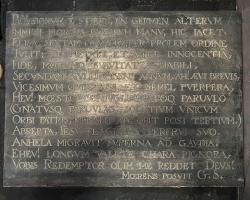
Right Middle: Here lies Eliza from the family of Boys [en Germen...?] cut off by the cruel hand of death. She was her mother's sixth child but second to none in piety, innocence, faith and a lovely, sweet character. Alas! While in the twenty fifth year of her brief life and in her first childbirth, she died, leaving a grieving husband and a little child, and as for the little one, on solace of the bereft father, he died an untimely death only three months old. Burning with eagerness to enjoy Jesus, she has moved away to heavenly bliss. Alas! Farewell dear pledges! One day Christ the Redeemer will restore me to you. Placed in grief by G.S.
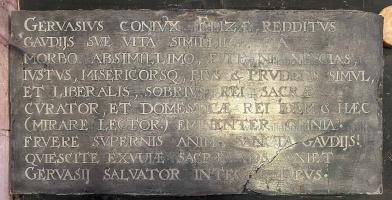
Left Middle: Gervase, husband of Eliza, restored to joy after a very similar life of piety but from a different iliness, was, in case you did not know him, just, merciful, pious and, at the same time, wise, generous and sober-minded, a preserver of the faith and family and all these (marvel, reader!) to a high degree to earn heavenly bliss for his saintly soul. Rest, sacred remains! God will come as Saviour of the entire Gervase.
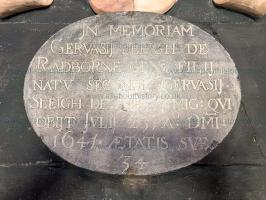
Middle middle roundel: To the memory of Gervase Sleigh of Radbourne, gentleman, second son of Sleigh of Ash, Esquire, who died July 23 in the year of our Lord 1641, aged 34.
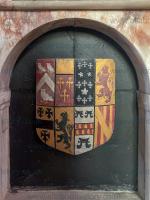
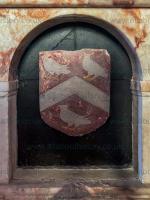
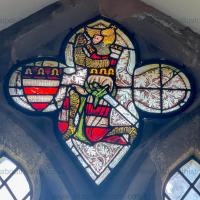
St Michael's Church, Sutton-on-the-Hill [Map]. Medieval stained glass discovered during the restoration of the Seligh monument.
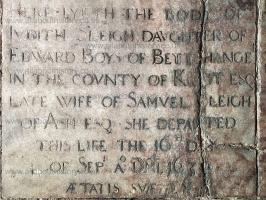
On 16th September 1634 Judith Boys died. She was buried at St Michael's Church, Sutton-on-the-Hill [Map].
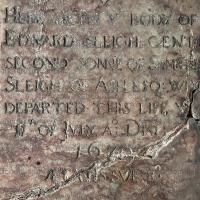
On 11th July 1639 Edward Sleigh of Ash [aged 8] died. He was buried at St Michael's Church, Sutton-on-the-Hill [Map].
Edward Sleigh of Ash: Around 1631 he was born to Samuel Sleigh of Ash and Etwall and Judith Boys.
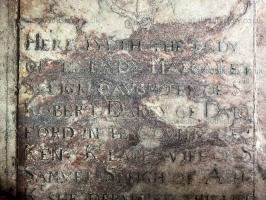
Before 20th October 1677 Margaret Darcy died. She was buried at St Michael's Church, Sutton-on-the-Hill [Map].
Margaret Darcy: she was born to Robert Darcy. On 17th February 1635 Samuel Sleigh of Ash and Etwall and she were married.
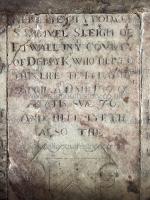
On 14th April 1679 Samuel Sleigh of Ash and Etwall [aged 74] died. He was buried at St Michael's Church, Sutton-on-the-Hill [Map].
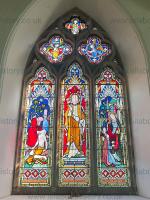
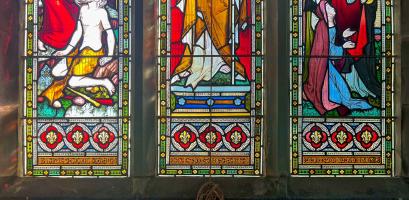
St Michael's Church, Sutton-on-the-Hill [Map]. Stained glass window in memory of Eileen Margaret Buckston, widow of the Reverend Garmin Buckston, who died 2nd July 1866 aged 71.
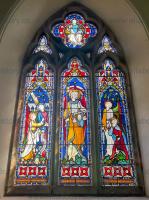
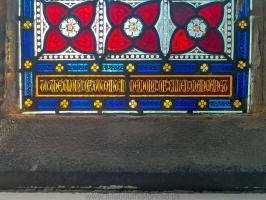
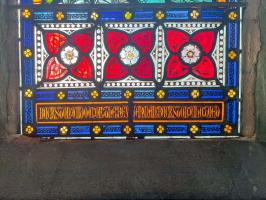
St Michael's Church, Sutton-on-the-Hill [Map]. Stained glass window in memory of Eileen Margaret Buckston commissioned by her daughter.
The History of William Marshal was commissioned by his son shortly after William’s death in 1219 to celebrate the Marshal’s remarkable life; it is an authentic, contemporary voice. The manuscript was discovered in 1861 by French historian Paul Meyer. Meyer published the manuscript in its original Anglo-French in 1891 in two books. This book is a line by line translation of the first of Meyer’s books; lines 1-10152. Book 1 of the History begins in 1139 and ends in 1194. It describes the events of the Anarchy, the role of William’s father John, John’s marriages, William’s childhood, his role as a hostage at the siege of Newbury, his injury and imprisonment in Poitou where he met Eleanor of Aquitaine and his life as a knight errant. It continues with the accusation against him of an improper relationship with Margaret, wife of Henry the Young King, his exile, and return, the death of Henry the Young King, the rebellion of Richard, the future King Richard I, war with France, the death of King Henry II, and the capture of King Richard, and the rebellion of John, the future King John. It ends with the release of King Richard and the death of John Marshal.
Available at Amazon in eBook and Paperback format.
St Michael's Church, Sutton-on-the-Hill [Map]. Stained glass window in memory of Sarah Ford White who died 29th October 1870.


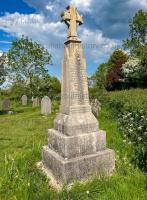
1944. War Memorial at St Michael's Church, Sutton-on-the-Hill [Map].
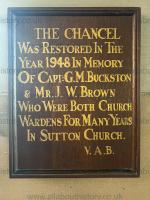
The Chancel of St Michael's Church, Sutton-on-the-Hill [Map], was restored in 1948 in memory of Captain G M Buckson and Mr J W Brown.