

The History of William Marshal was commissioned by his son shortly after William’s death in 1219 to celebrate the Marshal’s remarkable life; it is an authentic, contemporary voice. The manuscript was discovered in 1861 by French historian Paul Meyer. Meyer published the manuscript in its original Anglo-French in 1891 in two books. This book is a line by line translation of the first of Meyer’s books; lines 1-10152. Book 1 of the History begins in 1139 and ends in 1194. It describes the events of the Anarchy, the role of William’s father John, John’s marriages, William’s childhood, his role as a hostage at the siege of Newbury, his injury and imprisonment in Poitou where he met Eleanor of Aquitaine and his life as a knight errant. It continues with the accusation against him of an improper relationship with Margaret, wife of Henry the Young King, his exile, and return, the death of Henry the Young King, the rebellion of Richard, the future King Richard I, war with France, the death of King Henry II, and the capture of King Richard, and the rebellion of John, the future King John. It ends with the release of King Richard and the death of John Marshal.
Available at Amazon in eBook and Paperback format.
St Oswald's Church, Brereton is in Brereton, Cheshire [Map], Churches in Cheshire.
St Oswald's Church, Brereton [Map]. The present church was constructed around 1550.
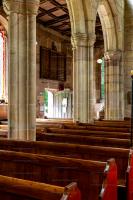
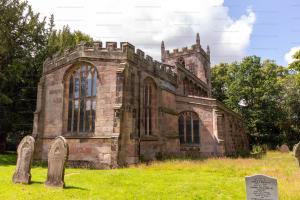
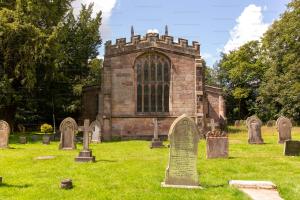
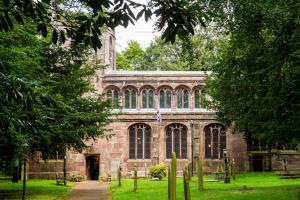
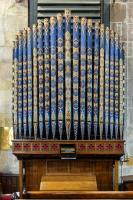
On 20th January 1561 Lawrence Smith [aged 46] and Jane Warburton [aged 33] were married at St Oswald's Church, Brereton [Map].
In 1618 William Brereton 1st Baron Brereton [aged 67] installed a memorial to the Brereton family when their remains were brought from St Mary's Church, Astbury, Cheshire and reinterred in the Chancel of St Oswald's Church, Brereton [Map]. The family motto "Opitulante Deo" being "God being my Helper". The inscription: In ancient times when this Church of Brereton was a donative chapel within the parish of Astbury, the ancestors of William Brereton knight, Baron of Malpas, (who erected this monument in 1618 A.D.), had been buried in the Churchyard at Astbury, where ancient monuments of some of them still remain at this date, marked in English with the words "Knightes burialls". But after the said chapel was made a parochial church, the ancestors of the said William Berereton, knight, patron of this Chapel of Brereton, were buried in this chancel, except those who died in countries abroad.
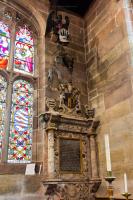

On 1st May 1632 Frances Coleclough [aged 74] died. On 16th June 1643 William Smethwich [aged 80] died. They were buried at St Oswald's Church, Brereton [Map]
Inscriptions on the monument "Here lieth the body of William Smethwicke of Smethwicke esq. who, mindful of his death, erected this monument for himself and, his wife, pious to God, pious in good workes which William was born Oct. 1, Anno D'ni 1551 and died June 16 Anno Dni' 1643." and
"Here alsoe lieth the body of Frances Smethwicke, daughter of Sir Anthony Coleclough, Knight, married to William Smethwicke aforesaid and lived in wedlocke with him 48 years a devout and hospitall matron, born Anno Dom: 1557, in the Castle of Kildare, in Ireland, Novemb. 6, and died 1st of May, 1632."
Frances Coleclough: On 6th November 1557 she was born to Anthony Coleclough at Kildare Castle. In 1585 William Smethwich and she were married.
William Smethwich: On 1st October 1551 he was born to Thomas Smethwick and Ann Vernon.


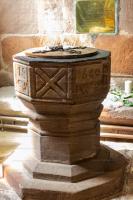
1660. Font at St Oswald's Church, Brereton [Map].
On or before 11th April 1722, the date he was buried at St Oswald's Church, Brereton [Map], Francis Brereton 5th Baron Brereton [aged 59] died unmarried and without issue. Baron Brereton extinct.
Archaeologia Volume 9 Appendix. 22nd May 1788. Owen Salusbury Brereton [aged 73], Esq. V. P. exhibited a beautiful coloured drawing of a window in the parish-church of Brereton [Map], one of the oldest in the county-palatine of Chester; but the date of it is not exactly known1. In the lower compartments are four figures representing the four persons who slew Thomas Becket at the high altar in Canterbury cathedral, 1170. They are in complete armour, with drawn swords in their hands, and on pendant scrolls are inscribed their names; William Tracy, Richard Britton, Reginald Fitzurse, and Hugh Morrel. A fifth figure, exactly correiponding with these, in the centre compartments, bears, on the like scroll, these words, Martyrum Thomam. In three compartments of the Upper division of the window are two priests [Note. In the original the word priests is crossed out, and the word "saints" written in the margin.], and between them a figure episcopally habited, most probably intended for Becket himself. Under the five lower figures, after their names are these words tended for two hexameter lines:
Martyrum Thomam fieri fecere beatum
Anno milleno centeno septuageno.
[Note. The above two lines in Gothic script]
Under these the following inscription represented in the opposite page:
"Left this monument in Glase being in the upper window of the North syde the chauncell of Brereton churche shoulde be broken, I Sir Will'm Brereton, knight, to the end hyt may remayne in memorie to the posteritie, have caused the same to be heare purtred, the 25th of Marche, 1608. W. Brereton."
Note 1. See Pl. XXIII.


Archaeologia Volume 10 Section IV. Some Observations on the Paintings in the Window of Brereton Church [Map]. By the Rev. Samuel Pegge [aged 85], in a Letter to Owen Salusbury Brereton [aged 74], Esq. Vice President. Read Nov. 26, 1789.
In 1819 Reverend Edward Royds [aged 28] was appointed Rector of St Oswald's Church, Brereton [Map] which office he held until his death in 1836. The first of four Rectors of St Oswald's Church, Brereton [Map] from the Royds family. This Edward, his brother Reverend Charles Smith Royds [aged 19], Edward's son Reverend Edward Royds, and his son Reverend Alfred Royds.
On 2nd March 1821 Reverend Edward Royds was baptised at St Oswald's Church, Brereton [Map].
On 7th June 1822 twins Clement Royds and Henry Royds of Elm House in Wavertree were baptised at St Oswald's Church, Brereton [Map].
The Deeds of the Dukes of Normandy
The Gesta Normannorum Ducum [The Deeds of the Dukes of Normandy] is a landmark medieval chronicle tracing the rise and fall of the Norman dynasty from its early roots through the pivotal events surrounding the Norman Conquest of England. Originally penned in Latin by the monk William of Jumièges shortly before 1060 and later expanded at the behest of William the Conqueror, the work chronicles the deeds, politics, battles, and leadership of the Norman dukes, especially William’s own claim to the English throne. The narrative combines earlier historical sources with firsthand information and oral testimony to present an authoritative account of Normandy’s transformation from a Viking settlement into one of medieval Europe’s most powerful realms. William’s history emphasizes the legitimacy, military prowess, and governance of the Norman line, framing their expansion, including the conquest of England, as both divinely sanctioned and noble in purpose. Later chroniclers such as Orderic Vitalis and Robert of Torigni continued the history, extending the coverage into the 12th century, providing broader context on ducal rule and its impact. Today this classic work remains a foundational source for understanding Norman identity, medieval statesmanship, and the historical forces that reshaped England and Western Europe between 800AD and 1100AD.
Available at Amazon in eBook and Paperback format.
On 12th March 1824 Thomas Molyneux Royds was born to Reverend Edward Royds [aged 33] and Mary Molyneux [aged 31]. He was baptised at St Oswald's Church, Brereton [Map] on 17th June 1824. He married 30th November 1844 Elizabeth Jane Roberts.
On 25th December 1825 Reverend Francis Coulman Royds was baptised at St Oswald's Church, Brereton [Map].
In 1836 Reverend Charles Smith Royds [aged 36] was appointed Rector of St Oswald's Church, Brereton [Map].

On 11th April 1836 Reverend Edward Royds [aged 45] died. On 14th April 1836 he was buried in the Chancel of St Oswald's Church, Brereton [Map]
In 1845 Reverend Edward Royds [aged 24] was appointed Rector of St Oswald's Church, Brereton [Map].
On 9th October 1848 Edward Royds was born to Reverend Edward Royds [aged 27] and Anne Mary Littledale [aged 28]. He was baptised at St Oswald's Church, Brereton [Map] on 14th November 1847. Coefficient of inbreeding 6.25%.
On 27th March 1849 Amy Royds was born to Reverend Edward Royds [aged 28] and Anne Mary Littledale [aged 28]. She was baptised at St Oswald's Church, Brereton [Map] on 29th April 1849. Coefficient of inbreeding 6.25%.
On 29th December 1849 John Howard [aged 68] died. He was buried at St Oswald's Church, Brereton [Map].
On 11th April 1850 Reverend Alfred Royds was born to Reverend Edward Royds [aged 29] and Anne Mary Littledale [aged 29]. He was baptised at St Oswald's Church, Brereton [Map] on 10th November 1850. Coefficient of inbreeding 6.25%. He married 13th August 1885 Eleanor Georgina Dixon.
On 15th February 1852 Mary Emily Royds was born to Reverend Edward Royds [aged 31] and Anne Mary Littledale [aged 31]. She was baptised at St Oswald's Church, Brereton [Map] on 4th April 1852. Coefficient of inbreeding 6.25%. She married 8th May 1883 Willoughby Brooke.
Chronicle of Walter of Guisborough
A canon regular of the Augustinian Guisborough Priory, Yorkshire, formerly known as The Chronicle of Walter of Hemingburgh, describes the period from 1066 to 1346. Before 1274 the Chronicle is based on other works. Thereafter, the Chronicle is original, and a remarkable source for the events of the time. This book provides a translation of the Chronicle from that date. The Latin source for our translation is the 1849 work edited by Hans Claude Hamilton. Hamilton, in his preface, says: 'In the present work we behold perhaps one of the finest samples of our early chronicles, both as regards the value of the events recorded, and the correctness with which they are detailed; Nor will the pleasing style of composition be lightly passed over by those capable of seeing reflected from it the tokens of a vigorous and cultivated mind, and a favourable specimen of the learning and taste of the age in which it was framed.'
Available at Amazon in eBook and Paperback format.
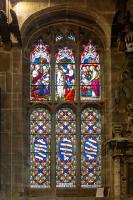
After 1859. Window in the North Wall of the Chancel of St Oswald's Church, Brereton [Map]. Three. Left. Jesus raising the son of the widow of Nain. Middle. Jesus raising Lazarus. Right. Jesus raising the daughter of Jairus. The dedication: In memory of Clement Royds, died 27 Apr 1842, Thomas Molyneux Royds, died 13 Jan 1852, Emily Smyth Royds [aged 24], died 23 Nov 1859.
Clement Royds: On 8th April 1822 he was born to Reverend Edward Royds and Mary Molyneux. He was a twin with his brother Henry Royds of Elm House in Wavertree. On 7th June 1822 twins Clement Royds and Henry Royds of Elm House in Wavertree were baptised at St Oswald's Church, Brereton [Map].
Thomas Molyneux Royds: On 12th March 1824 he was born to Reverend Edward Royds and Mary Molyneux. He was baptised at St Oswald's Church, Brereton [Map] on 17th June 1824. On 30th November 1844 Thomas Molyneux Royds and Elizabeth Jane Roberts were married at Exeter Farm, Braidwood, New South Wales. On 13th January 1852 Thomas Molyneux Royds died. He was buried in Braidwood Cemetery, New South Wales.
Emily Smyth Royds: On 6th February 1834 she was born to Reverend Edward Royds and Mary Molyneux. Before 23rd November 1859 Reverend Granville Smyth and she were married. On 23rd November 1859 Emily Smyth Royds died.
On 4th December 1859 Mary Molyneux [aged 66] died at Elkington Rectory. She was buried in the Chancel of St Oswald's Church, Brereton [Map] on 8th December 1859 where she has a memorial window in the south transept.
Before 1881. West Window and East Window in the Chancel of St Oswald's Church, Brereton [Map] by William Wailes.
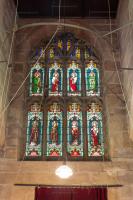
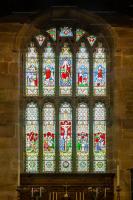
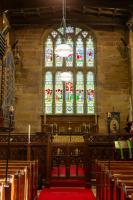
On 8th May 1883 Willoughby Brooke [aged 34] and Mary Emily Royds [aged 31] were married at St Oswald's Church, Brereton [Map].
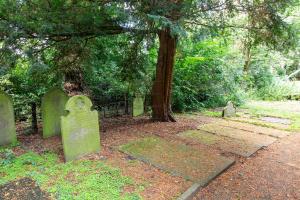
Around 1884. Graves of servants of Brereton Hall, Cheshire [Map] in the churchyard of St Oswald's Church, Brereton [Map].
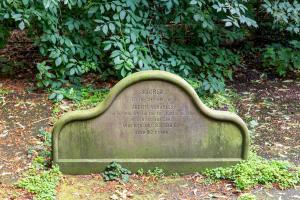

8th July 1885. St Oswald's Church, Brereton [Map]. Memorial to Ann Elizabeth Lowe, wife Samuel Ingham.
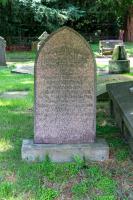
After 6th November 1887. St Oswald's Church, Brereton [Map]. Grave of Elizabeth Malano. Stone erected by Harriette Howard of Brereton Hall.

On 1st August 1895 Reverend Edward Royds [deceased] was buried in the Churchyard of St Oswald's Church, Brereton [Map].
In 1896 Reverend Alfred Royds [aged 45] was appointed Rector of St Oswald's Church, Brereton [Map].
On 9th January 1896 Anne Mary Littledale [aged 75] died. She was buried at St Oswald's Church, Brereton [Map] on 13th January 1896 where she has a memorial window in the south transept.
Jean de Waurin's Chronicle of England Volume 6 Books 3-6: The Wars of the Roses
Jean de Waurin was a French Chronicler, from the Artois region, who was born around 1400, and died around 1474. Waurin’s Chronicle of England, Volume 6, covering the period 1450 to 1471, from which we have selected and translated Chapters relating to the Wars of the Roses, provides a vivid, original, contemporary description of key events some of which he witnessed first-hand, some of which he was told by the key people involved with whom Waurin had a personal relationship.
Available at Amazon in eBook and Paperback format.
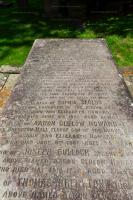
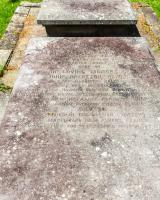
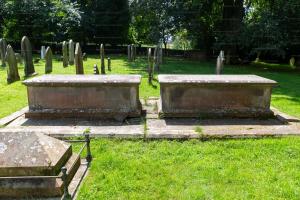
Around 1900. St Oswald's Church, Brereton [Map]. Graves and Memorials to members of the Howard family.
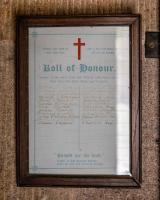
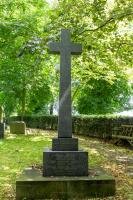
After 1918. St Oswald's Church, Brereton [Map] Roll of Honour and War Memorial.
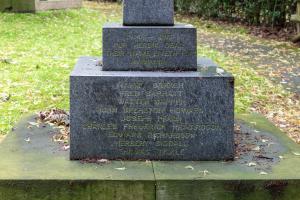
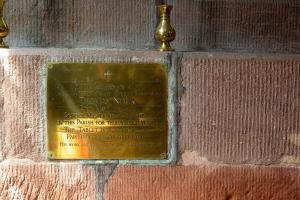
After 14th May 1923. St Oswald's Church, Brereton [Map]. Memorial to Thomas Nock, Schoolmaster and Organist for thirty years.

8th August 1999. St Oswald's Church, Brereton [Map]. Memorial to William Brereton 2nd Baron Brereton. Bellringer and Donor of three bells in honour of his marriage to Elizabeth Goring Baroness Brereton. A special event took place at St Oswald's.Church, Brereton on 8th August 1999: the dedication of a plaque to the memory of William, 2nd Lord Brereton, founding member and first Master in 1637 of one of the oldest English change ringing societies, the Ancient Society of College Youths, which still flourishes nationally and internationally from its base in London.

On 1st August 2001, Lammas Day, the Ancient Society of College Youths rang the Bells of St Oswald's Church, Brereton [Map] on the occasion of the anniversary of the Medieval Fair held on Brereton Green for three hundred years.

On 2nd August 2009. St Oswald's Church, Brereton [Map]. A Peal of 5040 Minor in 7 Methods by the Chester S. College Youths.
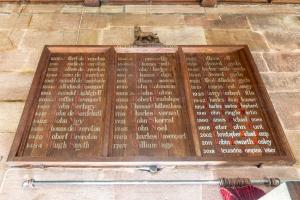
2018 Rectors of St Oswald's Church, Brereton [Map].
