


Text this colour links to Pages. Text this colour links to Family Trees. Text this colour are links that disabled for Guests.
Place the mouse over images to see a larger image. Click on paintings to see the painter's Biography Page.
Mouse over links for a preview. Move the mouse off the painting or link to close the popup.
The History of William Marshal was commissioned by his son shortly after William’s death in 1219 to celebrate the Marshal’s remarkable life; it is an authentic, contemporary voice. The manuscript was discovered in 1861 by French historian Paul Meyer. Meyer published the manuscript in its original Anglo-French in 1891 in two books. This book is a line by line translation of the first of Meyer’s books; lines 1-10152. Book 1 of the History begins in 1139 and ends in 1194. It describes the events of the Anarchy, the role of William’s father John, John’s marriages, William’s childhood, his role as a hostage at the siege of Newbury, his injury and imprisonment in Poitou where he met Eleanor of Aquitaine and his life as a knight errant. It continues with the accusation against him of an improper relationship with Margaret, wife of Henry the Young King, his exile, and return, the death of Henry the Young King, the rebellion of Richard, the future King Richard I, war with France, the death of King Henry II, and the capture of King Richard, and the rebellion of John, the future King John. It ends with the release of King Richard and the death of John Marshal.
Available at Amazon in eBook and Paperback format.
Stoke-on-Trent, Staffordshire is in Staffordshire.
The River Trent rises on Biddulph Moor, Staffordshire [Map] and flows, in a great horseshoe through, or near, Stoke-on-Trent, Staffordshire [Map], Stone, Staffordshire [Map], Essex Bridge [Map], Bishton Hall, Staffordshire [Map], Colwich, Staffordshire [Map] passing St Michael and All Angels Church, Colwich [Map], Rugeley, Staffordshire [Map], Kings Bromley, Staffordshire [Map], Alrewas, Staffordshire [Map], Burton-upon-Trent, Staffordshire [Map], Newton Solney, Derbyshire [Map], Repton, Derbyshire [Map], under Swarkestone Bridge, Derbyshire [Map], Sawley, Derbyshire [Map], Nottingham, Nottinghamshire [Map], Holme Pierrepoint, Nottinghamshire [Map], Stoke Ferry, Shelford [Map], under Gunthorpe Bridge, Nottinghamshire [Map], past Gunthorpe Lock [Map], Hoveringham, Nottingham [Map], Newark on Trent, Nottinghamshire [Map], Knaith [Map], Dunham Bridge [Map], Sutton on Trent, Nottinghamshire [Map], the Isle of Axholme [Map] and Gainsborough [Map] before joining the Humber Estuary at Trent Falls [Map].
St John the Baptist's Church, Burslem is also in Churches in Staffordshire.
In 1536 the stone tower was added to St John the Baptist's Church, Burslem [Map].
Before 26th December 1669, the date he was baptised at St John the Baptist's Church, Burslem [Map], Ralph Sneyd was born to William Sneyd (age 27).
In 1717 St John the Baptist's Church, Burslem [Map] was rebuilt, replacing an earlier timber-framed building destroyed in a fire.
In 1809 St John the Baptist's Church, Burslem [Map] became a parish. before that it was a chapelry in the parish of Stoke-upon-Trent, but often regarded as a parish, having its own churchwardens from 1553.
In December 1860 Ellis William Roberts was born to Thomas Roberts at Wolstanton, Staffordshire in Burslem, Staffordshire. He is recorded on the 1861 Census, taken on 07 Apr 1861, as being five months. He married 6th October 1888 Eliza Glover and had issue.
On 26th May 1779 John Sparrow of Bishton Hall in Staffordshire (age 42) and Elizabeth Moreton (age 38) were married at St Margaret's Church Wolstanton, Staffordshire by Ralph Moreton clerk, in presence of Mary Moreton and R Moreton.


Hulton Abbey is also in Abbeys in England.
In November 1246 Bertrade Mainwaring (age 49) died at Hulton Abbey [Map].
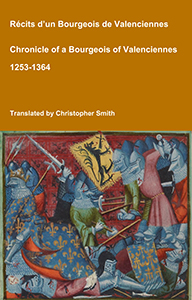
Chronicle of a Bourgeois of Valenciennes
Récits d’un bourgeois de Valenciennes aka The Chronicle of a Bourgeois of Valenciennes is a vivid 14th-century vernacular chronicle written by an anonymous urban chronicler from Valenciennes in the County of Hainaut. It survives in a manuscript that describes local and regional history from about 1253 to 1366, blending chronology, narrative episodes, and eyewitness-style accounts of political, military, and social events in medieval France, Flanders, and the Low Countries. The work begins with a chronological framework of events affecting Valenciennes and its region under rulers such as King Philip VI of France and the shifting allegiances of local nobility. It includes accounts of conflicts, sieges, diplomatic manoeuvres, and the impact of broader struggles like the Hundred Years’ War on urban life in Hainaut. Written from the perspective of a burgher (bourgeois) rather than a monastery or royal court, the chronicle offers a rare lay viewpoint on high politics and warfare, reflecting how merchants, townspeople, and civic institutions experienced the turbulence of the 13th and 14th centuries. Its narrative style combines straightforward reporting of events with moral and civic observations, making it a valuable source for readers interested in medieval urban society, regional politics, and the lived experience of war and governance in pre-modern Europe.
Available at Amazon in eBook and Paperback format.
On 1st April 1386 James Audley 2nd Baron Audley of Heighley (age 73) died. He was buried at Hulton Abbey [Map]. His son Nicholas (age 58) succeeded 3rd Baron Audley of Heighley in Staffordshire.
In 1391 Nicholas Audley 3rd Baron Audley of Heighley (age 63) died without issue. He was buried at Hulton Abbey [Map]. Baron Audley of Heighley in Staffordshire abeyant between his sisters Joan Audley (age 60) and Margaret Audley.