

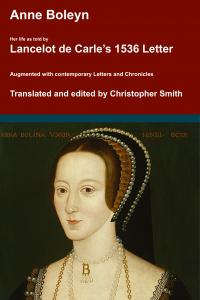
Anne Boleyn. Her Life as told by Lancelot de Carle's 1536 Letter.
In 1536, two weeks after the execution of Anne Boleyn, her brother George and four others, Lancelot du Carle, wrote an extraordinary letter that described Anne's life, and her trial and execution, to which he was a witness. This book presents a new translation of that letter, with additional material from other contemporary sources such as Letters, Hall's and Wriothesley's Chronicles, the pamphlets of Wynkyn the Worde, the Memorial of George Constantyne, the Portuguese Letter and the Baga de Secrets, all of which are provided in Appendices.
Available at Amazon in eBook and Paperback format.
Tonbridge, Kent is in Kent.
Tonbridge, Kent [Map] is on the River Medway.
Around 1044 Avice de Clare was born to Richard de Clare [aged 20] and Rohese Giffard [aged 9] at Tonbridge, Kent [Map]. She married Robert Stafford, son of Roger "The Spaniard" Tosny and Adelaide aka Godehildis Ramon, and had issue.
In 1064 Robert de Clare was born to Richard de Clare [aged 40] and Rohese Giffard [aged 29] at Tonbridge, Kent [Map]. He married 1114 his half third cousin twice removed Maud Senlis, daughter of Simon Senlis 1st Earl of Northampton, Earl of Huntingdon and Maud Queen Consort Scotland, and had issue.
Around 1066 Roger de Clare was born to Richard de Clare [aged 42] and Rohese Giffard [aged 31] at Tonbridge, Kent [Map].
In 1088 Gilbert de Clare [aged 22] was wounded at Tonbridge, Kent [Map].
Around 1100 Gilbert de Clare 1st Earl Pembroke was born to Gilbert de Clare [aged 34] and Adeliza Clermont [aged 42] at Tonbridge, Kent [Map]. He married in or before 1130 his half fourth cousin Isabel Beaumont Countess Pembroke, daughter of Robert Beaumont 1st Earl of Leicester Count Meulan and Elizabeth Capet Countess Leicester, Meulan and Surrey, and had issue.
In 1130 Richard "Strongbow" Clare 2nd Earl Pembroke was born to Gilbert de Clare 1st Earl Pembroke [aged 30] and Isabel Beaumont Countess Pembroke at Tonbridge, Kent [Map]. He married 26th August 1171 Aoife ni Diarmait Macmurrough Countess Pembroke and Buckingham and had issue.
In 1154 Elena de Clare was born to Roger Clare 2nd Earl Hertford [aged 38] and Maud St Hilary Countess Hertford at Tonbridge, Kent [Map]. She married John Grey and had issue.
Around 1245 Thomas de Clare was born to Richard de Clare 6th Earl Gloucester 5th Earl Hertford [aged 22] and Maud Lacy Countess Gloucester and Hertford [aged 21] at Tonbridge, Kent [Map]. He a great x 4 grandson of King Henry I "Beauclerc" England. He married February 1275 his fourth cousin once removed Juliana Fitzgerald and had issue.
On 10th November 1347 Hugh Audley 1st Earl Gloucester [aged 56] died at Tonbridge, Kent [Map]. He was buried at Tonbridge Priory, Kent [Map]. Earl Gloucester extinct. Baron Audley of Stratton Audley in Oxfordshire 1317dormant.
On 6th April 1395 William Stafford 4th Earl Stafford [aged 19] died at Pleshey Castle [Map]. He was buried at Tonbridge, Kent [Map]. His brother Edmund [aged 17] succeeded 5th Earl Stafford, 6th Baron Stafford.
On 5th September 1492 Andrew Judde was born to John Judde and Margaret Chichele at Tonbridge, Kent [Map]. He married (1) before 1523 Mary Murfyn (2) 1542 Agnes m Judde (3) 1552 Mary Mathews.
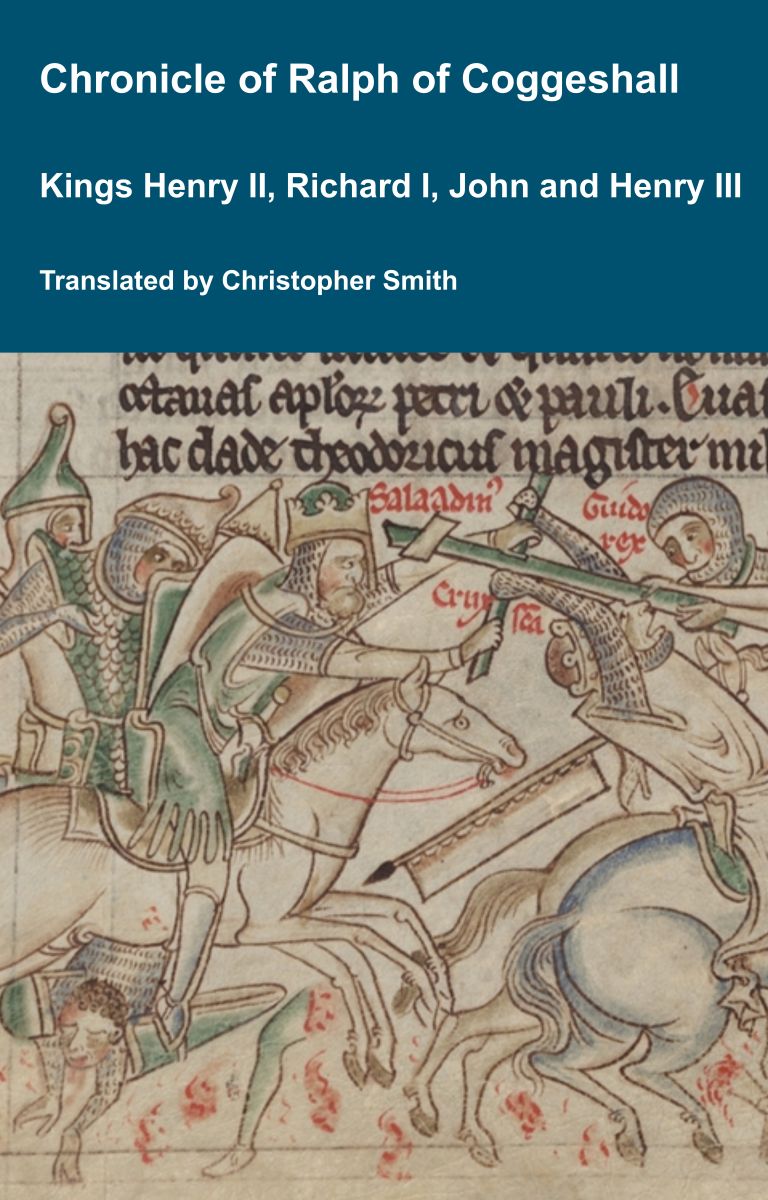
Chronicle of Abbot Ralph of Coggeshall
The Chronicle of Abbot Ralph of Coggeshall (Chronicon Anglicanum) is an indispensable medieval history that brings to life centuries of English and European affairs through the eyes of a learned Cistercian monk. Ralph of Coggeshall, abbot of the Abbey of Coggeshall in Essex in the early 13th century, continued and expanded his community’s chronicle, documenting events from the Norman Conquest of 1066 into the tumultuous reign of King Henry III. Blending eyewitness testimony, careful compilation, and the monastic commitment to record-keeping, this chronicle offers a rare narrative of political intrigue, royal power struggles, and social upheaval in England and beyond. Ralph’s work captures the reigns of pivotal figures such as Richard I and King John, providing invaluable insights into their characters, decisions, and the forces that shaped medieval rule. More than a simple annal, Chronicon Anglicanum conveys the texture of medieval life and governance, making it a rich source for scholars and readers fascinated by English history, monastic authorship, and the shaping of the medieval world.
Available at Amazon in eBook and Paperback format.
On 18th April 1527 Isabel Worsley [aged 67] died at Tonbridge, Kent [Map].
Letters and Papers Foreign and Domestic Henry VIII 1530. August 1530. Vesp. F. III. 15 b. B. M. Fiddes' Coll. 255. 197. Anne Boleyn [aged 29] to [Wolsey [aged 57]].
Thanks him for the gift of "this benefice for Mr. Barlow." However, it is not Tonbridge, Kent [Map] but Sonridge that she desires. The former is in her father's gift, and is not vacant. Will do all she can for those who have taken pains in the King's matter.
P.S.-Begs that for her sake he will remember the parson of Honey Lane [Farman].


Around May 1884 William Hamo Thornycroft [aged 34] and Agatha Cox [aged 19] were married at Tonbridge, Kent [Map]. He the son of Thomas Thornycroft [aged 68] and Mary Francis [aged 75].
Richard Clare was born to Richard de Clare and Rohese Giffard at Tonbridge, Kent [Map].
Parliament Rolls Richard II. 27. Be it remembered that the venerable father Thomas, archbishop of Canterbury, primate of all England, earnestly prayed to the lord king in the present parliament that whereas his church of Canterbury, by the gift and grant of his noble and holy progenitors, which the same king graciously confirmed, had such prerogative over the other churches of England that whatsoever archbishop of Canterbury for the time being had custody of all lordships, manors, tenements, and rents with appurtenances which were held of the same church in chief during the minority of the heirs of their tenants, even though the same tenants elsewhere held in chief of the lord king; and now concerning the castle and manor of Tonbridge, Kent [Map], which by virtue of this prerogative were in the custody of William de Courtenay, late archbishop of Canterbury now deceased, predecessor of the present archbishop, on the day on which he died, by reason of the minority of the heir of the earl of Stafford deceased, who held the aforesaid castle and manor from the aforesaid former archbishop in chief, dispute and controversy between the present archbishop and the executors of the will of the aforesaid late archbishop are pending at present. And whereas a certain composition was drawn up a short while ago between the archbishop of Canterbury and the prior and chapter of the church of Canterbury on the matter, it pleased the lord king, having inspected and examined that composition, to order a view and settlement of the matter for the peace and right of his said church of Canterbury, as should seem best to his royal majesty, to whose ordinance and decree on the foregoing the same archbishop proclaimed himself to be firmly obedient in all things, whereupon the same lord king immediately appointed the venerable fathers Robert archbishop of York, Robert Bishop of London and John Bishop of Ely, and John duke of Aquitaine and Lancaster, and John Earl of Huntingdon, and Thomas the earl marshal, to inspect and examine that composition, and further to discuss and settle the matter at their discretion, and fully to inform the lord king of what their deed and action should be. And later on Monday, the last day of the aforesaid parliament [10 February 1397], the archbishop of York, and the bishops, and the aforesaid duke and earls thus appointed by order of the lord king in the same parliament returned their decree and ordinance on the aforesaid matter by Walter Clopton, the lord king's justice, in this form - namely, that the third part of all manors, lands, and tenements of the inheritance of the aforesaid heir, and the issues, profits, and revenues of the same from the time of the death of the aforesaid late archbishop, should, according to the form of the aforesaid composition, remain and be in the hands of the aforesaid prior and chapter, to be used for their own purposes; and that two parts of the aforesaid lands and tenements, with the issues, profits, and revenues of the same two parts, should remain likewise in the hands of that prior and chapter, safely and securely to keep until the lord king shall have ordained to whom those said two parts of the issues, profits, and revenues shall be delivered and has declared his will thereon. And the castle of Tonbridge [Map] will be delivered to the aforesaid present archbishop of Canterbury without delay, to remain in his hands and keeping until the the coming of age of the aforesaid heir. The which ordinance and decree thus rendered by the archbishop of York, bishops, duke and earls, the aforesaid lord king, approving thereof, ordered to be placed on record on the roll of parliament at the request of the aforesaid present archbishop of Canterbury.
Rohese de Clare was born to Richard de Clare and Rohese Giffard at Tonbridge, Kent [Map]. She married Ralph Tillières.
Alice or Adeliza de Clare was born to Richard de Clare and Rohese Giffard at Tonbridge, Kent [Map].
Walter Fitzrichard aka de Clare was born to Richard de Clare and Rohese Giffard at Tonbridge, Kent [Map].
The River Medway rises near Turners Hill [Map] from where it flows through Wood Weir Reservoir [Map], past Forest Row [Map], between Hartwell [Map] and Hartfield [Map], after which it is joined by the River Grom, past Ashurst, Kent [Map], Hedge Barton, Kent [Map], Penshurst, Kent [Map], under Ensfield Bridge, Kent [Map], through Tonbridge, Kent [Map], past East Peckham, Surrey [Map], Nettlestead, Kent [Map], under Teston Bridge, Kent [Map], under Kettle Bridge, Kent [Map] and East Farleigh Bridge, Kent [Map], through Maidstone, Kent [Map].
After Maidstone the river flows past Aylesford, Kent [Map], Burnham Causewayed Enclosure [Map] and Wouldham, Kent [Map] to Rochester, Kent [Map].
Isabel de Clare was born to Richard de Clare and Rohese Giffard at Tonbridge, Kent [Map].
Tonbridge Castle is also in Castles in Kent.
On 2nd August 1274 King Edward I of England [aged 35] and Eleanor of Castile Queen Consort England [aged 33] arrived at Dover, Kent [Map] after an absence of four years. They travelled to London via Tonbridge Castle [Map], home of Gilbert "Red Earl" Clare 7th Earl Gloucester 6th Earl Hertford [aged 30] and Reigate Castle, Surrey [Map], home of John Warenne 6th Earl of Surrey [aged 43].
In 1324 Henry Cobham 1st Baron Cobham [aged 64] was appointed Constable of Tonbridge Castle.
Parliament Rolls Richard II. 27. Be it remembered that the venerable father Thomas, archbishop of Canterbury, primate of all England, earnestly prayed to the lord king in the present parliament that whereas his church of Canterbury, by the gift and grant of his noble and holy progenitors, which the same king graciously confirmed, had such prerogative over the other churches of England that whatsoever archbishop of Canterbury for the time being had custody of all lordships, manors, tenements, and rents with appurtenances which were held of the same church in chief during the minority of the heirs of their tenants, even though the same tenants elsewhere held in chief of the lord king; and now concerning the castle and manor of Tonbridge, Kent [Map], which by virtue of this prerogative were in the custody of William de Courtenay, late archbishop of Canterbury now deceased, predecessor of the present archbishop, on the day on which he died, by reason of the minority of the heir of the earl of Stafford deceased, who held the aforesaid castle and manor from the aforesaid former archbishop in chief, dispute and controversy between the present archbishop and the executors of the will of the aforesaid late archbishop are pending at present. And whereas a certain composition was drawn up a short while ago between the archbishop of Canterbury and the prior and chapter of the church of Canterbury on the matter, it pleased the lord king, having inspected and examined that composition, to order a view and settlement of the matter for the peace and right of his said church of Canterbury, as should seem best to his royal majesty, to whose ordinance and decree on the foregoing the same archbishop proclaimed himself to be firmly obedient in all things, whereupon the same lord king immediately appointed the venerable fathers Robert archbishop of York, Robert Bishop of London and John Bishop of Ely, and John duke of Aquitaine and Lancaster, and John Earl of Huntingdon, and Thomas the earl marshal, to inspect and examine that composition, and further to discuss and settle the matter at their discretion, and fully to inform the lord king of what their deed and action should be. And later on Monday, the last day of the aforesaid parliament [10 February 1397], the archbishop of York, and the bishops, and the aforesaid duke and earls thus appointed by order of the lord king in the same parliament returned their decree and ordinance on the aforesaid matter by Walter Clopton, the lord king's justice, in this form - namely, that the third part of all manors, lands, and tenements of the inheritance of the aforesaid heir, and the issues, profits, and revenues of the same from the time of the death of the aforesaid late archbishop, should, according to the form of the aforesaid composition, remain and be in the hands of the aforesaid prior and chapter, to be used for their own purposes; and that two parts of the aforesaid lands and tenements, with the issues, profits, and revenues of the same two parts, should remain likewise in the hands of that prior and chapter, safely and securely to keep until the lord king shall have ordained to whom those said two parts of the issues, profits, and revenues shall be delivered and has declared his will thereon. And the castle of Tonbridge [Map] will be delivered to the aforesaid present archbishop of Canterbury without delay, to remain in his hands and keeping until the the coming of age of the aforesaid heir. The which ordinance and decree thus rendered by the archbishop of York, bishops, duke and earls, the aforesaid lord king, approving thereof, ordered to be placed on record on the roll of parliament at the request of the aforesaid present archbishop of Canterbury.
Tonbridge Priory, Kent is also in Priories in England.
William of Worcester's Chronicle of England
William of Worcester, born around 1415, and died around 1482 was secretary to John Fastolf, the renowned soldier of the Hundred Years War, during which time he collected documents, letters, and wrote a record of events. Following their return to England in 1440 William was witness to major events. Twice in his chronicle he uses the first person: 1. when writing about the murder of Thomas, 7th Baron Scales, in 1460, he writes '… and I saw him lying naked in the cemetery near the porch of the church of St. Mary Overie in Southwark …' and 2. describing King Edward IV's entry into London in 1461 he writes '… proclaimed that all the people themselves were to recognize and acknowledge Edward as king. I was present and heard this, and immediately went down with them into the city'. William’s Chronicle is rich in detail. It is the source of much information about the Wars of the Roses, including the term 'Diabolical Marriage' to describe the marriage of Queen Elizabeth Woodville’s brother John’s marriage to Katherine, Dowager Duchess of Norfolk, he aged twenty, she sixty-five or more, and the story about a paper crown being placed in mockery on the severed head of Richard, 3rd Duke of York.
Available at Amazon in eBook and Paperback format.
On 10th November 1347 Hugh Audley 1st Earl Gloucester [aged 56] died at Tonbridge, Kent [Map]. He was buried at Tonbridge Priory, Kent [Map]. Earl Gloucester extinct. Baron Audley of Stratton Audley in Oxfordshire 1317dormant.
Around 1566 Francis Thynne [aged 22] attended at Tonbridge School, Kent.

Around 1668 Thomas Herbert 8th Earl Pembroke 5th Earl Montgomery [aged 12] educated at Tonbridge School, Kent.
Around 1825 Reginald Courtenay Bishop [aged 12] educated at Tonbridge School, Kent.
Around 1949 Murray Beauclerk 14th Duke St Albans [aged 9] educated at Tonbridge School, Kent.