

William of Worcester's Chronicle of England
William of Worcester, born around 1415, and died around 1482 was secretary to John Fastolf, the renowned soldier of the Hundred Years War, during which time he collected documents, letters, and wrote a record of events. Following their return to England in 1440 William was witness to major events. Twice in his chronicle he uses the first person: 1. when writing about the murder of Thomas, 7th Baron Scales, in 1460, he writes '… and I saw him lying naked in the cemetery near the porch of the church of St. Mary Overie in Southwark …' and 2. describing King Edward IV's entry into London in 1461 he writes '… proclaimed that all the people themselves were to recognize and acknowledge Edward as king. I was present and heard this, and immediately went down with them into the city'. William’s Chronicle is rich in detail. It is the source of much information about the Wars of the Roses, including the term 'Diabolical Marriage' to describe the marriage of Queen Elizabeth Woodville’s brother John’s marriage to Katherine, Dowager Duchess of Norfolk, he aged twenty, she sixty-five or more, and the story about a paper crown being placed in mockery on the severed head of Richard, 3rd Duke of York.
Available at Amazon in eBook and Paperback format.
Tutbury Castle, Staffordshire is in Tutbury, Staffordshire, Castles in Staffordshire.
Tutbury Castle, Staffordshire [Map] is on the River Dove around four miles upstream of where it joins the River Trent.
After 1066 Hugh of Avranches 1st Earl Chester (age 19) was given command of Tutbury Castle, Staffordshire [Map].
Around 1136 William Ferrers 3rd Earl of Derby was born to Robert Ferrers 2nd Earl of Derby and Margaret Peverell Countess Derby (age 22) at Tutbury Castle, Staffordshire [Map]. He married before 1161 Sybil de Braose Countess Derby, daughter of William de Braose 3rd Baron Bramber and Bertha Gloucester Baroness Bramber, and had issue.
Around 1204 Hugh Ferrers 6th Baron Burford (age 37) died at Tutbury Castle, Staffordshire [Map].
In 1239 Robert Ferrers 6th Earl of Derby was born to William Ferrers 5th Earl of Derby (age 46) and Margaret Quincy Countess Derby at Tutbury Castle, Staffordshire [Map]. He a great x 4 grandson of King Henry I "Beauclerc" England. Coefficient of inbreeding 1.65%. He married (1) 1249 his fourth cousin Mary or Marie Lusignan Countess Derby, daughter of Hugh XI of Lusignan VI Count of La Marche II Count Angoulême and Yolande Capet Countess Lusignan, La Marche and Angoulême (2) 26th June 1269 his third cousin once removed Eleanor Bohun Countess Derby, daughter of Humphrey Bohun and Eleanor de Braose, and had issue.
On 13th January 1312 Margaret Bardolf Baroness Welles was born to Thomas Bardolf 2nd Baron Bardolf (age 29) and Agnes Grandison Baroness Bardolf (age 23) at Tutbury Castle, Staffordshire [Map]. She married before 23rd August 1334 Adam Welles 3rd Baron Welles, son of Adam Welles 1st Baron Welles, and had issue.
Around 1320 Mary Plantagenet Baroness Percy was born to Henry Plantagenet 3rd Earl of Leicester 3rd Earl Lancaster (age 39) and Maud Chaworth (age 37) at Tutbury Castle, Staffordshire [Map]. She a great granddaughter of King Henry III of England. She married before 10th November 1341 her half third cousin once removed Henry Percy 11th and 3rd Baron Percy, son of Henry Percy 10th and 2nd Baron Percy and Idonia Clifford Baroness Percy, and had issue.

On 12th September 1368 Blanche Duchess of Lancaster (age 26) died at Tutbury Castle, Staffordshire [Map]. Her last words were said to be "Souveyne vous de moi" ("Don't forget me") the 'S' of which was possibly subsequently represented on the Lancastrian Esses Collar. She was buried at St Paul's Cathedral [Map]. Her son Henry of Grosmont (age 1) succeeded 3rd Earl Derby, 6th Earl Lancaster.
On 28th March 1484 Marmaduke Constable (age 27) was appointed Constable of Tutbury Castle.
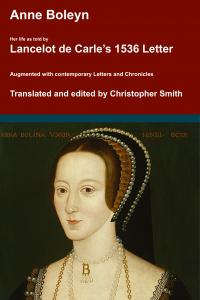
Anne Boleyn. Her Life as told by Lancelot de Carle's 1536 Letter.
In 1536, two weeks after the execution of Anne Boleyn, her brother George and four others, Lancelot du Carle, wrote an extraordinary letter that described Anne's life, and her trial and execution, to which he was a witness. This book presents a new translation of that letter, with additional material from other contemporary sources such as Letters, Hall's and Wriothesley's Chronicles, the pamphlets of Wynkyn the Worde, the Memorial of George Constantyne, the Portuguese Letter and the Baga de Secrets, all of which are provided in Appendices.
Available at Amazon in eBook and Paperback format.
On 26th January 1569 Mary Queen of Scots (age 26) was moved to the custody of George Talbot 6th Earl of Shrewsbury (age 41) and his wife Bess of Hardwick (age 42) at Tutbury Castle, Staffordshire [Map].


On 2nd February 1569 George Talbot 6th Earl of Shrewsbury (age 41) was Keeper of Mary Queen of Scots (age 26) at Tutbury Castle, Staffordshire [Map].
In September 1569 George Talbot 6th Earl of Shrewsbury (age 41) was Keeper of Mary Queen of Scots (age 26) at Tutbury Castle, Staffordshire [Map].
In January 1585 John St John 2nd Baron St John (age 50) made keeper of Mary Queen of Scots (age 42) at Tutbury Castle, Staffordshire [Map].
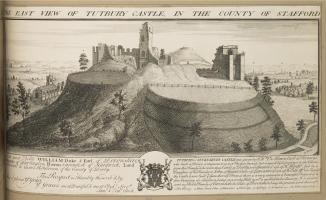
1731. Tutbury Castle, Staffordshire [Map] - East View by Nathaniel Buck.
Archaeologia Volume V32 1847 Section X. It was determined, therefore, to place the Queen under his care. The determination appears to have been taken as early as the month of October, for in the private correspondence of the family we find a report of a conversation with Queen Elizabeth in that month, in which she spoke in terms of high regard of the lady whom the earl had recently taken to wife, originally Elizabeth Hardwick, a daughter of the family of that name, to whom Hardwick [Map] belonged, and widow successively of Robert Barley, Sir William Cavendish, and Sir William Saint Loe, and expressed much solicitude to know when the earl might be expected at court; and again, a letter from the earl himself to his countess, written in November, wherein he informs her that he had been at court, and that the Queen had intimated to him that "ere it were long he should well perceive she did so trust him as she did few." He understood this to mean that he was to have the care of the Scottish Queen; and finally, in a third letter, which is dated on the 13th of December, he writes—"Now it is certain the Scots Queen comes to Tutbury [Map], to my chargea."
Note a. Hallamshire, fol. 1819, p. 64. These and other letters, the private and, as to some of them, the very confidential correspondence of Elizabeth Countess of Shrewsbury, passed, by some means and at some unknown time, out of the archives of the Cavendish family. They lay for half a century buried in a mase of antiquarian collections made by a Yorkshire antiquary of the last century, John Wilson, of Bromhead, where they were discovered by me in 1806. The whole collection was sold by auction a few years ago.
Chronicle of the Monastery of Melsa. On the same day, the said castle of Tutbury [Map] was surrendered to the king.
Eodem die redditum est regi dictum castrum de Tuttebery.
The River Dove rises on Axe Edge Moor, Derbyshire [Map] after which it travels broadly south past Longnor, Saffordshire [Map], Pilsbury [Map], Hartington, Derbyshire [Map], Milldale, Derbyshire [Map], Thorpe, Derbyshire [Map], just before whic it is joined by the River Manifold, Mapleton, Derbyshire [Map], Mayfield, Staffordshire [Map], Norbury, Derbyshire [Map], Rocester, Staffordshire [Map], Sudbury Hall, Derbyshire [Map] and Tutbury Castle, Staffordshire [Map] before joining the River Trent at Newton Solney, Derbyshire [Map].