

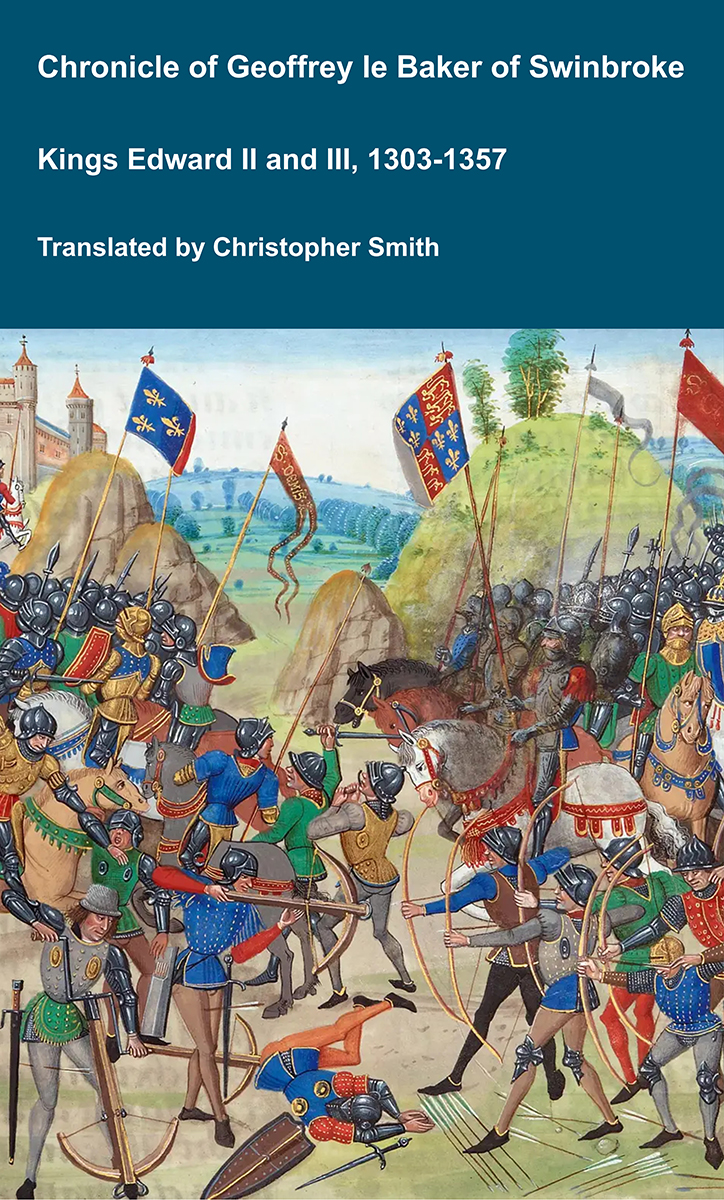
Chronicle of Geoffrey le Baker of Swinbroke
Baker was a secular clerk from Swinbroke, now Swinbrook, an Oxfordshire village two miles east of Burford. His Chronicle describes the events of the period 1303-1356: Gaveston, Bannockburn, Boroughbridge, the murder of King Edward II, the Scottish Wars, Sluys, Crécy, the Black Death, Winchelsea and Poitiers. To quote Herbert Bruce 'it possesses a vigorous and characteristic style, and its value for particular events between 1303 and 1356 has been recognised by its editor and by subsequent writers'. The book provides remarkable detail about the events it describes. Baker's text has been augmented with hundreds of notes, including extracts from other contemporary chronicles, such as the Annales Londonienses, Annales Paulini, Murimuth, Lanercost, Avesbury, Guisborough and Froissart to enrich the reader's understanding. The translation takes as its source the 'Chronicon Galfridi le Baker de Swynebroke' published in 1889, edited by Edward Maunde Thompson.
Available at Amazon in eBook and Paperback format.
 Bedlington, Northumberland
 Blaydon, Northumberland
 Blyth, Northumberland
 Capheaton, Northumberland
 Clara Vale, Northumberland
 Hartburn, Northumberland
 Harwood, Northumberland
 Monkwearmouth, Northumberland
 Newcastle upon Tyne, Northumberland
 North Shields, Northumberland
 Seaton Delavall, Northumberland
 Tynemouth, Northumberland
Tyne and Wear is in Northumberland.
The River Blyth rises near Kirkheaton, Northumberland [Map] from where it flows past Bradford [Map], Belsay, Northumberland [Map], Ogle, Northumberland [Map], Kirkley, Northumberland [Map], Horton Grange, Northumberland [Map], Stannington, Northumberland [Map], Bedlington, Northumberland [Map] to Blyth, Northumberland [Map] where it reaches the North Sea.
St Cuthbert's Church, Bedlington is also in Churches in Northumberland.

On 10th September 1904 James Arthur Joicey 2nd Baron Joicey [aged 24] and Georgiana Wharton Burdon Baroness Joicey [aged 24] were married at St Cuthbert's Church, Bedlington [Map].
The River Tyne is formed from the River North Tyne and River South Tyne which converge at Warden, Northumberland [Map]. From Warden, Northumberland [Map] it flows past Hexham, Northumberland [Map], Corbridge, Northumberland [Map], Riding Mill, Northumberland [Map], Bywell, Northumberland [Map], Ovingham, Northumberland [Map], Clara Vale, Northumberland [Map], Blaydon, Northumberland [Map], Newcastle upon Tyne, Northumberland [Map] and Wallsend [Map] and North Shields, Northumberland [Map] and South Shields, County Durham [Map] after which it joins the North Sea at Tynemouth, Northumberland [Map].
The River Blyth rises near Kirkheaton, Northumberland [Map] from where it flows past Bradford [Map], Belsay, Northumberland [Map], Ogle, Northumberland [Map], Kirkley, Northumberland [Map], Horton Grange, Northumberland [Map], Stannington, Northumberland [Map], Bedlington, Northumberland [Map] to Blyth, Northumberland [Map] where it reaches the North Sea.

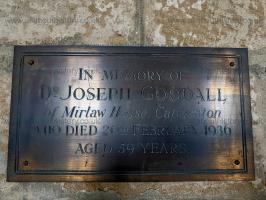
After 20th February 1936. St Wilfrid's Church, Kirkharle [Map]. Memorial to Dr Joseph Goodall of Mirlaw House, Capheaton [Map].
The River Tyne is formed from the River North Tyne and River South Tyne which converge at Warden, Northumberland [Map]. From Warden, Northumberland [Map] it flows past Hexham, Northumberland [Map], Corbridge, Northumberland [Map], Riding Mill, Northumberland [Map], Bywell, Northumberland [Map], Ovingham, Northumberland [Map], Clara Vale, Northumberland [Map], Blaydon, Northumberland [Map], Newcastle upon Tyne, Northumberland [Map] and Wallsend [Map] and North Shields, Northumberland [Map] and South Shields, County Durham [Map] after which it joins the North Sea at Tynemouth, Northumberland [Map].
The Devil's Causeway is a Roman Road from the Portgate, Northumberland [Map], where it crossed Dere Street, to Berwick-upon-Tweed, Northumberland [Map]. It passes through Great Whittingham, Northumberland [Map], Hartburn, Northumberland [Map], where it crosses the Hart Burn, Netherwitton, Northumberland [Map], Longhorsley, Northumberland [Map], Brinkburn Priory, Northumberland [Map], whereit crosses the River Coquet, north of North End [Map], Edlingham, Northumberland [Map] to Learchild Roman Fort [Map] where another road headed west to meet Dere Street at Bremenium [Map] aka High Rochester. The road then continues north passing Glanton, Northumberland [Map], Powburn, Northumberland [Map], where it crosses the River Till aka Breamish, the site of the Battle of Hedgeley Moor [Map], Newtown, Northumberland [Map], East Horton, Northumberland [Map], Lowick, Northumberland [Map], Berrington, Northumberland [Map] before reaching Berwick-upon-Tweed, Northumberland [Map].
The Hart Burn rises near Harwood, Northumberland [Map] from where it flows past Hetherton House, Northumberland [Map], Scots Gap, Northumberland [Map], Hartburn, Northumberland [Map] to Meldon Park, Northumberland [Map] where it joins the River Wansbeck.
The Hart Burn rises near Harwood, Northumberland [Map] from where it flows past Hetherton House, Northumberland [Map], Scots Gap, Northumberland [Map], Hartburn, Northumberland [Map] to Meldon Park, Northumberland [Map] where it joins the River Wansbeck.
Monkwearmouth Abbey is also in Abbeys in England.
The History of William Marshal was commissioned by his son shortly after William’s death in 1219 to celebrate the Marshal’s remarkable life; it is an authentic, contemporary voice. The manuscript was discovered in 1861 by French historian Paul Meyer. Meyer published the manuscript in its original Anglo-French in 1891 in two books. This book is a line by line translation of the first of Meyer’s books; lines 1-10152. Book 1 of the History begins in 1139 and ends in 1194. It describes the events of the Anarchy, the role of William’s father John, John’s marriages, William’s childhood, his role as a hostage at the siege of Newbury, his injury and imprisonment in Poitou where he met Eleanor of Aquitaine and his life as a knight errant. It continues with the accusation against him of an improper relationship with Margaret, wife of Henry the Young King, his exile, and return, the death of Henry the Young King, the rebellion of Richard, the future King Richard I, war with France, the death of King Henry II, and the capture of King Richard, and the rebellion of John, the future King John. It ends with the release of King Richard and the death of John Marshal.
Available at Amazon in eBook and Paperback format.
Around 675 Monkwearmouth Abbey [Map] was built at the request of Benedict Biscop [aged 47].
Bede. Among those who were present at this synod, was the venerable John, archchanter of the church of the holy Apostle Peter, and abbot of the monastery of St. Martin, who came lately from Rome, by order of Pope Agatho, together with the most reverend Abbot Biscop, surnamed Benedict, of whom mention has been made above, and this John, with the rest, signed the declaration of the Catholic faith. For the said Benedict, having built a monastery [Map] in Britain, in honour of the most blessed prince ot the apostles, at the mouth of the river Were went to Rome with Ceolfrid, his companion and fellow labourer in that work, who was after him abbot of the same monastery; he had been several times before at Rome, and was now honourably received by Pope Agatho of blessed memory; from whom he also obtained the confirmation of the immunities of this monastery, being a bull of privilege signed by apostolical authority, pursuant to what he knew to be the will and grant of King Egfrid, by whose consent and gift of land he had built that monastery.
The River Tyne is formed from the River North Tyne and River South Tyne which converge at Warden, Northumberland [Map]. From Warden, Northumberland [Map] it flows past Hexham, Northumberland [Map], Corbridge, Northumberland [Map], Riding Mill, Northumberland [Map], Bywell, Northumberland [Map], Ovingham, Northumberland [Map], Clara Vale, Northumberland [Map], Blaydon, Northumberland [Map], Newcastle upon Tyne, Northumberland [Map] and Wallsend [Map] and North Shields, Northumberland [Map] and South Shields, County Durham [Map] after which it joins the North Sea at Tynemouth, Northumberland [Map].
Chronicon ex Chronicis by Florence and John of Worcester. 20th September 1066. After these transactions, Harold Harfaager [aged 51], king of Norway, brother [Note. maternal half-brother] of St. Olave the king, suddenly arrived at the mouth of the river Tyne [Map], with a powerful fleet of more than five hundred great ships. Earl Tosti [aged 40] joined him with his fleet, as they had before agreed, and they made all sail into the Humber; and then ascending the river Tyne against the current, landed their troops at a place called Richale. As soon as king Harold [aged 44] received this news, he marched with all expedition towards Northumbria; but, before the king's arrival, the two brothers, earls Edwin and Morcar, at the head of a large army, fought a battle with the Norwegians on the northern bank of the river Ouse, near York, on the eve of the feast of St. Matthew the Apostle [20th September], being Wednesday; and their first onset was so furious that numbers of the enemy fell before it. But, after a long struggle, the English, unable to withstand the attack of the Norwegians, fled with great loss, and many more of them were drowned in the river than slain in the fight. The Norwegians remained in possession of the field of death; and, having taken one hundred and fifty hostages from York, and leaving there one hundred and fifty hostages of their own, returned to their ships.
Tudor Tracts Chapter 3. After long sojourning, my very good Lord! of the King's Majesty's army at Newcastle, for lack of commodious winds, which long hath been at North East and East North East, much to our grief; as your Lordship, I doubt not, knoweth: the same — as God would, who doth all things for the best — the first of May [1544], the 36th year of His Majesty's most prosperous reign, veered to the South and South South West so apt and propice [propitious] for our journey; being of every man so much desired, that there was no need to hasten them forwards. To be brief; such diligence was used that in two tides the whole fleet, being 200 sail at the least, was out of the haven of Tynemouth [Map] towards our enterprise.
The River Tyne is formed from the River North Tyne and River South Tyne which converge at Warden, Northumberland [Map]. From Warden, Northumberland [Map] it flows past Hexham, Northumberland [Map], Corbridge, Northumberland [Map], Riding Mill, Northumberland [Map], Bywell, Northumberland [Map], Ovingham, Northumberland [Map], Clara Vale, Northumberland [Map], Blaydon, Northumberland [Map], Newcastle upon Tyne, Northumberland [Map] and Wallsend [Map] and North Shields, Northumberland [Map] and South Shields, County Durham [Map] after which it joins the North Sea at Tynemouth, Northumberland [Map].
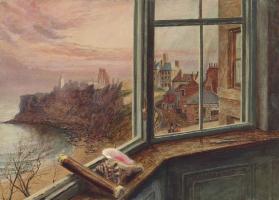
1864. Alice Boyd 14th of Penkill [aged 39]. View from the Window of Balcony House [Map], Tynemouth.
Tynemouth Castle, Northumberland is also in Castles in Northumberland.
On 27th April 1564 Henry "Wizard Earl" Percy 9th Earl of Northumberland was born to Henry Percy 8th Earl of Northumberland [aged 32] and Katherine Neville Countess Northumberland [aged 19] at Tynemouth Castle, Northumberland [Map]. He married 1594 his third cousin once removed Dorothy Devereux Countess Northumberland, daughter of Walter Devereux 1st Earl Essex and Lettice Knollys Countess Essex and Leicester, and had issue.


Tynemouth Priory is also in Priories in England.
Around 625 Tynemouth Priory [Map] was founded. It subsequently became a Benedictine house.
On 20th August 651 King Oswine of Deira was killed at Gilling East, North Yorkshire. He was buried at Tynemouth Priory [Map].
Chronicon ex Chronicis by Florence and John of Worcester. 1065. Æthelwin, the reverend bishop of Durham, raised the bones of St. Oswin, formerly king of Bernicia, from the tomb in which they had lain for four hundred and fifteen years, in the monastery [Map] which stands at the mouth of the river Tyne, and placed them in a shrine with great ceremony.