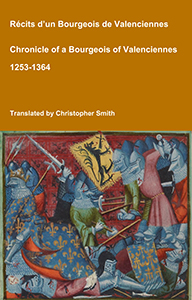
Chronicle of a Bourgeois of Valenciennes
Récits d’un bourgeois de Valenciennes aka The Chronicle of a Bourgeois of Valenciennes is a vivid 14th-century vernacular chronicle written by an anonymous urban chronicler from Valenciennes in the County of Hainaut. It survives in a manuscript that describes local and regional history from about 1253 to 1366, blending chronology, narrative episodes, and eyewitness-style accounts of political, military, and social events in medieval France, Flanders, and the Low Countries. The work begins with a chronological framework of events affecting Valenciennes and its region under rulers such as King Philip VI of France and the shifting allegiances of local nobility. It includes accounts of conflicts, sieges, diplomatic manoeuvres, and the impact of broader struggles like the Hundred Years’ War on urban life in Hainaut. Written from the perspective of a burgher (bourgeois) rather than a monastery or royal court, the chronicle offers a rare lay viewpoint on high politics and warfare, reflecting how merchants, townspeople, and civic institutions experienced the turbulence of the 13th and 14th centuries. Its narrative style combines straightforward reporting of events with moral and civic observations, making it a valuable source for readers interested in medieval urban society, regional politics, and the lived experience of war and governance in pre-modern Europe.
Available at Amazon in eBook and Paperback format.
University College, Oxford University is in Oxford University.
In 1440 John "Butcher of England" Tiptoft 1st Earl of Worcester (age 12) was educated at University College, Oxford University.
In 1578 William Glynne (age 12) educated at University College, Oxford University.
Around 1600 John Paulett 1st Baron Paulett (age 15) educated at University College, Oxford University.
In 1635 Philip Packer (age 16) matriculated University College, Oxford University.
On 29th April 1636 John Tufton 2nd Baronet (age 13) was educated at University College, Oxford University.
On 19th December 1668 Christopher Wray 2nd and 6th Baronet (age 16) was educated at University College, Oxford University.
Around 1696 Jocelyn Sidney 7th Earl of Leicester (age 14) educated at University College, Oxford University.
On 1st December 1710 Fulke Greville 6th Baron Brooke (age 17) commened his education at University College, Oxford University.
On 24th February 1711 Fulke Greville 6th Baron Brooke (age 18) died at University College, Oxford University. His brother William (age 16) succeeded 7th Baron Brooke of Beauchamps Court in Warwickshire.
Jean de Waurin's Chronicle of England Volume 6 Books 3-6: The Wars of the Roses
Jean de Waurin was a French Chronicler, from the Artois region, who was born around 1400, and died around 1474. Waurin’s Chronicle of England, Volume 6, covering the period 1450 to 1471, from which we have selected and translated Chapters relating to the Wars of the Roses, provides a vivid, original, contemporary description of key events some of which he witnessed first-hand, some of which he was told by the key people involved with whom Waurin had a personal relationship.
Available at Amazon in eBook and Paperback format.
On 19th June 1725 Charles Noel Somerset 4th Duke Beaufort (age 15) matriculated University College, Oxford University. He was awarded MA on 16th October 1727.
On 16th November 1726 Miles Stapylton 4th Baronet (age 18) matriculated University College, Oxford University.
On 10th October 1732 Charles Lyttelton (age 18) matriculated University College, Oxford University. He graduated BCL in March 1745.
In March 1771 Herbert Croft 5th Baronet (age 20) matriculated University College, Oxford University.
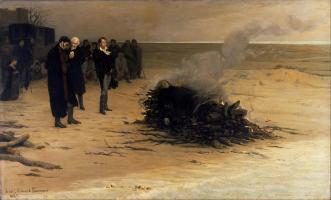
1911 Encyclopædia Britannica. Shelley (age 17) entered University College, Oxford, in April 1810, returned thence to Eton, and finally quitted the school at midsummer, and commenced residence in Oxford in October. Here he met a young Durham man, Thomas Jefferson Hogg, who had preceded him in the university by a couple of months; the two youths at once struck up a warm and intimate friendship. Shelley had at this time a love for chemical experiment, as well as for poetry, philosophy, and classical study, and was in all his tastes and bearing an enthusiast. Hogg was not in the least an enthusiast, rather a cynic, but he also was a steady and well-read classical student. In religious matters both were sceptics, or indeed decided anti-Christians; whether Hogg, as the senior and more informed disputant, pioneered Shelley into strict atheism, or whether Shelley, as the more impassioned and unflinching speculator, outran the easy-going jeering Hogg, is a moot point; we incline to the latter opinion. Certain it is that each egged on the other by perpetual disquisition on abstruse subjects, conducted partly for the sake of truth and partly for that of mental exercitation, without on either side any disposition to bow to authority or stop short of extreme conclusions. The upshot of this habit was that Shelley and Hogg, at the close of some five months of happy and uneventful academic life, got expelled from the university.