

Annals of the six Kings of England by Nicholas Trivet
Translation of the Annals of the Six Kings of England by that traces the rise and rule of the Angevin aka Plantagenet dynasty from the mid-12th to early 14th century. Written by the Dominican scholar Nicholas Trivet, the work offers a vivid account of English history from the reign of King Stephen through to the death of King Edward I, blending political narrative with moral reflection. Covering the reigns of six monarchs—from Stephen to Edward I—the chronicle explores royal authority, rebellion, war, and the shifting balance between crown, church, and nobility. Trivet provides detailed insight into defining moments such as baronial conflicts, Anglo-French rivalry, and the consolidation of royal power under Edward I, whose reign he describes with particular immediacy. The Annals combines careful year-by-year reporting with thoughtful interpretation, presenting history not merely as a sequence of events but as a moral and political lesson. Ideal for readers interested in medieval history, kingship, and the origins of the English state, this chronicle remains a valuable and accessible window into the turbulent world of the Plantagenet kings.
Available at Amazon in eBook and Paperback format.
Wells, Somerset is in Somerset.
On 14th January 1465 Bishop Thomas Beckington [aged 75] died at Wells, Somerset [Map].
The Manuscripts of His Grace the Duke of Rutland Volume 1. 16th March 1471. The Duke of Clarence [aged 21] to Henry Vernon [aged 26].
[1471,] March 16. Wells [Map]. — Henry Vernon. We pray you to finde the meanes as secretly as ye can to have sure and trusti men in the North, or whersoevere therl of Northumberland bee, to espie of the guyding there, and as the cas shall requir and it shalbee expedient to certifie us, and alway whan oon is goon that another bee abiding, and in lyke wyse that ye have about therl of Shrovesbury and the Lord Stanley oon commyng to us and an other alway abiding there. We bee adcerteigned that it is said about London that K[ing] E[dward] is saylled by the coste of Northfolk toward Humbre. Wherfor we pray you to sende thidder to enquire and understande of the trouth, and to certifie us therof, and if he bee in thoos costes that alway ye have spies there to certifie us from tyme to tyme of the tidinges and the guyding, oon commyng to. us and an other alway abiding as in the other places, dooing your effectuell devoir herein as our veray truste is in you, nat sparing for any coste, for we woll allowe yon at your accomptes the uttermast of thexpenses that ye shall make in that behalve. Wylling and desiring you that bicause of thees tidinges ye doo the gretter devoir to arredie you with as many as ye can make in defensible array as well of our tenauntes as of yours to bee redy to comme to us within an houres warnying, lyke as we wrote to you but late by your servaunt. Writen at Welles the xvj day of March. (Signed : — ) Gr. Clarence. Signet.
Around April 1497 Cornish rose in rebellion against taxes being raised by King Henry VII of England and Ireland [aged 40] to support his wars against Scotland and against changes to the operation and privileges of the Cornish tin mining industry. The rebel army of 15,000 sought to replace Henry's ministers who they saw as responsible for the taxation: Cardinal John Morton [aged 77] and Reginald Bray [aged 57], the Chancellor of the Duchy of Lancaster. The army travelled from Cornwall through Devon and Somerset attempting, unsuccessfully, to recruit more men. At Wells, Somerset [Map] they were joined by James Tuchet 7th Baron Audley, 4th Baron Tuchet [aged 34] who took on command. The rebel army then travelled through Salisbury and Winchester, Hampshire [Map].
When Henry became aware of the rebel army he diverted his main army led by Giles Daubeney 1st Baron Daubeney [aged 46] to meet the rebels. Daubeny's army camped at Hounslow Heath [Map] on 13th June 1497.


Around 1590 John Hoskins was born in Wells, Somerset [Map].
On 17th February 1734 Robert Crichton [aged 95] died at Wells, Somerset [Map].
On 15th January 1744 Admiral John Holloway was born at Wells, Somerset [Map].
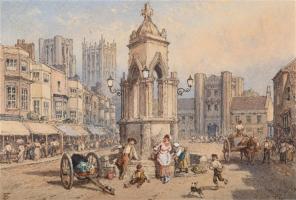
Before 1825. Myles Birket Foster. "Markey Day, Wells, Somerset [Map]".
In 1703 Bishop Richard Kidder [aged 70] was killed accidentally when a chimney from the Bishop's Palace, Wells fell on him and his wife whilst they were in bed during the 1703 Great Storm.

On 25th April 1870 Bishop Robert Eden 3rd Baron Auckland [aged 70] died at the Bishop's Palace, Wells. His son William [aged 41] succeeded 4th Baron Auckland of West Auckland. Lucy Walbanke-Childers Baroness Auckland [aged 34] by marriage Baroness Auckland of West Auckland albeit for seventeen days only since she died on 12 May 1870.