

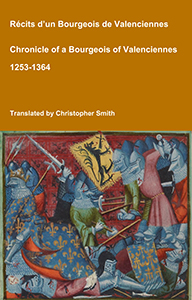
Chronicle of a Bourgeois of Valenciennes
Récits d’un bourgeois de Valenciennes aka The Chronicle of a Bourgeois of Valenciennes is a vivid 14th-century vernacular chronicle written by an anonymous urban chronicler from Valenciennes in the County of Hainaut. It survives in a manuscript that describes local and regional history from about 1253 to 1366, blending chronology, narrative episodes, and eyewitness-style accounts of political, military, and social events in medieval France, Flanders, and the Low Countries. The work begins with a chronological framework of events affecting Valenciennes and its region under rulers such as King Philip VI of France and the shifting allegiances of local nobility. It includes accounts of conflicts, sieges, diplomatic manoeuvres, and the impact of broader struggles like the Hundred Years’ War on urban life in Hainaut. Written from the perspective of a burgher (bourgeois) rather than a monastery or royal court, the chronicle offers a rare lay viewpoint on high politics and warfare, reflecting how merchants, townspeople, and civic institutions experienced the turbulence of the 13th and 14th centuries. Its narrative style combines straightforward reporting of events with moral and civic observations, making it a valuable source for readers interested in medieval urban society, regional politics, and the lived experience of war and governance in pre-modern Europe.
Available at Amazon in eBook and Paperback format.
Westbury Hundred, Wiltshire is in Wiltshire.

Anglo-Saxon Chronicle. 15th April 1053. In this year was the king [aged 50] at Winchester, Hampshire [Map], at Easter; and Earl Godwin [aged 52] with him, and Earl Harold [aged 31] his son, and Tosty [aged 27]. On the day after Easter sat he with the king at table; when he suddenly sunk beneath against the foot-rail, deprived of speech and of all his strength. He was brought into the king's chamber; and they supposed that it would pass over: but it was not so. He continued thus speechless and helpless till the Thursday; when he resigned his life, on the seventeenth before the calends of May; and he was buried at Winchester in the old minster. Earl Harold, his son, took to the earldom that his father had before, and to all that his father possessed; whilst Earl Elgar took to the earldom that Harold had before. The Welshmen this year slew a great many of the warders of the English people at Westbury, Wiltshire [Map]. This year there was no archbishop in this land: but Bishop Stigand held the see of Canterbury at Christ church, and Kinsey that of York. Leofwine and Wulfwy went over sea, and had themselves consecrated bishops there. Wulfwy took to the bishopric which Ulf had whilst he was living and in exile.
The River Biss rises near Upton Scudamore, Wiltshire [Map] as the Biss Brook after which it flows past Westbury, Wiltshire [Map] to Yarnbrook, Wiltshire [Map] where it becomes the River Biss. Thereafter it continues north through Trowbridge, Wiltshire [Map] after which it joins the Gloucestershire River Avon.
Around 1452 Robert Willoughby 1st Baron Willoughby 9th Baron Latimer was born to John Willoughby 8th Baron Latimer of Corby [aged 31] and Anne Cheney [aged 23] at Broke Westbury, Wiltshire. He married 1472 Blanche Champernowne and had issue.
In 1491 Edward Willoughby was born to Robert Willoughby 2nd Baron Willoughby 10th Baron Latimer [aged 19] and Elizabeth Beauchamp Baroness Willoughby of Broke [aged 23] at Broke Westbury, Wiltshire. He married before 1512 his second cousin Margaret Neville, daughter of Richard Neville 2nd Baron Latimer of Snape and Anne Stafford Baroness Latimer, and had issue.