

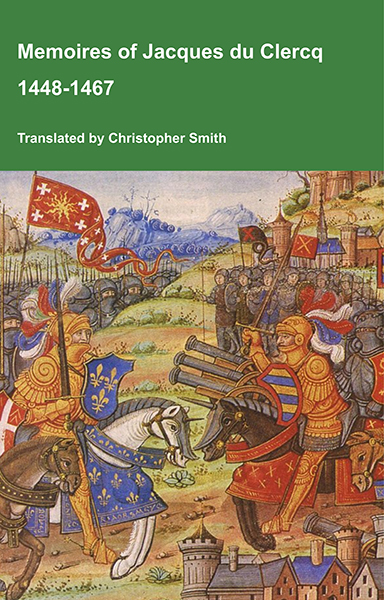
This is a translation of the 'Memoires of Jacques du Clercq', published in 1823 in two volumes, edited by Frederic, Baron de Reissenberg. In his introduction Reissenberg writes: 'Jacques du Clercq tells us that he was born in 1424, and that he was a licentiate in law and a counsellor to Philip the Good, Duke of Burgundy, in the castellany of Douai, Lille, and Orchies. It appears that he established his residence at Arras. In 1446, he married the daughter of Baldwin de la Lacherie, a gentleman who lived in Lille. We read in the fifth book of his Memoirs that his father, also named Jacques du Clercq, had married a lady of the Le Camelin family, from Compiègne. His ancestors, always attached to the counts of Flanders, had constantly served them, whether in their councils or in their armies.' The Memoires cover a period of nineteen years beginning in in 1448, ending in in 1467. It appears that the author had intended to extend the Memoirs beyond that date; no doubt illness or death prevented him from carrying out this plan. As Reissenberg writes the 'merit of this work lies in the simplicity of its narrative, in its tone of good faith, and in a certain air of frankness which naturally wins the reader’s confidence.' Du Clercq ranges from events of national and international importance, including events of the Wars of the Roses in England, to simple, everyday local events such as marriages, robberies, murders, trials and deaths, including that of his own father in Book 5; one of his last entries.
Available at Amazon in eBook and Paperback format.
Whitby Abbey is in Whitby, Abbeys in England.
On 12th October 633 King Penda's alliance of Gwynedd and Mercia defeated the Northumbrians at the Battle of Hatfield Chase.
Eadfrith Deira was captured.
King Edwin of Northumbria (age 47) was killed. He was buried at Whitby Abbey [Map] - see Bede. His first cousin Osric succeeded King Deira. His nephew Eanfrith (age 43) succeeded King Bernicia.
Edwin's son Osfrith Deira was killed.
Bede. [15th November 655]. Then King Oswy (age 43), according to the vow he had made to the Lord, returned thanks to God for the victory granted him, and gave his daughter Elfled (age 1)438, who was scarce a year old, to be consecrated to Him in perpetual virginity; bestowing also twelve small estates of land, wherein the practice of earthly warfare should cease, and place and means should be afforded to devout and zealous monks to wage spiritual warfare, and pray for the eternal peace of his nation. Of these estates six were in the province of the Deiri, and the other six in that of the Bernicians. Each of the estates contained ten families, that is, a hundred and twenty in all. The aforesaid daughter of King Oswy, who was to be dedicated to God, entered the monastery called Heruteu [Map]439, or, "The Island of the Hart," at that time ruled by the Abbess Hilda (age 41)440, who, two years after, having acquired an estate of ten families, at the place called Streanaeshalch [Map]441, built a monastery there, in which the aforesaid king's daughter was first trained in the monastic life and afterwards became abbess; till, at the age of fifty-nine, the blessed virgin departed to be united to her Heavenly Bridegroom. In this monastery, she and her father, Oswy, her mother (age 29), Eanfled, her mother's father, Edwin442, and many other noble persons, are buried in the church of the holy Apostle Peter. King Oswy concluded this war in the district of Loidis, in the thirteenth year of his reign, on the 15th of November443, to the great benefit of both nations; for he delivered his own people from the hostile depredations of the pagans, and, having made an end of their heathen chief, converted the Mercians and the adjacent provinces to the grace of the Christian faith.
Note 438. She is mentioned as joint-abbess with her mother, Eanfled, of the monastery of Whitby (IV, 26). Eddius calls her "sapientissima virgo," "semper totius provinciae consolatrix optimaque consiliatrix." Her influence helped to restore Wilfrid to the bishopric. She was the friend of St. Cuthbert, who is said to have wrought a miraculous cure on her behalf. It was to her that he prophesied the death of her brother Egfrid (IV, 26, p. 285, note).
Note 439. Hartlepool [Map] in the county of Durham (cf. IV, 23).
Note 440. For the main facts of her life, v. IV, 23. She was Abbess of Whitby at the time of the Synod (c. 25).
Note 441. Whitby [Map]. It was a mixed monastery (cf. IV, 23).
Note 442. The ancient life of Gregory the Great, by a monk of Whitby, tells how Edwin's body was translated thither from the place where he fell. For the fate of his head, cf. II, 20.
Note 443. In 655: cf. V, 24 (death of Penda).
In 670 Eanflæd Queen Consort Bernicia (age 43) retired to the Whitby Abbey [Map].
On 15th February 670 King Oswiu of Northumbria (age 58) died. He was buried at Whitby Abbey [Map] - see Bede. In 670 His son Ecgfrith (age 25) succeeded King Northumbria. Æthelthryth Wuffingas Queen Consort Deira and Northumbria (age 34) by marriage Queen Consort Northumbria.
Bede. 680. In the year of the incarnation of our ot the Abbess Lord 680, the most religious serant of Christ, Hilda (age 66), abbess of the monastery that is called Streaneshalch [Map], as above-mentioned, after having performed many heavenly works on earth, passed from thence to receive the rewards of the heavenly life, on the 17th of November, at the age of sixty-six years; the first thirty-three of which she spent living most nobly in the secular habit; and more nobly dedicated the remaining half to our Lord in a monastic life. For she was nobly born, being the daughter of Hereric, nephew to King Edwin, with which king she also embraced the faith and mysteries of Christ, at the preaching of Paulinus, the first bishop of the Northumbrians, of blessed memory, and preserved the same undefiled till she attained to the sight of him in heaven.
Bede. 680. When she had for some years governed this monastery, wholly intent upon establishing a regular life, it happened that she also undertook either to build or to arrange a monastery in the place called Streaneshalch [Map], which work she industriously performed; for she put this monastery under the same regular discipline as she had done the former; and taught there the strict observance of justice, piety, chastity, and other virtues, and particularly of peace and charity; so that, after the example of the primitive church, no person was there rich, and none poor, all being in common to all, and none having any property. Her prudence was so great, that not only indifferent persons, but even kings and princes, as occasion offered, asked and received her advice; she obhged those who were under her direction to attend so much to reading of the Holy Scriptures, and to exercise themselves so much in works of justice, that many might be there found fit for ecclesiastical duties, and to serve at the altar.
Around 680 Eanflæd Queen Consort Bernicia (age 53) was appointed Abbot of Whitby.
In After 680 Ætfflæd of Whitby (age 26) was appointed joint Abbot of Whitby.
After 685 Eanflæd Queen Consort Bernicia (deceased) died. She was buried at Whitby Abbey [Map] - see Bede.
In 714 Ætfflæd of Whitby (age 60) died. She wass buried at Whitby Abbey [Map].
Before 1096 William "aux Gernons aka with Whiskers" Percy 1st Baron Percy Topcliffe refounded at Whitby Abbey [Map].
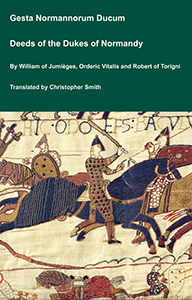
The Deeds of the Dukes of Normandy
The Gesta Normannorum Ducum [The Deeds of the Dukes of Normandy] is a landmark medieval chronicle tracing the rise and fall of the Norman dynasty from its early roots through the pivotal events surrounding the Norman Conquest of England. Originally penned in Latin by the monk William of Jumièges shortly before 1060 and later expanded at the behest of William the Conqueror, the work chronicles the deeds, politics, battles, and leadership of the Norman dukes, especially William’s own claim to the English throne. The narrative combines earlier historical sources with firsthand information and oral testimony to present an authoritative account of Normandy’s transformation from a Viking settlement into one of medieval Europe’s most powerful realms. William’s history emphasizes the legitimacy, military prowess, and governance of the Norman line, framing their expansion, including the conquest of England, as both divinely sanctioned and noble in purpose. Later chroniclers such as Orderic Vitalis and Robert of Torigni continued the history, extending the coverage into the 12th century, providing broader context on ducal rule and its impact. Today this classic work remains a foundational source for understanding Norman identity, medieval statesmanship, and the historical forces that reshaped England and Western Europe between 800AD and 1100AD.
Available at Amazon in eBook and Paperback format.
Around 1230 Isabel Bruce (age 69) died at Whitby Abbey [Map].
In 1244 Richard Percy 5th Baron Percy Topcliffe (age 74) died. He was buried at Whitby Abbey [Map]. His nephew William (age 47) succeeded 6th Baron Percy of Topcliffe.
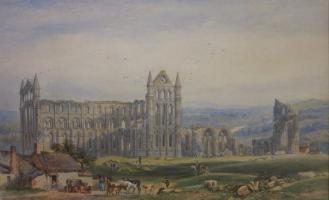
1878. William Richardson (age 63). "Whitby Abbey [Map]".
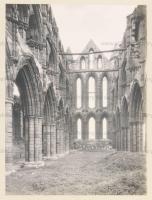
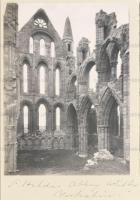
27th April 1896. Godfrey Bingley (age 53). Whitby Abbey [Map]. Photograph of the view from the Choir of St. Hilda's Abbey, Whitby, North Yorkshire.
William Percy was appointed Prior Whitby Abbey.
Serlo Percy was appointed Prior Whitby Abbey.
Reinfrid Taillebois was appointed Prior Whitby Abbey.