

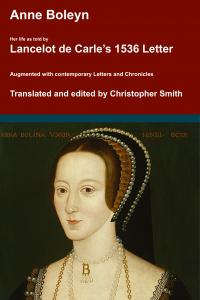
Anne Boleyn. Her Life as told by Lancelot de Carle's 1536 Letter.
In 1536, two weeks after the execution of Anne Boleyn, her brother George and four others, Lancelot du Carle, wrote an extraordinary letter that described Anne's life, and her trial and execution, to which he was a witness. This book presents a new translation of that letter, with additional material from other contemporary sources such as Letters, Hall's and Wriothesley's Chronicles, the pamphlets of Wynkyn the Worde, the Memorial of George Constantyne, the Portuguese Letter and the Baga de Secrets, all of which are provided in Appendices.
Available at Amazon in eBook and Paperback format.
Whitby is in East Yorkshire.
Around 1156 Henry Percy was born to Jocelin Percy [aged 35] and Agnes Percy 4th Baroness Percy Topcliffe [aged 21] at Whitby. He married before 29th September 1198 Isabel Bruce.
In 1556 Henry Cholmley was born to Richard "The Great Black Knight of the North" Cholmeley [aged 41] and Catherine Clifford Baroness Scrope Bolton [aged 43] at Whitby. He married 1575 his third cousin Margaret Babthorpe and had issue.
Henry Machyn's Diary. 5th July 1557. At Whyttby, Thomas Warden and John Deyctam, skott.
In October 1580 Richard Cholmley was born to Henry Cholmley [aged 24] and Margaret Babthorpe [aged 22] at Whitby.
In 1598 Catherine Clifford Baroness Scrope Bolton [aged 85] died at Whitby.
On 23rd September 1631 Richard Cholmley [aged 50] died at Whitby.
Calendar of State Papers Charles II 14 Sep 1666. 14th September 1666. 111. Whitby. Thomas Waade to Williamson. The destruction of London by fire is reported to be a hellish contrivance of the French, Hollanders, and fanatic party. At the first notice of it there, the trained bands were in arms, those for the North Rriding endezvousing at Malton, Sir Jordan Crosland's regiment at Easingwold, and Sir Thomas Strickland's foot company was sent to guard Whitby. The country being alarmed with the men-of-war, Alderman Shipton of Lythe raised 200 men ina moment, with such arms as they could get who were very willing to engage the enemy if they durst land, but seeing such a flocking of people, they weighed anchor, and are cruising off, expecting laden colliers from Newcastle or Sunderland.
In August 1684 Hugh Cholmley was born to Nathaniel Cholmley at Whitby. He married before 15th November 1721 Katherine Wentworth, daughter of Henry Wentworth and Mary Lowther Lady Wentworth, and had issue.
Around 1st September 1881 Alfred Jerome Vassalli was born to John Vassalli of Scarborough at Whitby. He married 3rd September 1902 Annie Pembroke Reynolds and had issue.
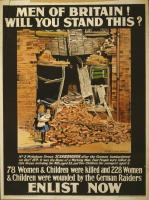
On 16th December 1914 the German Navy bombarded Scarborough, North Yorkshire [Map], Hartlepool and Whitby.
Two shore guns fired at the leading ship, while the third fired at the last, smaller, vessel. The gunners were hampered by a rising cloud of smoke and dust around them, affecting visibility. They found their shells had no effect on the armoured sides of the ships, so instead aimed at masts and rigging. The accuracy of the third gun was sufficient to oblige Blücher to move behind the lighthouse to prevent further hits.
The German ships fired 1,150 shells into Hartlepool, striking targets including the steelworks, gasworks, railways, seven churches and 300 houses. People fled the town by road and attempted to do so by train; 86 civilians were killed and 424 injured. The death of Private Theophilus Jones of the Durham Light Infantry, age 29, was the first death of a British soldier from enemy action on British soil for 200 years.
The raid caused a great scandal in Britain, became a rallying cry against Germany for its attack upon civilians. The attack became part of a British propaganda campaign; 'Remember Scarborough' was used on army recruitment posters
On 21st July 1632 Hugh Cholmley 4th Baronet was born to Hugh Cholmley 1st Baronet [aged 31] and Elizabeth Twysden Lady Cholmley at Fyling Hall. He married 19th February 1666 Anne Compton Lady Rushout, daughter of Spencer Compton 2nd Earl of Northampton and Mary Beaumont Countess of Northampton, and had issue.
Chronicle of Walter of Guisborough
A canon regular of the Augustinian Guisborough Priory, Yorkshire, formerly known as The Chronicle of Walter of Hemingburgh, describes the period from 1066 to 1346. Before 1274 the Chronicle is based on other works. Thereafter, the Chronicle is original, and a remarkable source for the events of the time. This book provides a translation of the Chronicle from that date. The Latin source for our translation is the 1849 work edited by Hans Claude Hamilton. Hamilton, in his preface, says: 'In the present work we behold perhaps one of the finest samples of our early chronicles, both as regards the value of the events recorded, and the correctness with which they are detailed; Nor will the pleasing style of composition be lightly passed over by those capable of seeing reflected from it the tokens of a vigorous and cultivated mind, and a favourable specimen of the learning and taste of the age in which it was framed.'
Available at Amazon in eBook and Paperback format.
On 11th March 1791 Nathaniel Cholmley [aged 69] died. Catherine Cholmley [aged 39] inherited Whitby Manor.
On 3rd February 1818 Catherine Cholmley [aged 66] died. Robert Grimes inherited Whitby Manor.
In or before 1865 Robert Grimes died. George Strickland 7th Baronet [aged 82], son of Henrietta Cholmley Lady Strickland, inherited Whitby Manor. He changed his name with royal licence to Cholmley

On 23rd January 1874 George Strickland 7th Baronet [aged 91] died. His son Charles [aged 54] succeeded 8th Baronet Strickland of Boynton in Yorkshire. Esther Ann Strickland inherited Whitby Manor