

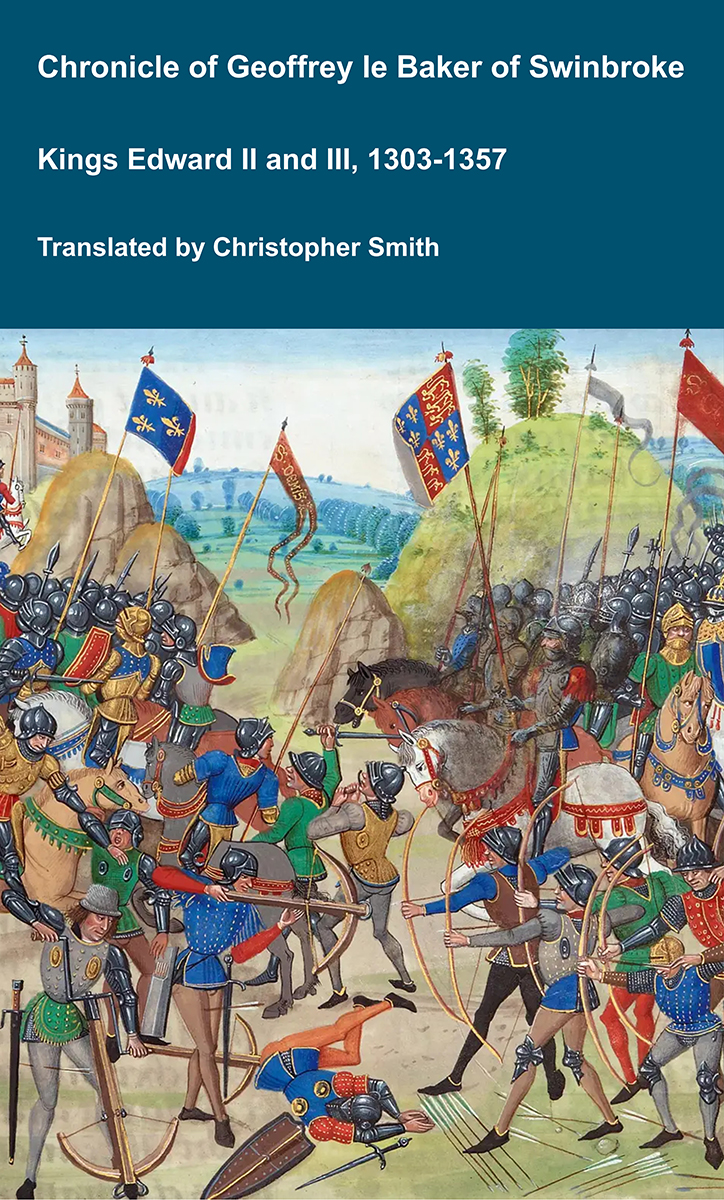
Chronicle of Geoffrey le Baker of Swinbroke
Baker was a secular clerk from Swinbroke, now Swinbrook, an Oxfordshire village two miles east of Burford. His Chronicle describes the events of the period 1303-1356: Gaveston, Bannockburn, Boroughbridge, the murder of King Edward II, the Scottish Wars, Sluys, Crécy, the Black Death, Winchelsea and Poitiers. To quote Herbert Bruce 'it possesses a vigorous and characteristic style, and its value for particular events between 1303 and 1356 has been recognised by its editor and by subsequent writers'. The book provides remarkable detail about the events it describes. Baker's text has been augmented with hundreds of notes, including extracts from other contemporary chronicles, such as the Annales Londonienses, Annales Paulini, Murimuth, Lanercost, Avesbury, Guisborough and Froissart to enrich the reader's understanding. The translation takes as its source the 'Chronicon Galfridi le Baker de Swynebroke' published in 1889, edited by Edward Maunde Thompson.
Available at Amazon in eBook and Paperback format.
Wilsford Barrows is in Stonehenge Barrows, Stonehenge Bronze Age Barrows.

Colt Hoare 1812. No. 1 [Wilsford Barrow 1 G73a [Map]] is small circular barrow, which had been explored.
Colt Hoare 1812. No. 2 [Wilsford Barrow 2 G71 [Map]] is a remarkably fine Druid barrow, which also had been opened, but not examined minutely, for on one side of the cist we found a neat lance-head of brass, and a pin of the same metal, intermixed with a part of the interment of burned bones.
Colt Hoare 1812. No. 3 [Wilsford Barrow 3 G72 [Map]] is another barrow of the same species, which produced a similar interment by cremation, and a considerable quantity of glass, jet, and amber beads, together with a fine brass pin.
Colt Hoare 1812. No. 4 [In Wilsford Barrow 4 G73 [Map]] we found only the cinerarium, containing the ashes, but missed the interment.


Colt Hoare 1812. No. 5 [Wilsford Barrow 5 G65 [Map]], a flat bowl-shaped barrow, produced on the floor a simple interment of burned bones, placed by the side of a circular cist, which contained another deposit of burned bones within beautiful sepulchral urn, Tumuli Plate XXVIII. No. 1. Close to this urn was another oval cist, containing a similar deposit, together with a spear-head of brass, which appeared to have been almost melted into a rude lump by the heat of the funeral pile. The discovery of three interments within so short a space, and so connected with each other, leads us to conjecture that this might have been a family sepulchre, and probably other interments may still remain undiscovered.
Colt Hoare 1812. No. 6 [Wilsford Barrow 6 G64a [Map]], a Druid barrow, had been opened before.
Colt Hoare 1812. No. 7 [Wilsford Barrow 7 G70 [Map]] is another of the same species. but has three sepulchral mounds within its area; in one of which we found the relicks of the skeleton of a youth, and fragments of a drinking in the centre tump was a simple interment of burned bones, with a small brass pin; and the third seemed to have been opened before.
Colt Hoare 1812. No. 8 [Wilsford Barrow 8 G69 [Map]] is a Druid barrow of the second class, which had also been examined.
Colt Hoare 1812. No. 9 [Wilsford Barrow 9 G64 [Map]] is a large and almost bowl-shaped barrow, eight feet in elevation. Within a cist two feet deep, we discovered a little pile of burned bones, and with them an ivory pin, a rude ring of bone, and the small brass celt, engraved in Tumuli Plate XXVIII. No. 2. The cist was protected by a thick covering of flints, and immediately over it was the skeleton of a dog.
Colt Hoare 1812. No. 10 [Wilsford Barrow 10 G63 [Map]] is a pond barrow.
Henrici Quinti, Angliæ Regis, Gesta, is a first-hand account of the Agincourt Campaign, and subsequent events to his death in 1422. The author of the first part was a Chaplain in King Henry's retinue who was present from King Henry's departure at Southampton in 1415, at the siege of Harfleur, the battle of Agincourt, and the celebrations on King Henry's return to London. The second part, by another writer, relates the events that took place including the negotiations at Troye, Henry's marriage and his death in 1422.
Available at Amazon in eBook and Paperback format.
Colt Hoare 1812. No. 11 [Wilsford Barrow 11 G68 [Map]] and No. 12 [Map] adjoin each other, and are wide and low barrows. The former had been opened, and its scattered relicks seemed to indicate two interments having taken place within it, cremation, and the skeleton. The latter proved a singular, though not a productive barrow, and required a good deal of skill and perseverance in opening. From the small elevation of the mound above the natural soil we expected to meet with the interment in a few minutes; but we were obliged to dig ten feet below the level, when we discovered a skeleton, with its head laid towards the east. After digging to the depth of six feet, our labourers began to doubt if the chalk had ever been moved; but a stag's horn, and some charred wood, soon convinced them to the contrary, and encouraged them to proceed, until they finally discovered the object of their research. From the very extraordinary depth at which this body was deposited, we naturally expected to have found some of the rudest weapons of ancient times, but arms, trinkets, or pottery accompanied this very original British interment.
Colt Hoare 1812. No. 11 [Wilsford Barrow 11 G68 [Map]] and No. 12 [Map] adjoin each other, and are wide and low barrows. The former had been opened, and its scattered relicks seemed to indicate two interments having taken place within it, cremation, and the skeleton. The latter proved a singular, though not a productive barrow, and required a good deal of skill and perseverance in opening. From the small elevation of the mound above the natural soil we expected to meet with the interment in a few minutes; but we were obliged to dig ten feet below the level, when we discovered a skeleton, with its head laid towards the east. After digging to the depth of six feet, our labourers began to doubt if the chalk had ever been moved; but a stag's horn, and some charred wood, soon convinced them to the contrary, and encouraged them to proceed, until they finally discovered the object of their research. From the very extraordinary depth at which this body was deposited, we naturally expected to have found some of the rudest weapons of ancient times, but arms, trinkets, or pottery accompanied this very original British interment.
Colt Hoare 1812. No. 13 [Wilsford Barrow 13 G62 [Map]], a large bowl-shaped barrow, we found the skeleton of a young and stout man deposited in a shallow cist, with the head towards the south-east, and near it a large and rude drinking cup, engraved in Plate XXVIII. No. 3.
Colt Hoare 1812. No. 14 [Wilsford Barrow 14 G66 [Map]], a Druid barrow, had experienced a prior investigation;
Colt Hoare 1812. No. 15 and in [Wilsford Barrow 15 G61 [Map]] we could find no interment.
Colt Hoare 1812. No. 16 [Wilsford Barrow 16 G60 [Map]], a bowl-shaped barrow, produced, at a foot beneath the surface, an interment of burned bones, and some instruments made of stags horns, some whetstones, an arrow-head of flint, another in an unfinished state, and a small spear-head. Tumuli Plate XXVIII. No. 4, 5, 6. At a greater depth was the primary interment of a skeleton, with its head laid towards the north-west.
Colt Hoare 1812. No. 17 [Wilsford Barrow 17 G59 [Map]] had been opened before.

Colt Hoare 1812. No. 18 [Wilsford Barrow 18 G58 [Map]]. This large bell-shaped barrow, 121 feet in diameter, and 11 in elevation, may be considered as the monarch of this group, both as to its size, as well as contents. On the floor of the barrow we found the skeleton of a very tall and stout man, lying on his right side, with his head towards the south-east. At his feet were laid a massive hammer of a dark coloured stone. A brass celt, a tube of bone, a handle to some instrument of the same, a whetstone with a groove in the centre, and several other articles of bone, amongst which is the enormous tusk of a wild boar; but amongst these numerous relicks, the most curious article is one of twisted brass, whose ancient use, I leave to my learned brother antiquaries to ascertain. It is unlike any thing we have ever yet discovered, and was evidently fixed into a handle as may be seen by the three holes, and one of the pins still remaining: the rings seem to have been annexed to it for the purpose of suspension. This article, together with the celt and boar's tusk form a very interesting engraving, and are all drawn of the same size as the originals in Tumuli Plate XXIX.