

William of Worcester's Chronicle of England
William of Worcester, born around 1415, and died around 1482 was secretary to John Fastolf, the renowned soldier of the Hundred Years War, during which time he collected documents, letters, and wrote a record of events. Following their return to England in 1440 William was witness to major events. Twice in his chronicle he uses the first person: 1. when writing about the murder of Thomas, 7th Baron Scales, in 1460, he writes '… and I saw him lying naked in the cemetery near the porch of the church of St. Mary Overie in Southwark …' and 2. describing King Edward IV's entry into London in 1461 he writes '… proclaimed that all the people themselves were to recognize and acknowledge Edward as king. I was present and heard this, and immediately went down with them into the city'. William’s Chronicle is rich in detail. It is the source of much information about the Wars of the Roses, including the term 'Diabolical Marriage' to describe the marriage of Queen Elizabeth Woodville’s brother John’s marriage to Katherine, Dowager Duchess of Norfolk, he aged twenty, she sixty-five or more, and the story about a paper crown being placed in mockery on the severed head of Richard, 3rd Duke of York.
Available at Amazon in eBook and Paperback format.
Windmill Tump aka Rodmarton Long Barrow is in Rodmarton, Gloucestershire, Cotswolds Neolithic Tombs.
Archaeologia Volume 9 Appendix. Nov. 22, 1787.
Mr. Lyson's exhibited an urn taken out of a tumulus or barrow [Windmill Tump aka Rodmarton Long Barrow [Map]], in a field called Inlands, near Hazleden, in the parish of Rodmarton and county of Gloucester, in the year 1779. It was deposited in the centre of the tumulus, in a pentagonal cell about two feet five inches in depth, formed by five large hewn stones, over which was placed another very large stone to secure it.
The tumulus from the top of it to the level of the field in which it stood was somewhat more than ten feet in depth, and consisted of fine black earth mixed with wood ashes, except a stratum of rubbish twenty inches in depth from the top. In the urn was a considerable quantity of ashes and burnt bones.
Another smaller tumulus adjoining to the one above mentioned was also opened at the same time, in which the urn was not deposited in a cell, but buried in the earth, so that it could not be taken out entire. Such parts as could be preserved of it were exhibited, from which it appears to have been of the same kind as the preceding.
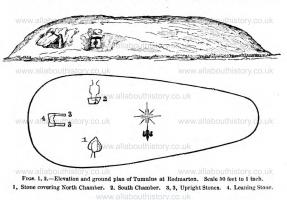
Proceedings of the Society of Antiquaries V2 1883 Pages 275-279. The Rev. samuel Lysons, F.S.A., gave an account of the opening of a tumulus [Windmill Tump aka Rodmarton Long Barrow [Map]] on his property at Rodmarton, in Gloucestershire, of which the following are the particulars. The tumulus was of the kind known as long barrows; its extreme length was 176 feet; greatest width 71 feet; height about 10 feet. (See figs. 1, 2.) It lay nearly due east and west.
Archæological Handbook of Gloucestershire. Windmill Tump aka Rodmarton Long Barrow [Map]
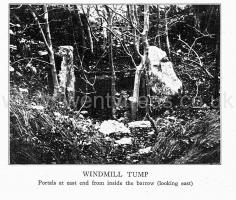
This was opened by Mr. Lysons in 1863; it lies within half a mile of the village of Rodmarton, and was known by the popular name of "Windmill Tump." It is 176 feet long, 71 feet wide, and ten feet high; its direction was east and west, the widest end being towards the east. A few feet below the surface of the east end two very large stones were found standing upright, each of them eight feet six inches in height; against these was leaning a third stone of vast size, in a slanting position. A chamber was found on the north side formed of seven large upright stones, with a paved floor, covered at the top by a single stone measuring nine feet by eight feet, and eighteen inches thick. The chamber was approached by a narrow passage, with walls on either side. Within the chamber were fortified no less than thirteen skeletons, also five flint arrow-heads, a large piece of natural flint, and some coarse black pottery. Another chamber was discovered on the southern side, much of the same character, but composed of nine stones instead of seven.
See "Archaeologia," vol. IX, p367.
Also "Our British Ancestors" (Lysons), p137.
Also "Relig. Brit. Rom.," vol. II, p8.
Also "Relig. Brit. Rom.," vol. III, p7.
Also "Proc. Soc. Ant.," 2nd ser., vol. II, p275.
Also "Crania Brit.," vol. II.
Long Barrows of the Cotswolds. Windmill Tump aka Rodmarton Long Barrow [Map]
Gloucestershire, 5^ N.E. Parish of Rodmarton.
Latitude 51° 40' 26". Longitude 2° 05' 50"- Heiht above O.D. about 480 feet.
Thurnam's account in Crania Britannica is as follows:- The barrow is placed on the edge of a hill which slopes to the west, where two or three valleys meet. Its present length is about 180 feet; greatest breadth 70 feet; the height, near the east end, about 8 feet. During the year 1863 it was explored by the owner, the Rev. S. Lysons, b .b.A. (by whom it is briefly described in the Proceedings of the Society of Antiquaries, 2 S. II., 275). About 25 feet from the eastern end, and somewhat more than a foot below the surface, two standing stones were uncovered. The stones were about 5 feet apart, and faced each other north and south. They were sunk about 3 feet below the natural level, having a total height of feet, that on the north side being a few inches higher than the other. In front of these, on the east side, and resting against them, was an oblong flat slab, about 8 feet in length by 4 feet in breadth, preserved in a slanting position by two low walls of flat stones, which slightly diverged from the outer edges of the two uprights, the space between which was filled in to a certain height by a third dry wall [Thurnam's plan. No. 1]. The three stones together occupied the same situation as the triliths which form entrances to the sepulchral chambers at Stoney Littleton [Map] and at Uley [Map]. [Also numerous other Long Barrows, such as those at Camp, West Tump, Belas Knap, Lodge Park, etc]. After noting the traces of fire pbseiwed at the base of the mound in front of these stones, he continues:- "Not only was there a considerable deposit of fine charcoal, but the colour of the stones of which the barrow is formed was in some places changed to a grey and in others to a reddish hue. Beneath or near this trilith there was no trace of human bones; but numerous bones and teeth of oxen, horses, and tusks of boars were scattered about. Near the centre of the tumulus, a foot or two below the surface, a coin of Claudius Gothicus [A.D. 268-270], a curved nail, and a ferrule about 3 inches long, both of iron - vestiges probably of Roman tomb-breakers- were picked up.