

Chronicle of a Bourgeois of Valenciennes
Récits d’un bourgeois de Valenciennes aka The Chronicle of a Bourgeois of Valenciennes is a vivid 14th-century vernacular chronicle written by an anonymous urban chronicler from Valenciennes in the County of Hainaut. It survives in a manuscript that describes local and regional history from about 1253 to 1366, blending chronology, narrative episodes, and eyewitness-style accounts of political, military, and social events in medieval France, Flanders, and the Low Countries. The work begins with a chronological framework of events affecting Valenciennes and its region under rulers such as King Philip VI of France and the shifting allegiances of local nobility. It includes accounts of conflicts, sieges, diplomatic manoeuvres, and the impact of broader struggles like the Hundred Years’ War on urban life in Hainaut. Written from the perspective of a burgher (bourgeois) rather than a monastery or royal court, the chronicle offers a rare lay viewpoint on high politics and warfare, reflecting how merchants, townspeople, and civic institutions experienced the turbulence of the 13th and 14th centuries. Its narrative style combines straightforward reporting of events with moral and civic observations, making it a valuable source for readers interested in medieval urban society, regional politics, and the lived experience of war and governance in pre-modern Europe.
Available at Amazon in eBook and Paperback format.
Winterbourne Basset Stone Circle is in Winterbourne Basset, Wiltshire [Map], Avebury Stone Circles.
Avebury by William Stukeley. If we descend the Hakpen-hill [Map], westward from hence towards Winterburn-basset, upon the declivity of the Hakpen, is another Druid's house, called too Old Chapel. 'Tis a square, double ditched, but small ditches, in the middle a broad oblong square bank. Before it a sort of court, nearly as big as the other. Near it, they say, they have found much old iron and pewter. It seems to have been set round with stones [Winterbourne Basset Stone Circle [Map]].
Avebury by William Stukeley. At Winterburn-basset, a little north of Abury, in a field north-west of the church, upon elevated ground, is a double circle of stones concentric, 60 cubits diameter. The two circles [Winterbourne Basset Stone Circle [Map]] are near one another, so that one may walk between. Many of the stones have of late been carryed away. West of it is a single, broad, flat, and high stone, standing by itself. And about as far northward from the circle, in a ploughed field, is a barrow set round with, or rather composed of large stones. I take this double circle to have been a family-chapel, as we may call it, to an archdruid dwelling near thereabouts, whilst Abury was his cathedral.
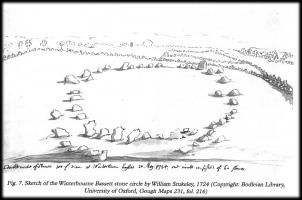
1724. An unpublished pen and ink wash sketch of Winterbourne Basset Stone Circle [Map] by Stukeley, archived amongst the Gough Maps at the Bodleian Library, Oxford (Gough Maps 231 Fol 216).
Wiltshire Archaeological Magazine 1857 V4 Pages 307-363. "At Winterbourne Basset, (about three miles) north of Abury, a field north west of the church, upon elevated ground, is a double circle of stones [Winterbourne Basset Stone Circle [Map]], concentric, 60 cubits diameter. The two circles are near one another, so that one may walk between. Many of the stones have of late been carried away. West of it is a single, broad, flat, and high stone, standing by itself; and about as far northward from the circle, in a ploughed field, is a barrow set round with, or rather composed of large stones."1 "By the above description, I was enabled," says Sir R. Hoare, "to find the remains of this circle, which is situated in a pasture ground at the angle of a road leading to Broad Hinton, and consists at present only of a few inconsiderable stones."2
Note 1. Stukeley's Abury, p. 45.
Note 2. Hoare's Ancient Wiltshire, ii. p. 95.
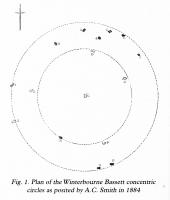
Winterbourne Basset Stone Circle [Map]. 1884 plan by A C Smith.