

Chronicle of Walter of Guisborough
A canon regular of the Augustinian Guisborough Priory, Yorkshire, formerly known as The Chronicle of Walter of Hemingburgh, describes the period from 1066 to 1346. Before 1274 the Chronicle is based on other works. Thereafter, the Chronicle is original, and a remarkable source for the events of the time. This book provides a translation of the Chronicle from that date. The Latin source for our translation is the 1849 work edited by Hans Claude Hamilton. Hamilton, in his preface, says: 'In the present work we behold perhaps one of the finest samples of our early chronicles, both as regards the value of the events recorded, and the correctness with which they are detailed; Nor will the pleasing style of composition be lightly passed over by those capable of seeing reflected from it the tokens of a vigorous and cultivated mind, and a favourable specimen of the learning and taste of the age in which it was framed.'
Available at Amazon in eBook and Paperback format.
 Winterbourne Stoke West Barrow 1 G61
 Winterbourne Stoke West Barrow 2 G62
 Winterbourne Stoke West Barrow 3 G63
 Winterbourne Stoke West Barrow 4 G63a
 Winterbourne Stoke West Barrow 5 G64a
 Winterbourne Stoke West Barrow 6 G64b
 Winterbourne Stoke West Barrow 7 G64
 Winterbourne Stoke West Barrow 8 G66
 Winterbourne Stoke West Barrow 9 G65
 Winterbourne Stoke West Barrow 10 G67
 Winterbourne Stoke West Barrow 11 G69
 Winterbourne Stoke West Barrow 12 G68
Winterbourne Stoke West Barrows is in Winterborne Stoke Barrows.
Colt Hoare 1812. No. 1 [Winterbourne Stoke West Barrow 1 G61 [Map]] is a large and wide Druid barrow, in which it appeared that the primary interment had been moved to make room for the subsequent deposit of a skeleton, which also had been disturbed at some still later period. In examining the cist which contained the skeleton, we observed that the feet had not been displaced; near them was an iron knife; and in our further researches we found at the bottom of the cist several fragments of burned bones, belonging to the remains of the original interment.
Colt Hoare 1812. No. 2 [Winterbourne Stoke West Barrow 2 G62 [Map]], like many of the others in this group, is much mutilated, and of large diameter, but not more four feet in elevation. It contained an interment of burned bones secured within a very large brown urn rudely ornamented, which was broken by taking out. A considerable quantity of linen cloth was perceptible among the bones.
Colt Hoare 1812. No. 3 [Winterbourne Stoke West Barrow 3 G63 [Map]], a flat barrow, mutilated, and about the same elevation as the last, contained within an oval cist, a simple interment of burned bones, and shreds of linen cloth.
Colt Hoare 1812. No. 4 [Winterbourne Stoke West Barrow 4 G63a [Map]] afforded no sepulchral remains, and probably was not intended for a barrow.
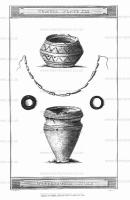
Colt Hoare 1812. No. 5 [Winterbourne Stoke West Barrow 5 G64a [Map]], a circular flat barrow, contained a double cist; the smallest of which produced a little dagger of brass, and a variety of beads, amongst which were two joints of the vertebral column of a petrified encrinus. The beads, in number about four dozen, were neatly made of clay, but not well burned, except two of the largest, which had been ornamented with faint striæ. Besides the above were a great quantity of curious little shells, in shape like the Hirlas horn used by the Britons, which were perforated lengthways, and formed probably the necklace of some female. (Tumuli Plate XIII.) The large cist contained only the bones of a sheep.
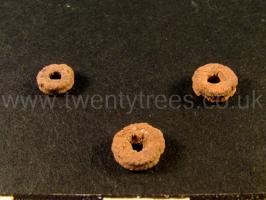
Wiltshire Museum. DZSWS:STHEAD.67. 3 beads made from sectioning a fossil encrinite stem (or sea lily) found in a primary deposit (no inhumation) in (confluent) bowl barrow Winterbourne Stoke G64a [Map] (i), excavated by William Cunnington.
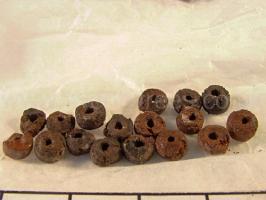
Wiltshire Museum. DZSWS:STHEAD.68. 18 clay beads (48 originally discovered) found in a primary deposit (no inhumation) in (confluent) bowl barrow Winterbourne Stoke G64a [Map] (i), excavated by William Cunnington.
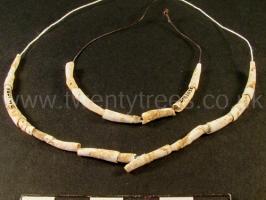
Wiltshire Museum. DZSWS:STHEAD.69. 22 fossil dentalium beads found in a primary deposit (no inhumation) in (confluent) bowl barrow Winterbourne Stoke G64a [Map] (i), excavated by William Cunnington.
Colt Hoare 1812. No. 6 [Winterbourne Stoke West Barrow 6 G64b [Map]] is a flat circular barrow, in which we found an oval cists containing burned bones, and a rude little cup, resembling a saucer, which was broken.

Wiltshire Museum. DZSWS:STHEAD.69a. 1 saucer-shaped incense cup (broken) decorated with three lines of impressed cord around its with broad flat rim, found with a primary cremation in Bowl barrow Winterbourne Stoke G64b [Map], excavated by William Cunnington.
Abbot John Whethamstede’s Chronicle of the Abbey of St Albans
Abbot John Whethamstede's Register aka Chronicle of his second term at the Abbey of St Albans, 1451-1461, is a remarkable text that describes his first-hand experience of the beginning of the Wars of the Roses including the First and Second Battles of St Albans, 1455 and 1461, respectively, their cause, and their consequences, not least on the Abbey itself. His text also includes Loveday, Blore Heath, Northampton, the Act of Accord, Wakefield, and Towton, and ends with the Coronation of King Edward IV. In addition to the events of the Wars of the Roses, Abbot John, or his scribes who wrote the Chronicle, include details in the life of the Abbey such as charters, letters, land exchanges, visits by legates, and disputes, which provide a rich insight into the day-to-day life of the Abbey, and the challenges faced by its Abbot.
Available at Amazon in eBook and Paperback format.
Colt Hoare 1812. No. 7 [Winterbourne Stoke West Barrow 7 G64 [Map]] is a small pond barrow.
Colt Hoare 1812. No. 8 [Winterbourne Stoke West Barrow 8 G66 [Map]], a very irregular flat barrow, three feet high, produced near the centre a large urn standing upright within a circular cist, and containing, amongst an interment of burned bones, a small brass dagger, with a bone top to it, neatly finished, with five holes on the side for so many rivets, by which it was fastened a wooden handle. The urn found in this tumulus was very large, and elegantly formed; (Tumuli Plate XIII.) it contained a few black beads that had undergone the action of fire, and was so closely cemented to the chalk, that we had great difficulty in detaching it from the cist.
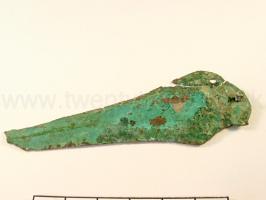
Wiltshire Museum. DZSWS:STHEAD.86. 1 bronze knife dagger with 3 rivet holes and one rivet remaining (broken in three places) found with a primary cremation (in an upright food vessel) in bowl barrow Winterbourne Stoke G66 [Map], excavated by William Cunnington.
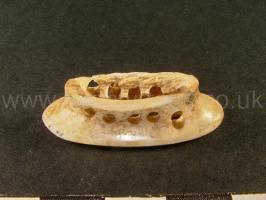
Wiltshire Museum. DZSWS:STHEAD.86a. 1 bone pommel with 5 rivet holes in both sides and two in the end found with a primary cremation (in an upright food vessel) in bowl barrow Winterbourne Stoke G66 [Map], excavated by William Cunnington.
Colt Hoare 1812. No. 9 [Winterbourne Stoke West Barrow 9 G65 [Map]], a flat circular barrow, contained two small round cists, in each of which was deposited an interment of burncd bones; in one we found curious little double cup;1 in the other, no articles whatever.
Note 1. This cup has a division in the middle, which renders the hollow on each side equal it is unlike in this particular any we have yet found, and is very neatly ornamented in the usual rude style, with the Vandyke pattern. An engraving of it, full size, is given in Tumuli Plate XIII.
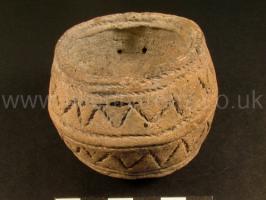
Wiltshire Museum. DZSWS:STHEAD.71. 1 reversible incense cup, with its inside base at waist height allowing it to be used upside down, decorated with impressed cord in two bands of zigzags with two parallel lines either side of each and one around the inside rim (also perforated four times for suspension) found with a primary cremation in Bowl barrow Winterbourne Stoke G65 [Map], excavated by William Cunnington.
Colt Hoare 1812. No. 11 [Winterbourne Stoke West Barrow 11 G69 [Map]]. This barrow, more perfect in its external form than the rest, contained within an oblong cist, a simple interment of burned bones.
Colt Hoare 1812. No. 12 [Winterbourne Stoke West Barrow 12 G68 [Map]]. The vallum of this large Druid barrow is so much defaced, and the elevation of the mound so very trifling, that it might easily escape general notice. It contained a very large rude urn, sixteen inches and a half deep, inverted over an interment of burned bones, and within it a smaller vase. With them were found two black rings similar to those before described, but not perforated for suspension, large amber bead perforated, four pully beads, and three of a black colour. The three last mentioned barrows are situated on the outside of the bank and ditch, which, at first sight, bear an equivocal appearance from their singular shape, resembling a pentagon, which I have before, stated as being a favourite form with the Britons; but on a close investigation of them, they appear decidedly of a more modern date than the barrows. The name of the hill, Conigar, and the vulgar tradition of this spot having once been appropriated to a rabbit-warren, will corroborate this conjecture, and ascertain the origin of this earthen enclosure. On the adjoining hill, called High Down, and to the N. W. of the group of barrows, are the decided remains of a British village, in which we found coins of the Lower Empire, pottery of various sorts, with animal bones, and all the usual indicia of an ancient British and Roman population.

Wiltshire Museum. DZSWS:STHEAD.70b. 1 rough bowl-shaped incense cup decorated with irregular squares of impressed dots around one side and smaller squares, crosses and other shapes around the other (the thick rim also has lines of impressed dots around it) found with a primary cremation under an inverted MBA urn in disc barrow Winterbourne Stoke G68 [Map], excavated by William Cunnington.
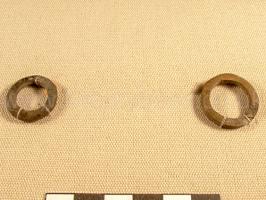
Wiltshire Museum. DZSWS:STHEAD.329. 2 rings of Kimmerage shale found with a primary cremation under an inverted MBA urn in disc barrow Winterbourne Stoke G68 [Map], excavated by William Cunnington.
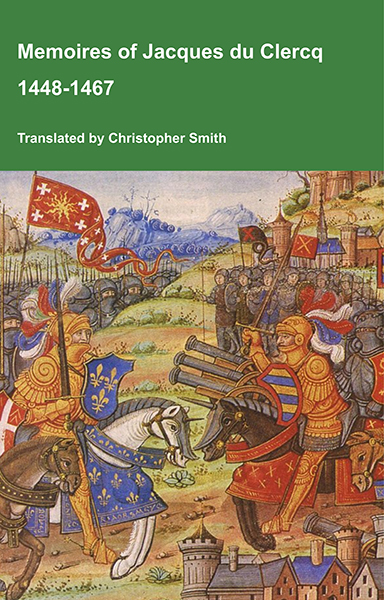
This is a translation of the 'Memoires of Jacques du Clercq', published in 1823 in two volumes, edited by Frederic, Baron de Reissenberg. In his introduction Reissenberg writes: 'Jacques du Clercq tells us that he was born in 1424, and that he was a licentiate in law and a counsellor to Philip the Good, Duke of Burgundy, in the castellany of Douai, Lille, and Orchies. It appears that he established his residence at Arras. In 1446, he married the daughter of Baldwin de la Lacherie, a gentleman who lived in Lille. We read in the fifth book of his Memoirs that his father, also named Jacques du Clercq, had married a lady of the Le Camelin family, from Compiègne. His ancestors, always attached to the counts of Flanders, had constantly served them, whether in their councils or in their armies.' The Memoires cover a period of nineteen years beginning in in 1448, ending in in 1467. It appears that the author had intended to extend the Memoirs beyond that date; no doubt illness or death prevented him from carrying out this plan. As Reissenberg writes the 'merit of this work lies in the simplicity of its narrative, in its tone of good faith, and in a certain air of frankness which naturally wins the reader’s confidence.' Du Clercq ranges from events of national and international importance, including events of the Wars of the Roses in England, to simple, everyday local events such as marriages, robberies, murders, trials and deaths, including that of his own father in Book 5; one of his last entries.
Available at Amazon in eBook and Paperback format.
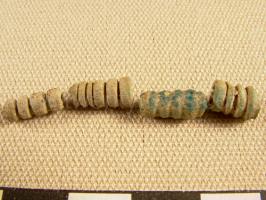
Wiltshire Museum. DZSWS:STHEAD.329a. 4 segmented faience beads found with a primary cremation under an inverted MBA urn in disc barrow Winterbourne Stoke G68 [Map], excavated by William Cunnington.