

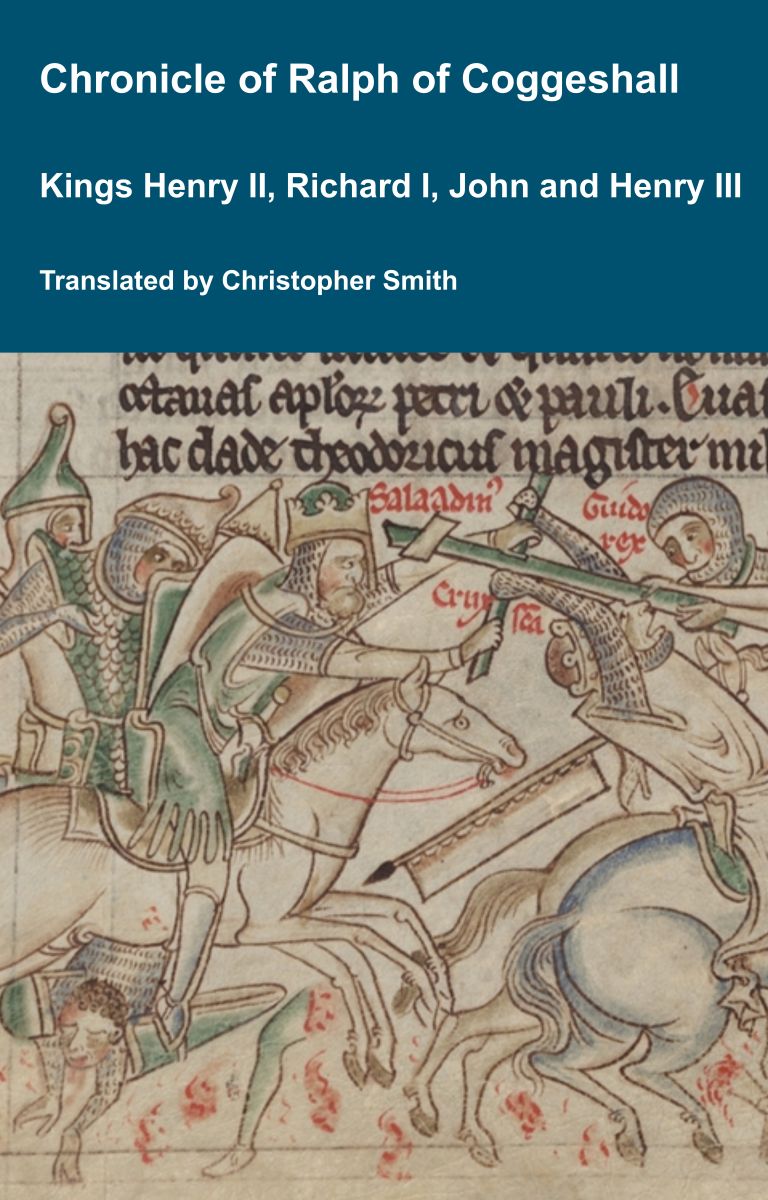
Chronicle of Abbot Ralph of Coggeshall
The Chronicle of Abbot Ralph of Coggeshall (Chronicon Anglicanum) is an indispensable medieval history that brings to life centuries of English and European affairs through the eyes of a learned Cistercian monk. Ralph of Coggeshall, abbot of the Abbey of Coggeshall in Essex in the early 13th century, continued and expanded his community’s chronicle, documenting events from the Norman Conquest of 1066 into the tumultuous reign of King Henry III. Blending eyewitness testimony, careful compilation, and the monastic commitment to record-keeping, this chronicle offers a rare narrative of political intrigue, royal power struggles, and social upheaval in England and beyond. Ralph’s work captures the reigns of pivotal figures such as Richard I and King John, providing invaluable insights into their characters, decisions, and the forces that shaped medieval rule. More than a simple annal, Chronicon Anglicanum conveys the texture of medieval life and governance, making it a rich source for scholars and readers fascinated by English history, monastic authorship, and the shaping of the medieval world.
Available at Amazon in eBook and Paperback format.
Winterslow Barrow 223320 is in Winterslow, Wiltshire [Map].
Winterslow Barrow 223320 [Map]. A Bronze Age bell barrow, part of the Winterslow Hut Barrow Group, situated to the northwest of 'The Pheasant'. The barrow was designated as Idmiston 23 by Grinsell (1957) and survives as an earthwork 30 metres in diameter and 3.5 metres high. The mound is not situated within the centre of the ditched area, as the berm varies from 9 metres to 12 metres in width. The ditch is visible both as an earthwork and a cropmark, is 4 metres wide and up to 0.2 metres in depth. Excavations by the Rev. A.B Hutchins in 1814 located an intrusive Saxon inhumation accompanied by a shield, spear, buckle and a bucket. The grave goods give a 5th or 6th century date for the burial.
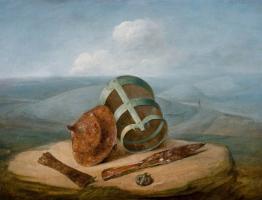
1814. Thomas Guest (age 33). Grave Group from a Surface Interment at Winterslow Barrow 223320 [Map]. The bucket, shield boss and grip, spearhead and bronze brooch date to the Saxon period. They are from a surface interment (burial) in the Winterslow 'colossal barrow', which is possibly pictured behind the grave goods.
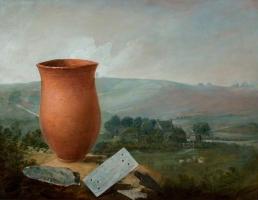
1814. Thomas Guest (age 33). Grave Group from a Bell Barrow at Winterslow Barrow 223320 [Map]. The beaker, copper dagger and two flint arrowheads were excavated from a bell barrow by the Revd A. B. Hutchings, and they are now in the Ashmolean Museum, Oxford.
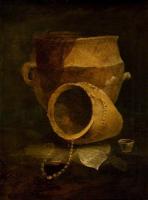
1814. Thomas Guest (age 33). Two Biconical Urns from a Barrow at Winterslow Barrow 223320 [Map].
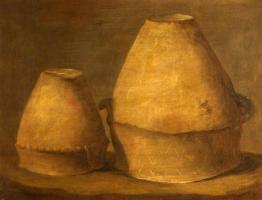
1814. Thomas Guest (age 33). These Bronze Age Urns excavated by Reverend A. B. Hutchings at Winterslow Barrow 223320 [Map] are now in the Ashmolean Museum, Oxford. This is one of four paintings by Guest in the Museum's collection.