

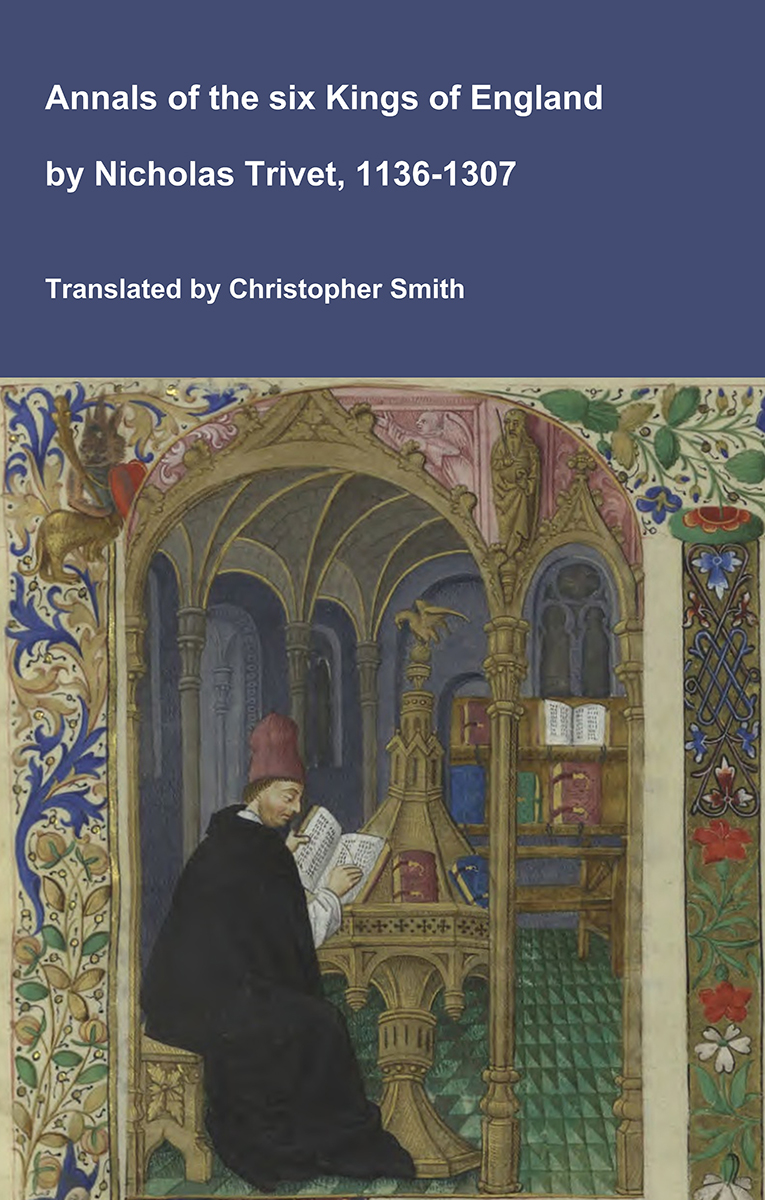
Annals of the six Kings of England by Nicholas Trivet
Translation of the Annals of the Six Kings of England by that traces the rise and rule of the Angevin aka Plantagenet dynasty from the mid-12th to early 14th century. Written by the Dominican scholar Nicholas Trivet, the work offers a vivid account of English history from the reign of King Stephen through to the death of King Edward I, blending political narrative with moral reflection. Covering the reigns of six monarchs—from Stephen to Edward I—the chronicle explores royal authority, rebellion, war, and the shifting balance between crown, church, and nobility. Trivet provides detailed insight into defining moments such as baronial conflicts, Anglo-French rivalry, and the consolidation of royal power under Edward I, whose reign he describes with particular immediacy. The Annals combines careful year-by-year reporting with thoughtful interpretation, presenting history not merely as a sequence of events but as a moral and political lesson. Ideal for readers interested in medieval history, kingship, and the origins of the English state, this chronicle remains a valuable and accessible window into the turbulent world of the Plantagenet kings.
Available at Amazon in eBook and Paperback format.
Wisbech, Cambridgeshire is in Cambridgeshire.
See: Wisbech Castle [Map].
Rotuli Litterarum Clausarum. The King to Savaric de Mauléon, greetings. Know that Hugh de Foresta, the bearer of these presents, has lost his land in our service. And therefore we order you to provide him with some land from the confiscations of our enemies, from which he may be able to maintain himself. Witness T. at Wisbech [Map], on the 12th day of October [1216].
Rex Sauar̃ de Maɫ Leone saɫt. Sciatis qd Hugo de Foresta psenc lator amisit tram suā ₽ svico nr̃o. Et io vob mandam qd tram un sustentari posset alicubi ei ₽videa[tis de Pris inimicoz nr̃oz. T.] apd Wisebech. xij. die Oct.
Chronica Majora by Matthew Paris. 11th November 1236. On the day after the feast of St. Martin, and within the octaves of that feast, great inundations of the sea suddenly broke forth by night, and a fierce storm of wind arose, which caused inundations of the rivers as well as of the sea, and in places, especially on the coast, drove the ships from their ports, tearing them from their anchors, drowned great numbers of people, destroyed flocks of sheep, and herds of cattle, tore up trees by the roots, overthrew houses, and ravaged the coast. The sea rose for two days and the intermediate night, a circumstance before unheard of, and did not ebb and flow in its usual way, being impeded (as was said) by the violence of the opposing winds. The dead bodies of those drowned were seen lying unburied in caves formed by the sea, near the coast, and at Wisbeach [Map] and the neighbouring villages, and along the seacoast, an endless number of human beings perished: in one town, and that not a populous one, about a hundred bodies were consigned to the tomb in one day.
Around 1580 Mary Day was born at Wisbech, Cambridgeshire [Map].
In 1595 Thomas "The Black" Pepys (age 32) and Mary Day (age 15) were married at Wisbech, Cambridgeshire [Map].
Samuel Pepys' Diary. 14th July 1663. Up a little late, last night recovering my sleepiness for the night before, which was lost, and so to my office to put papers and things to right, and making up my journal from Wednesday last to this day. All the morning at my office doing of business; at noon Mr. Hunt came to me, and he and I to the Exchange [Map], and a Coffee House, and drank there, and thence to my house to dinner, whither my uncle Thomas came, and he tells me that he is going down to Wisbech [Map], there to try what he can recover of my uncle Day's estate, and seems to have good arguments for what he do go about, in which I wish him good speed. I made him almost foxed, the poor man having but a bad head, and not used I believe nowadays to drink much wine.
Samuel Pepys' Diary. 17th September 1663. Up, and my father being gone to bed ill last night and continuing so this morning, I was forced to come to a new consideration, whether it was fit for to let my uncle and his son go to Wisbeach [Map] about my uncle Day's estate alone or no, and concluded it unfit; and so resolved to go with them myself, leaving my wife there, I begun a journey with them, and with much ado, through the fens, along dikes, where sometimes we were ready to have our horses sink to the belly, we got by night, with great deal of stir and hard riding, to Parson's Drove, a heathen place, where I found my uncle and aunt Perkins, and their daughters, poor wretches! in a sad, poor thatched cottage, like a poor barn, or stable, peeling of hemp, in which I did give myself good content to see their manner of preparing of hemp; and in a poor condition of habitt took them to our miserable inn, and there, after long stay, and hearing of Frank, their son, the miller, play, upon his treble, as he calls it, with which he earns part of his living, and singing of a country bawdy song, we sat down to supper; the whole crew, and Frank's wife and child, a sad company, of which I was ashamed, supped with us.
Samuel Pepys' Diary. 18th September 1663. Up, and got our people together as soon as we could; and after eating a dish of cold cream, which was my supper last night too, we took leave of our beggarly company, though they seem good people, too; and over most sad Fenns, all the way observing the sad life which the people of the place which if they be born there, they do call the Breedlings' of the place, do live, sometimes rowing from one spot to another, and then wadeing, to Wisbeach [Map], a pretty town, and a fine church and library, where sundry very old abbey manuscripts; and a fine house, built on the church ground by Secretary Thurlow (age 47), and a fine gallery built for him in the church, but now all in the Bishop of Ely's hands.
On 21st March 1841 Keomi aka Keytumas Gray was born to Osery Gray at Wisbech, Cambridgeshire [Map]. The year of her birth complicated - the Census records are inconsistent. Her grave states "Died 19 Sep 1914 aged 73" which would make her birth year 1841. She married 24th September 1875 Charles Stewart Bonnett and had issue.


The River Nene rises near Badby, Northamptonshire [Map] from where it flows past Newnham, Northamptonshire [Map], Weedon, Northamptonshire [Map], Nether Heyford, Northamptonshire [Map], Kinslingbury, Northamptonshire [Map], Hunsbury Meadows, Northamptonshire [Map], Northampton [Map], Billing, Northamptonshire [Map], Great Doddinton, Northamptonshire [Map], Rushden, Northamptonshire [Map], Thrapston, Northamptonshire [Map], around Oundle, Northamptonshire [Map], past St Mary and All Saints Church, Fotheringhay [Map] and the remains of Fotheringhay Castle, Northamptonshire [Map], Wansford [Map], through the centre of Peterborough [Map] after which it is canalised to Rings End [Map]. After Rings End [Map] it continues through Wisbech, Cambridgeshire [Map], under Sutton Bridge [Map] after which it reaches The Wash at Guys Head [Map].
Wisbech Castle is also in Castles in Cambridgeshire.
On 27th September 1584 or 15th October 1584 Bishop Thomas Watson (age 69) died at Wisbech Castle [Map] having been confined for the previous twenty-five years.
Annals of the six Kings of England by Nicholas Trivet
Translation of the Annals of the Six Kings of England by that traces the rise and rule of the Angevin aka Plantagenet dynasty from the mid-12th to early 14th century. Written by the Dominican scholar Nicholas Trivet, the work offers a vivid account of English history from the reign of King Stephen through to the death of King Edward I, blending political narrative with moral reflection. Covering the reigns of six monarchs—from Stephen to Edward I—the chronicle explores royal authority, rebellion, war, and the shifting balance between crown, church, and nobility. Trivet provides detailed insight into defining moments such as baronial conflicts, Anglo-French rivalry, and the consolidation of royal power under Edward I, whose reign he describes with particular immediacy. The Annals combines careful year-by-year reporting with thoughtful interpretation, presenting history not merely as a sequence of events but as a moral and political lesson. Ideal for readers interested in medieval history, kingship, and the origins of the English state, this chronicle remains a valuable and accessible window into the turbulent world of the Plantagenet kings.
Available at Amazon in eBook and Paperback format.
On 17th November 1600 Robert Drury (age 33) signed his name to the appeal against George Blackwell, dated from Wisbech Castle [Map].