

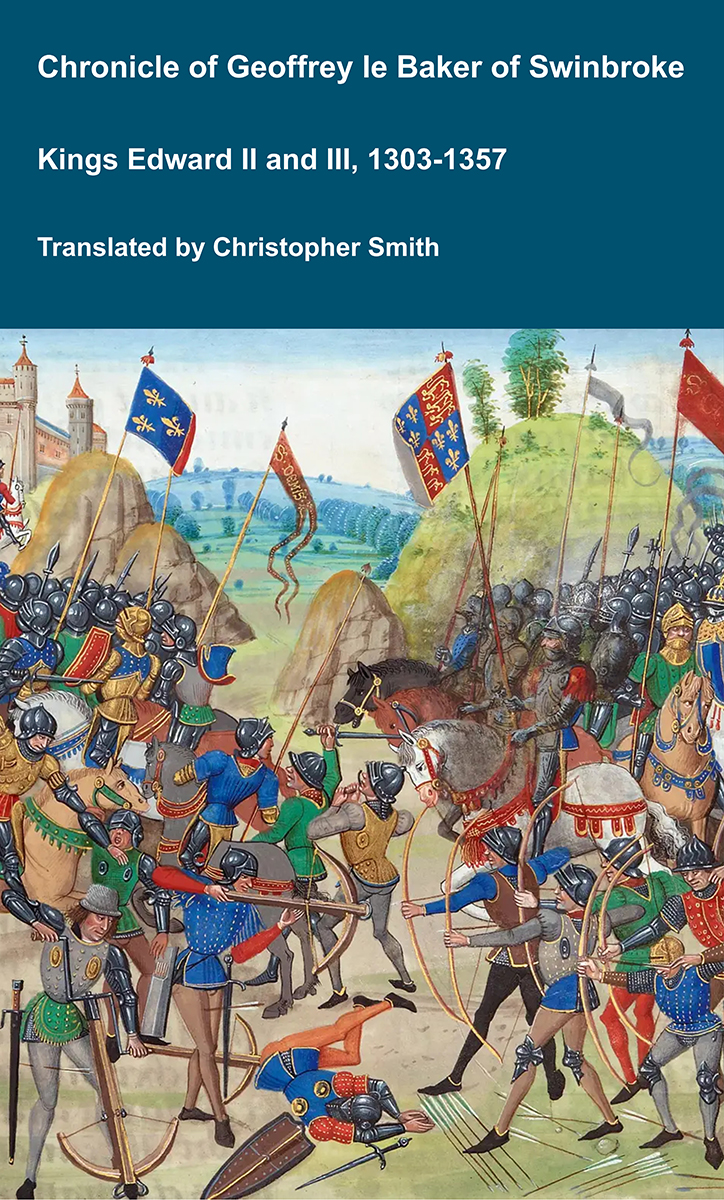
Chronicle of Geoffrey le Baker of Swinbroke
Baker was a secular clerk from Swinbroke, now Swinbrook, an Oxfordshire village two miles east of Burford. His Chronicle describes the events of the period 1303-1356: Gaveston, Bannockburn, Boroughbridge, the murder of King Edward II, the Scottish Wars, Sluys, Crécy, the Black Death, Winchelsea and Poitiers. To quote Herbert Bruce 'it possesses a vigorous and characteristic style, and its value for particular events between 1303 and 1356 has been recognised by its editor and by subsequent writers'. The book provides remarkable detail about the events it describes. Baker's text has been augmented with hundreds of notes, including extracts from other contemporary chronicles, such as the Annales Londonienses, Annales Paulini, Murimuth, Lanercost, Avesbury, Guisborough and Froissart to enrich the reader's understanding. The translation takes as its source the 'Chronicon Galfridi le Baker de Swynebroke' published in 1889, edited by Edward Maunde Thompson.
Available at Amazon in eBook and Paperback format.
Army is in Military.
Patent Rolls. 8th May 1461. York [Map]. Grant for life to William Herbert [aged 38], knight, of the offices of office of chief justice and chamberlain of South Wales, steward of the commontes in the counties of Caermarthen and Cardigan, and chief forester in those counties (Carmarthenshire,Cardiganshire).
Patent Rolls. 8th May 1461. York [Map]. Grant for life to William Herbert [aged 38], knight, of the offices of office of chief justice and chamberlain of South Wales, steward of the commontes in the counties of Caermarthen and Cardigan, and chief forester in those counties (Carmarthenshire,Cardiganshire).

On 21st November 1777 Charles Gould aka Morgan 2nd Baronet [aged 17] was commissioned ensign and lieutenant in the Coldstream Guards.
In 1838 George Phipps 2nd Marquess Normanby [aged 18] was appointed Lieutenant in the Coldstream Guards.
In 1839 Poulett George Henry Somerset [aged 16] commissioned as Coldstream Guards.
In 1867 Ronald Campbell [aged 18] was commissioned in the Coldstream Guards in 1867, promoted Captain in 1871, becoming Adjutant 1st Battalion 1871-78.
In 1909 Captain Percy Lyulph Wyndham [aged 21] enlisted in the Coldstream Guards. He was commissioned as Lieutenant in May 1910.
In 1854 Henry Byng 4th Earl Strafford [aged 22] was appointed Coldstream Guards: Adjutant.
In 1854 Henry Byng 4th Earl Strafford [aged 22] promoted by purchase as Coldstream Guards: Captain.
The History of William Marshal was commissioned by his son shortly after William’s death in 1219 to celebrate the Marshal’s remarkable life; it is an authentic, contemporary voice. The manuscript was discovered in 1861 by French historian Paul Meyer. Meyer published the manuscript in its original Anglo-French in 1891 in two books. This book is a line by line translation of the first of Meyer’s books; lines 1-10152. Book 1 of the History begins in 1139 and ends in 1194. It describes the events of the Anarchy, the role of William’s father John, John’s marriages, William’s childhood, his role as a hostage at the siege of Newbury, his injury and imprisonment in Poitou where he met Eleanor of Aquitaine and his life as a knight errant. It continues with the accusation against him of an improper relationship with Margaret, wife of Henry the Young King, his exile, and return, the death of Henry the Young King, the rebellion of Richard, the future King Richard I, war with France, the death of King Henry II, and the capture of King Richard, and the rebellion of John, the future King John. It ends with the release of King Richard and the death of John Marshal.
Available at Amazon in eBook and Paperback format.
In 1847 Henry Byng 4th Earl Strafford [aged 15] joined the Coldstream Guards: Lieutenant.
In 1865 Henry Byng 4th Earl Strafford [aged 33] was appointed Coldstream Guards: Supernumary Major.
In 1511 Richard Wingfield [aged 42] was appointed Deputy of Calais.
In 1540 Henry Fitzalan 12th or 19th Earl of Arundel [aged 27] was appointed Deputy of Calais.


Henry Machyn's Diary. After 20th April 1599. The (blank) day of Aprell was browth from the Towre [Map] unto Westmynster Hall [Map] to be reynyd, my lord Wentworth, last depute of Calles, for the lossyng of Calles; and ther wher serten of ys a-cussars; but he quytt hym-seylff, thanke be God, and clen delevered, and whent in-to Wytyngtun colege, and ther he lys.
Frederick Cavendish was appointed Field Marshall.

In 1832 John William Montagu 7th Earl Sandwich [aged 20] was commissioned Ensign in the Grenadier Guards.
Adeline Horsey Recollections. After mamma's death I kept house for papa at 8 Upper Grosvenor Street. My brothers were rarely at home. William [aged 17] was educated at Eton [Map], and when he was sixteen years old the Duke of Wellington [aged 73] gave him a commission in the Grenadier Guards. Later he went through the Crimean War, and he retired from the Army in 1883, on account of ill-health, with the rank of Lieutenant-General.
Algernon [aged 16] entered the Navy in 1840 as a midshipman, and the same year took part in the operations on the coast of Syria. After the battle of Acre he received the Turkish medal and clasps: his promotion was rapid, and as Admiral, his flagship, the Shah, engaged the Huascar, which he forced to surrender to the Peruvian authorities.
Now that I was so much alone I occasionally found time hang heavy on my hands, and I welcomed any excitement as a break in the monotony, for of course our period of mourning prevented us entertaining or accepting invitations. One day my maid told me about a fortune-teller who had a wonderful gift for predicting the future. I was very much interested, and made up my mind to consult the oracle. My maid attempted to dissuade me, saying that the woman lived in Bridge Street, Westminster, which was not at all a nice neighbourhood. I have always had my own way and, disguised in a borrowed cloak, bonnet and thick veil, and accompanied by my protesting servant, I started off to Bridge Street late one November afternoon.
It was dusk when we reached Westminster and found Bridge Street, badly lighted and evil-smelling. We knocked at the door, stated whom we wished to see, and we were ushered through a dark passage into a dirty room reeking of tobacco.
The fortune-teller was a wrinkled old woman who was smoking a short clay pipe with evident enjoyment. When I told her what I had come for, she produced a greasy pack of cards, and after I had "crossed her pahn" she commenced to tell my future.
"Ah!" said she at last, and she looked curiously, "my pretty young lady, fate holds a great deal in store for you. You will not marry for several years, but when you do it will be to a widower - a man in a high position. You will suffer much unkindness before you experience real happiness, you will obtain much and lose much, you will marry again after your husband's death, and you will live to a great age".
I was quite impressed by my "fortune", but I was a little disappointed, for like most girls I had my day-dreams of a young husband, and the prospect of a widower was thus rather depressing.
Strangely enough, the prediction came true, for Lord Cardigan [aged 45] was a widower, and nearly all the men who proposed to me were widowers! I was asked in marriage by Lord Sherborne [aged 38], a widower with ten children; by the Duke of Leeds [aged 40], who was a widower with eleven children, and by Christopher Maunsell Talbot [aged 39], once Father of the House of Commons, also a widower with four children. Prince Soltykoff, the Duke of St. Albans [aged 41], Harry Howard, and Disraeli [aged 38] were other widowers who proposed to me, so I suppose I must have had some unaccountable fascination for bereaved husbands.


On 1st April 1762 Captain George Marlay [aged 14] was appointed Cornet of the 9th Regiment of Dragoons.
On 6th October 1799 Lieutenant Colonel Philip Bainbrigge [aged 44] was killed in action at the Battle of Egmont on Zee at which battle he was commanding the 20th Regiment of Foot. He was buried in the churchyard near the field of battle. Monument in St Oswald's Church, Ashbourne [Map]. Signed Hayward Lichfield - possibly Peter Hayward.
Lieutenant Colonel Philip Bainbrigge: Around 1755 he was born.


On 27th May 1676 Captain George Marlay was appointed Lieutenant of the 62nd Regiment.
On 16th August 1770 Captain George Marlay [aged 22] was appointed Adjutant of the 62nd Regiment.
The Deeds of the Dukes of Normandy
The Gesta Normannorum Ducum [The Deeds of the Dukes of Normandy] is a landmark medieval chronicle tracing the rise and fall of the Norman dynasty from its early roots through the pivotal events surrounding the Norman Conquest of England. Originally penned in Latin by the monk William of Jumièges shortly before 1060 and later expanded at the behest of William the Conqueror, the work chronicles the deeds, politics, battles, and leadership of the Norman dukes, especially William’s own claim to the English throne. The narrative combines earlier historical sources with firsthand information and oral testimony to present an authoritative account of Normandy’s transformation from a Viking settlement into one of medieval Europe’s most powerful realms. William’s history emphasizes the legitimacy, military prowess, and governance of the Norman line, framing their expansion, including the conquest of England, as both divinely sanctioned and noble in purpose. Later chroniclers such as Orderic Vitalis and Robert of Torigni continued the history, extending the coverage into the 12th century, providing broader context on ducal rule and its impact. Today this classic work remains a foundational source for understanding Norman identity, medieval statesmanship, and the historical forces that reshaped England and Western Europe between 800AD and 1100AD.
Available at Amazon in eBook and Paperback format.
On 16th August 1770 Captain George Marlay [aged 22] was appointed Captain of the 62nd Regiment.
On 17th November 1780 Captain George Marlay [aged 32] was appointed Major (brevet) of the 62nd Regiment.
On 20th September 1854 Charles Pierrepont Darcy Lane-Fox [aged 24] was wounded, Poulett George Henry Somerset [aged 32] fought.
Major-General John Douglas [aged 37] commanded the 79th Regiment of Foot.
William Frederick Waldegrave [aged 38] died from wounds received.
Henry Hugh Manvers Percy [aged 37] was shot through the arm.
General George Augustus Frederick Paget [aged 36], Godfrey Morgan 1st Viscount Tredegar [aged 23] and Hedworth Jolliffe 2nd Baron Hylton [aged 25] fought.
Arthur Williams-Wynn [aged 35], Captain of the 23rd Royal Welsh Fusiliers, was killed.


On 25th October 1854 Poulett George Henry Somerset [aged 32] and William Archer Amherst 3rd Earl Amherst [aged 18] fought.
Major-General John Douglas [aged 37] commanded the 79th Regiment of Foot.
General George Augustus Frederick Paget [aged 36] and Henry Hugh Manvers Percy [aged 37] fought.
Before 19th July 1915 Lieutenant Theodore William Warlow [aged 20] was appointed Lieutenant of the 6th Battalion King's Own Yorkshire Light Infantry.
Henry Reginald Courtenay was appointed Major-General of the Royal Artillery.
Before 16th July 1861 Henry Eliot Yorke [aged 23] was appointed Lieutenant of the Royal Bombay Artillery.