

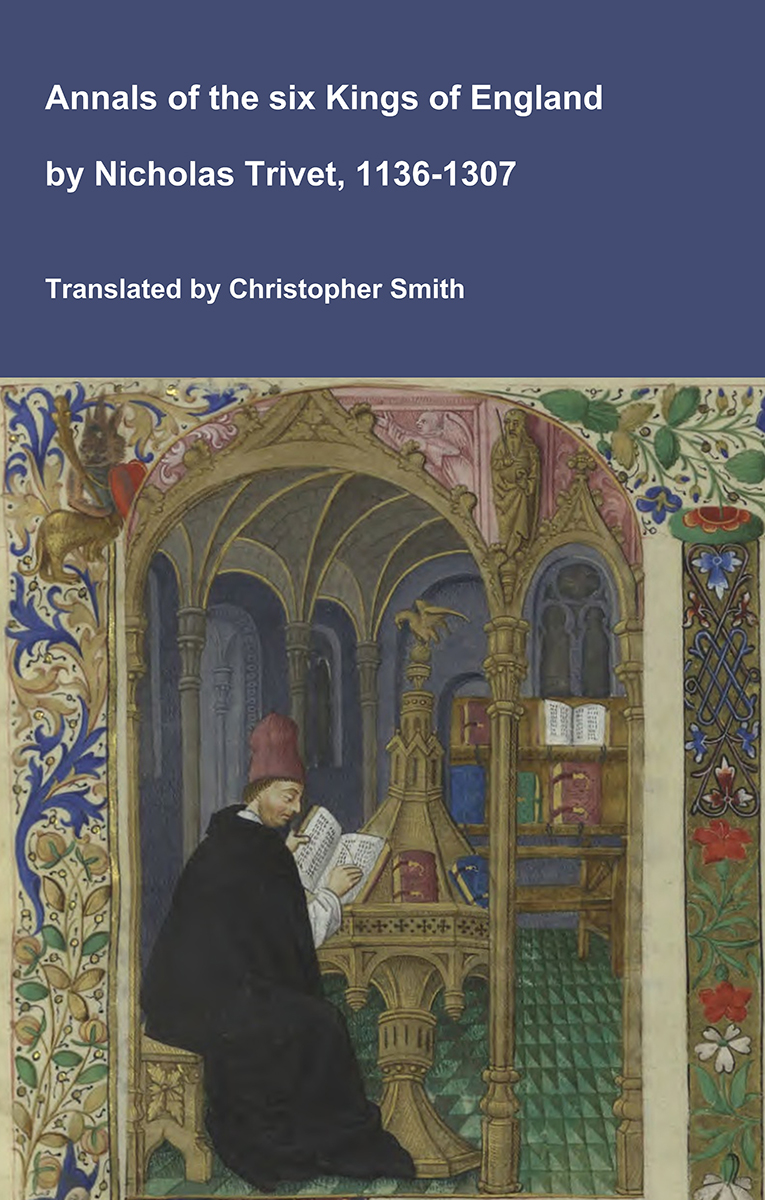
Annals of the six Kings of England by Nicholas Trivet
Translation of the Annals of the Six Kings of England by that traces the rise and rule of the Angevin aka Plantagenet dynasty from the mid-12th to early 14th century. Written by the Dominican scholar Nicholas Trivet, the work offers a vivid account of English history from the reign of King Stephen through to the death of King Edward I, blending political narrative with moral reflection. Covering the reigns of six monarchs—from Stephen to Edward I—the chronicle explores royal authority, rebellion, war, and the shifting balance between crown, church, and nobility. Trivet provides detailed insight into defining moments such as baronial conflicts, Anglo-French rivalry, and the consolidation of royal power under Edward I, whose reign he describes with particular immediacy. The Annals combines careful year-by-year reporting with thoughtful interpretation, presenting history not merely as a sequence of events but as a moral and political lesson. Ideal for readers interested in medieval history, kingship, and the origins of the English state, this chronicle remains a valuable and accessible window into the turbulent world of the Plantagenet kings.
Available at Amazon in eBook and Paperback format.
Baron Mortimer is in Baronies of England Alphabetically.
There have been three creations of Baron Mortimer:
1st. 1258. Roger Mortimer 1st Baron Mortimer of Wigmore. Merged with the Crown. 28th June 1461. Coronation of Edward IV.
2nd. 28th November 1274. Hugh Mortimer 1st Baron Mortimer. Abeyant. 20th July 1304.
3rd. 6th February 1299. Roger Mortimer 1st Baron Mortimer of Chirk. Abeyant. 1359.
Baron Mortimer of Wigmore is also in Baronies of England Chronologically, Forfeit Baronies of England, Merged with the Crown Baronies of England.
Summary
1258. Roger Mortimer 1st Baron Mortimer of Wigmore [aged 27] created.
30th October 1282. Son Edmund Mortimer 2nd Baron Mortimer of Wigmore [aged 31] succeeded.
July 1304. Son Roger Mortimer 1st Earl March [aged 17] succeeded.
29th November 1330. King Edward III of England [aged 18] forfeit. See Execution of Mortimer.
1348. Half Third Cousin Twice Removed Roger Mortimer 2nd Earl March [aged 19] restored.
26th February 1360. Son Edmund Mortimer 3rd Earl March, Earl of Ulster [aged 8] succeeded.
27th December 1381. Son Roger Mortimer 4th Earl March 3rd Earl of Ulster [aged 7] succeeded.
20th July 1398. Son Edmund Mortimer 5th Earl March 7th Earl of Ulster [aged 6] succeeded.
18th January 1425. Nephew Richard Plantagenet 3rd Duke of York [aged 13] succeeded.
30th December 1460. Son King Edward IV of England [aged 18] succeeded. See Battle of Wakefield.
28th June 1461. King Edward IV of England merged with the crown. See Coronation of Edward IV.
Before 1258 Roger Mortimer 1st Baron Mortimer of Wigmore [aged 26] was created 1st Baron Mortimer of Wigmore.
On 30th October 1282 Roger Mortimer 1st Baron Mortimer of Wigmore [aged 51] died. He was buried at Wigmore Abbey [Map] where the inscription of his tombstone reads "Here lies buried, glittering with praise, Roger the pure, Roger Mortimer the second, called Lord of Wigmore by those who held him dear. While he lived all Wales feared his power, and given as a gift to him all Wales remained his. It knew his campaigns, he subjected it to torment". His son Edmund [aged 31] succeeded 2nd Baron Mortimer of Wigmore.
In July 1304 Edmund Mortimer 2nd Baron Mortimer of Wigmore [aged 53] died at Wigmore Castle, Herefordshire [Map]. He was buried at Wigmore Abbey [Map]. His son Roger [aged 17] succeeded 3rd Baron Mortimer of Wigmore. Joan Geneville Baroness Mortimer 2nd Baroness Geneville [aged 18] by marriage Baroness Mortimer of Wigmore.
On 29th November 1330 Roger Mortimer 1st Earl March [aged 43] was hanged, drawn and quartered at Tyburn [Map] accused of assuming royal power and of various other high misdemeanours. His body hung at the gallows for two days and nights. He was buried at Christ Church, Greyfriars [Map]. Isabella of France Queen Consort England [aged 35] subsequently requested his burial at Wigmore Abbey [Map] and, after firstly refusing, King Edward III of England [aged 18] allowed his remains to be removed to Wigmore Abbey [Map]. Earl March, Baron Mortimer of Wigmore forfeit.
In 1348 Roger Mortimer 2nd Earl March [aged 19] was restored 4th Baron Mortimer of Wigmore.
On 26th February 1360 Roger Mortimer 2nd Earl March [aged 31] died. He was buried at Wigmore Abbey [Map]. His son Edmund [aged 8] succeeded 3rd Earl March, 5th Baron Mortimer of Wigmore.
On 27th December 1381 Edmund Mortimer 3rd Earl March, Earl of Ulster [aged 29] died. He was buried at Wigmore Abbey [Map]. His son Roger [aged 7] succeeded 4th Earl March, 3rd Earl of Ulster, 6th Baron Mortimer of Wigmore.
On 20th July 1398 Roger Mortimer 4th Earl March 3rd Earl of Ulster [aged 24] died at Kells, County Meath. He was buried at Wigmore Abbey [Map]. His son Edmund [aged 6] succeeded Heir to the Throne of England, 5th Earl March, 4th Earl of Ulster, 7th Baron Mortimer of Wigmore.
On 18th January 1425 Edmund Mortimer 5th Earl March 7th Earl of Ulster [aged 33] died at Trim Castle. He was buried at Clare Priory, Suffolk [Map]. His nephew Richard [aged 13] succeeded 6th Earl March, 5th Earl of Ulster, 8th Baron Mortimer of Wigmore.
On 30th December 1460 the Lancastrian army took their revenge for the defeats of the First Battle of St Albans and the Battle of Northampton at the Battle of Wakefield near Sandal Castle [Map]. The Lancastrian army was commanded by Henry Holland 3rd Duke Exeter [aged 30], Henry Beaufort 2nd or 3rd Duke of Somerset [aged 24] and Henry Percy 3rd Earl of Northumberland [aged 39], and included John Courtenay 7th or 15th Earl Devon [aged 25] and William Gascoigne XIII [aged 30], both knighted, and James Butler 1st Earl Wiltshire 5th Earl Ormonde [aged 40], John "Butcher" Clifford 9th Baron Clifford [aged 25], John Neville 1st Baron Neville of Raby [aged 50], Thomas Ros 9th Baron Ros Helmsley [aged 33], Henry Roos and Thomas St Leger [aged 20].
The Yorkist army was heavily defeated.
Richard Plantagenet 3rd Duke of York [aged 49] was killed. His son Edward [aged 18] succeeded 4th Duke York, 7th Earl March, 9th Earl of Ulster, 3rd Earl Cambridge, 9th Baron Mortimer of Wigmore.
Thomas Neville [aged 30], and Edward Bourchier were killed.
Father and son Thomas Harrington [aged 60] and John Harrington [aged 36] were killed, the former dying of his wounds the day after.
William Bonville 6th Baron Harington [aged 18] was killed. His daughter Cecily succeeded 7th Baroness Harington.
Thomas Parr [aged 53] fought in the Yorkist army.
Following the battle Richard Neville Earl Salisbury [aged 60] was beheaded by Thomas "Bastard of Exeter" Holland. William Bonville [aged 40] was executed.
Edmund York 1st Earl of Rutland [aged 17] was killed on Wakefield Bridge [Map] by John "Butcher" Clifford. Earl of Rutland extinct.
On 28th June 1461 King Edward IV of England [aged 19] was crowned IV King of England. Duke York, Earl March, Earl of Ulster, Earl Cambridge, Baron Mortimer of Wigmore merged with the Crown. Cardinal Thomas Bourchier [aged 43] was assisted by Archbishop William Booth [aged 73] at Westminster Abbey [Map].
Baron Mortimer Burford aka Richard's Castle is also in Baronies of England Chronologically, Abeyant Baronies of England.
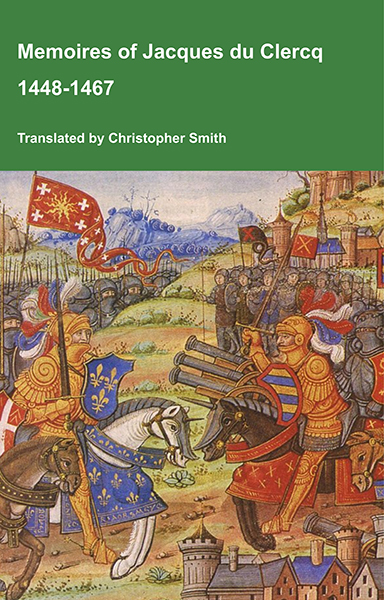
This is a translation of the 'Memoires of Jacques du Clercq', published in 1823 in two volumes, edited by Frederic, Baron de Reissenberg. In his introduction Reissenberg writes: 'Jacques du Clercq tells us that he was born in 1424, and that he was a licentiate in law and a counsellor to Philip the Good, Duke of Burgundy, in the castellany of Douai, Lille, and Orchies. It appears that he established his residence at Arras. In 1446, he married the daughter of Baldwin de la Lacherie, a gentleman who lived in Lille. We read in the fifth book of his Memoirs that his father, also named Jacques du Clercq, had married a lady of the Le Camelin family, from Compiègne. His ancestors, always attached to the counts of Flanders, had constantly served them, whether in their councils or in their armies.' The Memoires cover a period of nineteen years beginning in in 1448, ending in in 1467. It appears that the author had intended to extend the Memoirs beyond that date; no doubt illness or death prevented him from carrying out this plan. As Reissenberg writes the 'merit of this work lies in the simplicity of its narrative, in its tone of good faith, and in a certain air of frankness which naturally wins the reader’s confidence.' Du Clercq ranges from events of national and international importance, including events of the Wars of the Roses in England, to simple, everyday local events such as marriages, robberies, murders, trials and deaths, including that of his own father in Book 5; one of his last entries.
Available at Amazon in eBook and Paperback format.
Summary
28th November 1274. Hugh Mortimer 1st Baron Mortimer [aged 84] created.
28th November 1275. Son Robert Mortimer 2nd Baron Mortimer [aged 50] succeeded.
7th April 1287. Son Hugh Mortimer 3rd Baron Mortimer [aged 32] succeeded.
20th July 1304. Matilda Baroness Mortimer abeyant.
Before 28th November 1274 Hugh Mortimer 1st Baron Mortimer [aged 84] was created 1st Baron Mortimer Burford aka Richard's Castle. There is some doubt as to whether this Barony existed.
On or before 28th November 1275 Hugh Mortimer 1st Baron Mortimer [aged 85] died. His son Robert [aged 50] succeeded 2nd Baron Mortimer Burford aka Richard's Castle. Joyce Zouche Baroness Mortimer [aged 35] by marriage Baroness Mortimer Burford aka Richard's Castle.
On 7th April 1287 Robert Mortimer 2nd Baron Mortimer [aged 62] died at Richard's Castle, Herefordshire [Map]. He was buried at Worcester Cathedral [Map]. His son Hugh [aged 32] succeeded 3rd Baron Mortimer Burford aka Richard's Castle. Matilda Baroness Mortimer by marriage Baroness Mortimer Burford aka Richard's Castle.
On 20th July 1304 Hugh Mortimer 3rd Baron Mortimer [aged 49] died from poisoning, possibly by his wife Matilda Baroness Mortimer. He was buried in Worcester Cathedral [Map]. Baron Mortimer Burford aka Richard's Castle abeyant between his daughters Joan Mortimer Baroness Talbot and Alice Mortimer [aged 4] and their descendants. His wife sought the protection of Margaret of France Queen Consort England [aged 25]. After the death of King Edward I of England [aged 65] in 1307 she, Matilda Baroness Mortimer died suddenly, probably murdered in revenge for the murder of her husband.
Baron Mortimer of Chirk is also in Baronies of England Chronologically, Abeyant Baronies of England.
Summary
6th February 1299. Roger Mortimer 1st Baron Mortimer of Chirk [aged 43] created.
3rd August 1336. Son Roger de Mortimer 2nd Baron Mortimer succeeded.
3rd August 1336. Son John de Mortimer 3rd Baron Mortimer of Chirk succeeded.
1359. John de Mortimer 3rd Baron Mortimer of Chirk abeyant.
On 6th February 1299 Roger Mortimer 1st Baron Mortimer of Chirk [aged 43] was created 1st Baron Mortimer of Chirk by writ of summons.
On 3rd August 1336 Roger Mortimer 1st Baron Mortimer of Chirk [aged 80] died at the Tower of London [Map] after four and a half years imprisonment. He was buried at either Wigmore Abbey [Map] or St Augustine's Priory, Bristol [Map]. His son Roger succeeded 2nd Baron Mortimer of Chirk although he was never summoned to Parliament.
After 3rd August 1336 Roger de Mortimer 2nd Baron Mortimer died. His son John succeeded 3rd Baron Mortimer of Chirk. He was an infant at the time of his father's death. He was never summoned to Parliament.
After 1359 John de Mortimer 3rd Baron Mortimer of Chirk [deceased] died. Baron Mortimer of Chirk abeyant presumably. He had surrendered his claim to Chirk Castle [Map] in 1359 and lived in obscurity thereafter.