

Henrici Quinti, Angliæ Regis, Gesta, is a first-hand account of the Agincourt Campaign, and subsequent events to his death in 1422. The author of the first part was a Chaplain in King Henry's retinue who was present from King Henry's departure at Southampton in 1415, at the siege of Harfleur, the battle of Agincourt, and the celebrations on King Henry's return to London. The second part, by another writer, relates the events that took place including the negotiations at Troye, Henry's marriage and his death in 1422.
Available at Amazon in eBook and Paperback format.
Baronet Littleton is in Baronetcies of England Alphabetically.
Baronet Littleton of Stoke Milburgh in Suffolk is also in Baronetcies of England Chronologically, Extinct Baronetcies of England.
Summary
1642. Adam Littleton 1st Baronet [aged 52] created.
6th September 1647. Son Thomas Littleton 2nd Baronet [aged 26] succeeded.
12th April 1681. Son Thomas Littleton 3rd Baronet [aged 34] succeeded.
31st December 1709. Thomas Littleton 3rd Baronet extinct.
In 1642 Adam Littleton 1st Baronet [aged 52] was created 1st Baronet Littleton of Stoke Milburgh in Suffolk. Audrey Poyntz Lady Littleton [aged 50] by marriage Lady Littleton of Stoke Milburgh in Suffolk.
On 6th September 1647 Adam Littleton 1st Baronet [aged 57] died. His son Thomas [aged 26] succeeded 2nd Baronet Littleton of Stoke Milburgh in Suffolk. Anne Littleton Lady Littleton by marriage Lady Littleton of Stoke Milburgh in Suffolk.
On 12th April 1681 or 14th April 1681 Thomas Littleton 2nd Baronet [aged 60] died. His son Thomas [aged 34] succeeded 3rd Baronet Littleton of Stoke Milburgh in Suffolk
On 6th September 1682 Thomas Littleton 3rd Baronet [aged 35] and Anne Baun Lady Littleton were married. She by marriage Lady Littleton of Stoke Milburgh in Suffolk.
On 31st December 1709 Thomas Littleton 3rd Baronet [aged 62] died without issue. Baronet Littleton of Stoke Milburgh in Suffolk extinct. His estates were inherited by Elizabeth Littleton.
Baronet Littleton of Pillaton Hall is also in Baronetcies of England Chronologically, Extinct Baronetcies of England.
Summary
28th June 1657. Edward Littleton 1st Baronet [aged 58] created.
August 1657. Son Edward Littleton 2nd Baronet [aged 25] succeeded.
1709. Grandson Edward Littleton 3rd Baronet succeeded.
2nd January 1741. Half First Cousin Edward Littleton 4th Baronet [aged 14] succeeded.
18th May 1812. Edward Littleton 4th Baronet extinct.
Before 1632 Edward Littleton 1st Baronet [aged 32] and Hester Courteen Lady Littleton were married. She by marriage Lady Littleton of Pillaton Hall.
Before 1653 Edward Littleton 2nd Baronet [aged 20] and Mary Wrottesley Lady Littleton were married. She by marriage Lady Littleton of Pillaton Hall. They were half third cousin once removed.
On 28th June 1657 Edward Littleton 1st Baronet [aged 58] was created 1st Baronet Littleton of Pillaton Hall.
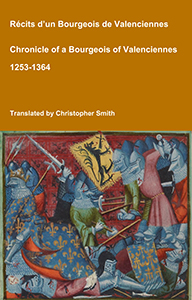
Chronicle of a Bourgeois of Valenciennes
Récits d’un bourgeois de Valenciennes aka The Chronicle of a Bourgeois of Valenciennes is a vivid 14th-century vernacular chronicle written by an anonymous urban chronicler from Valenciennes in the County of Hainaut. It survives in a manuscript that describes local and regional history from about 1253 to 1366, blending chronology, narrative episodes, and eyewitness-style accounts of political, military, and social events in medieval France, Flanders, and the Low Countries. The work begins with a chronological framework of events affecting Valenciennes and its region under rulers such as King Philip VI of France and the shifting allegiances of local nobility. It includes accounts of conflicts, sieges, diplomatic manoeuvres, and the impact of broader struggles like the Hundred Years’ War on urban life in Hainaut. Written from the perspective of a burgher (bourgeois) rather than a monastery or royal court, the chronicle offers a rare lay viewpoint on high politics and warfare, reflecting how merchants, townspeople, and civic institutions experienced the turbulence of the 13th and 14th centuries. Its narrative style combines straightforward reporting of events with moral and civic observations, making it a valuable source for readers interested in medieval urban society, regional politics, and the lived experience of war and governance in pre-modern Europe.
Available at Amazon in eBook and Paperback format.
In August 1657 Edward Littleton 1st Baronet [aged 58] died. His son Edward [aged 25] succeeded 2nd Baronet Littleton of Pillaton Hall.
In 1709 Edward Littleton 2nd Baronet [aged 77] died. His grandson Edward succeeded 3rd Baronet Littleton of Pillaton Hall.

On 2nd January 1741 Edward Littleton 3rd Baronet died. His half first cousin Edward [aged 14] succeeded 4th Baronet Littleton of Pillaton Hall.
On 18th May 1812 Edward Littleton 4th Baronet [aged 85] died without issue. Baronet Littleton of Pillaton Hall extinct. His estates were inherited by his great-nephew Edward John Walhouse aka Littleton 1st Baron Hatherton [aged 21] who took the surname Littleton.