

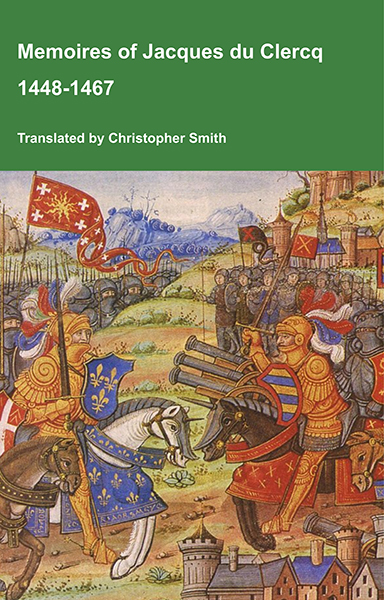
This is a translation of the 'Memoires of Jacques du Clercq', published in 1823 in two volumes, edited by Frederic, Baron de Reissenberg. In his introduction Reissenberg writes: 'Jacques du Clercq tells us that he was born in 1424, and that he was a licentiate in law and a counsellor to Philip the Good, Duke of Burgundy, in the castellany of Douai, Lille, and Orchies. It appears that he established his residence at Arras. In 1446, he married the daughter of Baldwin de la Lacherie, a gentleman who lived in Lille. We read in the fifth book of his Memoirs that his father, also named Jacques du Clercq, had married a lady of the Le Camelin family, from Compiègne. His ancestors, always attached to the counts of Flanders, had constantly served them, whether in their councils or in their armies.' The Memoires cover a period of nineteen years beginning in in 1448, ending in in 1467. It appears that the author had intended to extend the Memoirs beyond that date; no doubt illness or death prevented him from carrying out this plan. As Reissenberg writes the 'merit of this work lies in the simplicity of its narrative, in its tone of good faith, and in a certain air of frankness which naturally wins the reader’s confidence.' Du Clercq ranges from events of national and international importance, including events of the Wars of the Roses in England, to simple, everyday local events such as marriages, robberies, murders, trials and deaths, including that of his own father in Book 5; one of his last entries.
Available at Amazon in eBook and Paperback format.
Baronet Radclyffe of Derwentwater in Cumberland is in Baronetcies of England Alphabetically, Baronetcies of England Chronologically, Forfeit Baronetcies of England.
Summary
1620. Francis Radclyffe 1st Baronet (age 55) created.
23rd December 1622. Son Edward Radclyffe 2nd Baronet (age 33) succeeded.
13th December 1663. Son Francis Radclyffe 1st Earl Derwentwater (age 38) succeeded.
April 1697. Son Edward Radclyffe 2nd Earl Derwentwater (age 42) succeeded.
29th April 1705. Son James Radclyffe 3rd Earl Derwentwater (age 15) succeeded.
24th February 1716. James Radclyffe 3rd Earl Derwentwater forfeit. See 1715 Battle of Preston.
In 1620 Francis Radclyffe 1st Baronet (age 55) was created 1st Baronet Radclyffe of Derwentwater in Cumberland.
On 23rd December 1622 Francis Radclyffe 1st Baronet (age 57) died. His son Edward (age 33) succeeded 2nd Baronet Radclyffe of Derwentwater in Cumberland.
On 13th December 1663 Edward Radclyffe 2nd Baronet (age 74) died. His son Francis (age 38) succeeded 3rd Baronet Radclyffe of Derwentwater in Cumberland.
In April 1697 Francis Radclyffe 1st Earl Derwentwater (age 72) died. His son Edward (age 42) succeeded 2nd Earl Derwentwater, 4th Baronet Radclyffe of Derwentwater in Cumberland.
On 29th April 1705 Edward Radclyffe 2nd Earl Derwentwater (age 50) died. His son James (age 15) succeeded 3rd Earl Derwentwater, 5th Baronet Radclyffe of Derwentwater in Cumberland.
The 1715 Battle of Preston was the final action of the 1715 Jacobite Rebellion. It commenced on 9th November 1715 when Jacobite cavalry entered Preston, Lancashire [Map]. Royalist troops arrived in number over the next few days surrounding Preston forcing the Jacocobite surrender. 1463 were taken prisoner of which 463 were English. The Scottish prisoners included:
George Seton 5th Earl of Winton (age 38). The only prisoner to plead not guilty, sentenced to death, escaped from the Tower of London [Map] on 4th August 1716 around nine in the evening. Travelled to France then to Rome.
On 24th February 1716 William Gordon 6th Viscount Kenmure (age 44) was beheaded on Tower Hill [Map].
On 9th February 1716 William Maxwell 5th Earl Nithsale was sentenced to be executed on 24th February 1716. The night before his wife (age 36) effected his escape from the Tower of London [Map] by exchanging his clothes with those of her maid. They travelled to Paris then to Rome where the court of James "Old Pretender" Stewart (age 27) was.
James Radclyffe 3rd Earl Derwentwater (age 26) was imprisoned in the Tower of London [Map]. He was examined by the Privy Council on 10th January 1716 and impeached on 19th January 1716. He pleaded guilty in the expectation of clemency. He was attainted and condemned to death. Attempts were made to procure his pardon. His wife Anna Maria Webb Countess Derwentwater (age 24), her sister Mary Webb (age 21) [Note. Assumed to be her sister Mary], their aunt Anne Brudenell Duchess Richmond (age 45), Barbara Villiers 1st Duchess of Cleveland appealed to King George I (age 55) in person without success.
On 24th February 1716 James Radclyffe 3rd Earl Derwentwater was beheaded on Tower Hill [Map]. Earl Derwentwater, Baronet Radclyffe of Derwentwater in Cumberland forfeit.
William Murray 2nd Lord Nairne was tried on 9th February 1716 for treason, found guilty, attainted, and condemned to death. He survived long enough to benefit from the Indemnity Act of 1717.
General Thomas Forster of Adderstone (age 31) was attainted. He was imprisoned at Newgate Prison, London [Map] but escaped to France.
On 14th May 1716 Henry Oxburgh was hanged, drawn and quartered at Tyburn [Map]. He was buried at Church of St Gile's in the Fields. His head was spiked on Temple Bar.
The trials and sentences were overseen by the Lord High Steward William Cowper 1st Earl Cowper (age 50) for which he subsequently received his Earldom.
 Become a Member via our Buy Me a Coffee page to read more.