

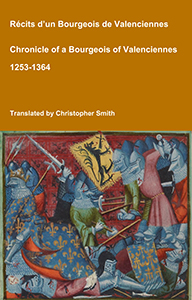
Chronicle of a Bourgeois of Valenciennes
Récits d’un bourgeois de Valenciennes aka The Chronicle of a Bourgeois of Valenciennes is a vivid 14th-century vernacular chronicle written by an anonymous urban chronicler from Valenciennes in the County of Hainaut. It survives in a manuscript that describes local and regional history from about 1253 to 1366, blending chronology, narrative episodes, and eyewitness-style accounts of political, military, and social events in medieval France, Flanders, and the Low Countries. The work begins with a chronological framework of events affecting Valenciennes and its region under rulers such as King Philip VI of France and the shifting allegiances of local nobility. It includes accounts of conflicts, sieges, diplomatic manoeuvres, and the impact of broader struggles like the Hundred Years’ War on urban life in Hainaut. Written from the perspective of a burgher (bourgeois) rather than a monastery or royal court, the chronicle offers a rare lay viewpoint on high politics and warfare, reflecting how merchants, townspeople, and civic institutions experienced the turbulence of the 13th and 14th centuries. Its narrative style combines straightforward reporting of events with moral and civic observations, making it a valuable source for readers interested in medieval urban society, regional politics, and the lived experience of war and governance in pre-modern Europe.
Available at Amazon in eBook and Paperback format.
Bishop of Bristol is in Bishop. See Bristol Cathedral [Map].
On 18th November 1554 Bishop John Holyman (age 59) was consecrated Bishop of Bristol.

On 13th November 1589 Bishop Richard Fletcher (age 44) was elected Bishop of Bristol.
On 14th December 1589 Bishop Richard Fletcher (age 44) was consecrated Bishop of Bristol.
In 1623 Bishop Robert Wright (age 63) was appointed Bishop of Bristol.
On 10th February 1633 Bishop George Coke (age 62) was consecrated Bishop of Bristol.

On 12th August 1684 Bishop John Lake (age 60) was translated to Bishop of Bristol.

In 1685 Bishop Jonathan Trelawny 3rd Baronet (age 34) was appointed Bishop of Bristol.
Before 1734 Bishop Charles Cecil (age 38) was appointed Bishop of Bristol.
On 19th October 1738 Bishop Joseph Butler (age 46) was elected Bishop of Bristol.
On 3rd December 1738 Bishop Joseph Butler (age 46) was consecrated Bishop of Bristol at Lambeth Palace [Map].
In 1782 Bishop Lewis Bagot (age 41) was appointed Bishop of Bristol.
Abbot John Whethamstede’s Chronicle of the Abbey of St Albans
Abbot John Whethamstede's Register aka Chronicle of his second term at the Abbey of St Albans, 1451-1461, is a remarkable text that describes his first-hand experience of the beginning of the Wars of the Roses including the First and Second Battles of St Albans, 1455 and 1461, respectively, their cause, and their consequences, not least on the Abbey itself. His text also includes Loveday, Blore Heath, Northampton, the Act of Accord, Wakefield, and Towton, and ends with the Coronation of King Edward IV. In addition to the events of the Wars of the Roses, Abbot John, or his scribes who wrote the Chronicle, include details in the life of the Abbey such as charters, letters, land exchanges, visits by legates, and disputes, which provide a rich insight into the day-to-day life of the Abbey, and the challenges faced by its Abbot.
Available at Amazon in eBook and Paperback format.
In 1783 Bishop Christopher Wilson (age 69) was appointed Bishop of Bristol which position he held until his death in 1792.
On 3rd June 1793 Bishop Spencer Madan (age 64) was consecrated Bishop of Bristol.
On 11th May 1794 Bishop Reginald Courtenay (age 52) was consecrated as Bishop of Bristol.
In 1803 Bishop George Pelham (age 36) was consecrated Bishop of Bristol.
In 1820 Bishop John Kaye (age 36) was appointed Bishop of Bristol.

In 1834 Bishop Joseph Allen (age 64) was appointed Bishop of Bristol.