

The History of William Marshal was commissioned by his son shortly after William’s death in 1219 to celebrate the Marshal’s remarkable life; it is an authentic, contemporary voice. The manuscript was discovered in 1861 by French historian Paul Meyer. Meyer published the manuscript in its original Anglo-French in 1891 in two books. This book is a line by line translation of the first of Meyer’s books; lines 1-10152. Book 1 of the History begins in 1139 and ends in 1194. It describes the events of the Anarchy, the role of William’s father John, John’s marriages, William’s childhood, his role as a hostage at the siege of Newbury, his injury and imprisonment in Poitou where he met Eleanor of Aquitaine and his life as a knight errant. It continues with the accusation against him of an improper relationship with Margaret, wife of Henry the Young King, his exile, and return, the death of Henry the Young King, the rebellion of Richard, the future King Richard I, war with France, the death of King Henry II, and the capture of King Richard, and the rebellion of John, the future King John. It ends with the release of King Richard and the death of John Marshal.
Available at Amazon in eBook and Paperback format.
Bishop of Dorchester is in Bishop. See Dorchester on Thames, Oxfordshire [Map].
In 634 Bishop Birinus of Dorchester came to England landing at Hamwic where he founded St Mary's Church, Southampton. He was appointed Bishop of Dorchester.
In 650 Bishop Egelbert [aged 25] was appointed Bishop of Dorchester.
Anglo-Saxon Chronicle. 650. This year Egelbert [aged 25], from Gaul, after Birinus the Romish bishop, obtained the bishopric of the West-Saxons.
Anglo-Saxon Chronicle. 660. This year Bishop Egelbert [aged 35] departed from Kenwal; and Wina held the bishopric three years. And Egbert accepted the bishopric of Paris, in Gaul, by the Seine.
In 660 Bishop Wine of London was translated to Bishop of Dorchester. Possibly.
Anglo-Saxon Chronicle. 670. This year died Oswy [aged 58], King of Northumberland, on the fifteenth day before the calends of March; and Egferth [aged 25] his son reigned after him. Lothere, the nephew of Bishop Egelbert [aged 45], succeeded to the bishopric over the land of the West-Saxons, and held it seven years. He was consecrated by Archbishop Theodore [aged 68]. Oswy was the son of Ethelfrith, Ethelfrith of Ethelric, Ethelric of Ida, Ida of Eoppa.
In 670 Bishop Lothere was appointed Bishop of Dorchester.
After 934 Archbishop Oscytel was elected Bishop of Dorchester.
In 1016 Bishop Æthelric was consecrated Bishop of Dorchester.
In 1034 Bishop Eadnoth was consecrated Bishop of Dorchester.
In 1049 Bishop Ulf aka Ulfus Normanus was consecrated Bishop of Dorchester.
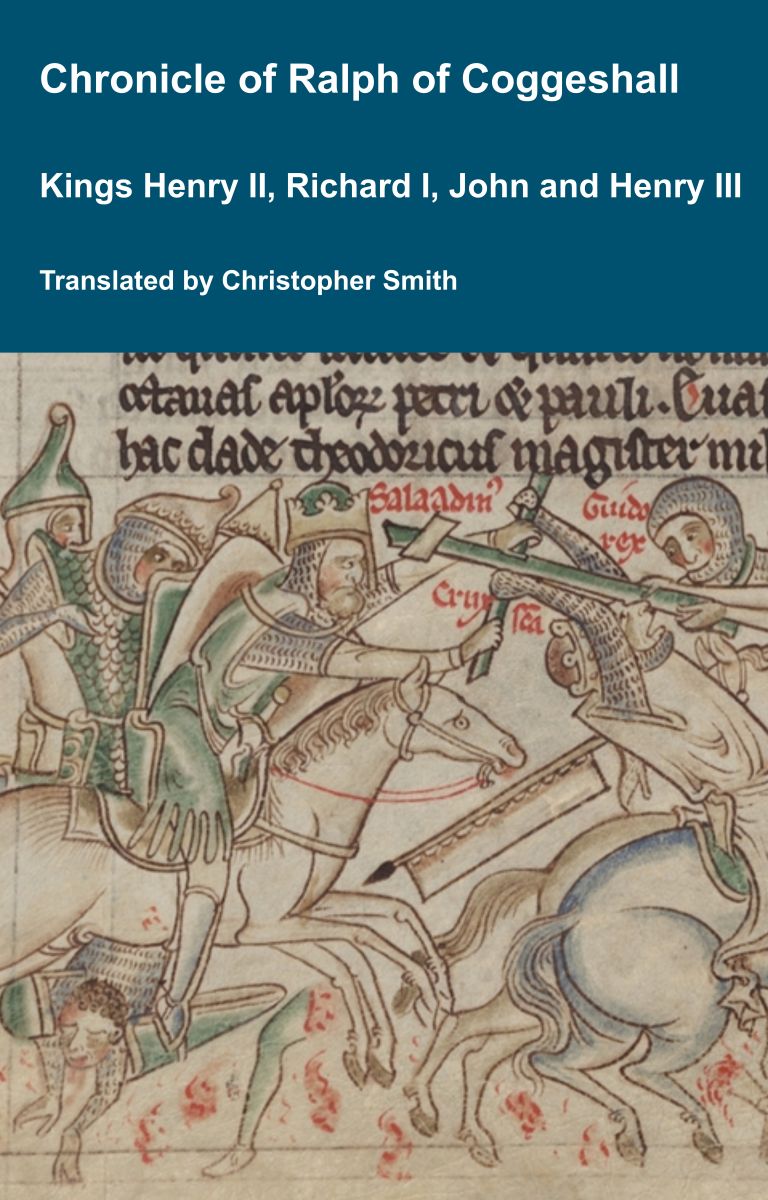
Chronicle of Abbot Ralph of Coggeshall
The Chronicle of Abbot Ralph of Coggeshall (Chronicon Anglicanum) is an indispensable medieval history that brings to life centuries of English and European affairs through the eyes of a learned Cistercian monk. Ralph of Coggeshall, abbot of the Abbey of Coggeshall in Essex in the early 13th century, continued and expanded his community’s chronicle, documenting events from the Norman Conquest of 1066 into the tumultuous reign of King Henry III. Blending eyewitness testimony, careful compilation, and the monastic commitment to record-keeping, this chronicle offers a rare narrative of political intrigue, royal power struggles, and social upheaval in England and beyond. Ralph’s work captures the reigns of pivotal figures such as Richard I and King John, providing invaluable insights into their characters, decisions, and the forces that shaped medieval rule. More than a simple annal, Chronicon Anglicanum conveys the texture of medieval life and governance, making it a rich source for scholars and readers fascinated by English history, monastic authorship, and the shaping of the medieval world.
Available at Amazon in eBook and Paperback format.
In 1053 Bishop Wulfwy was elected Bishop of Dorchester.
Anglo-Saxon Chronicle. 15th April 1053. In this year was the king [aged 50] at Winchester, Hampshire [Map], at Easter; and Earl Godwin [aged 52] with him, and Earl Harold [aged 31] his son, and Tosty [aged 27]. On the day after Easter sat he with the king at table; when he suddenly sunk beneath against the foot-rail, deprived of speech and of all his strength. He was brought into the king's chamber; and they supposed that it would pass over: but it was not so. He continued thus speechless and helpless till the Thursday; when he resigned his life, on the seventeenth before the calends of May; and he was buried at Winchester in the old minster. Earl Harold, his son, took to the earldom that his father had before, and to all that his father possessed; whilst Earl Elgar took to the earldom that Harold had before. The Welshmen this year slew a great many of the warders of the English people at Westbury, Wiltshire [Map]. This year there was no archbishop in this land: but Bishop Stigand held the see of Canterbury at Christ church, and Kinsey that of York. Leofwine and Wulfwy went over sea, and had themselves consecrated bishops there. Wulfwy took to the bishopric which Ulf had whilst he was living and in exile.
Bede. In short, we afterwards saw five bishops taken out of that monastery, and all of them men of singular merit and sanctity, whose names were Bosa, Eda, Oftfor, John, and Wilfrid. We have above taken notice, that the first of them was consecrated bishop at York; of the second, it is to be observed that he was appointed bishop of Dorchester. Of the two last we shall speak hereafter, as they were consecrated: the first was bishop of Hagulstad [Map], the second of the church of York; of the third we will here take notice, that having applied himself to the reading and observation of the Scriptures, in both the monasteries of Hilda, at length being desirous to attain to greater perfection, he went into Kent, to Archbishop Theodore, of blessed memory; where having spent some more time in sacred studies, he also resolved to go to Rome, which, in those days, was reckoned of great moment: returning thence into Britain, he took his way into the province of the Wiccii, where King Osric then ruled, and continued there a long time, preaching the word of faith, and making himself an example of ofood life to all that saw and heard him. At that time, Bosel, the bishop of that province, laboured under such weakness of body, that he could not himself perform the episcopal functions; for which reason, this Oftfor was, by universal consent, chosen bishop in his stead, and by order of King Ethelred, consecrated by Bishop Wilfrid, of blessed memory, who was then bishop of the Midland Angles, because Archbishop Theodore was dead, and no other bishop ordained in his place. Before the aforesaid man of God, Bosel, Tatfrid, a most learned and indus- trious man, and of excellent ability, had been chosen bishop there, from the same abbess's monastery, but had been snatched away by an untimely death, before he could be ordained.