

The History of William Marshal was commissioned by his son shortly after William’s death in 1219 to celebrate the Marshal’s remarkable life; it is an authentic, contemporary voice. The manuscript was discovered in 1861 by French historian Paul Meyer. Meyer published the manuscript in its original Anglo-French in 1891 in two books. This book is a line by line translation of the first of Meyer’s books; lines 1-10152. Book 1 of the History begins in 1139 and ends in 1194. It describes the events of the Anarchy, the role of William’s father John, John’s marriages, William’s childhood, his role as a hostage at the siege of Newbury, his injury and imprisonment in Poitou where he met Eleanor of Aquitaine and his life as a knight errant. It continues with the accusation against him of an improper relationship with Margaret, wife of Henry the Young King, his exile, and return, the death of Henry the Young King, the rebellion of Richard, the future King Richard I, war with France, the death of King Henry II, and the capture of King Richard, and the rebellion of John, the future King John. It ends with the release of King Richard and the death of John Marshal.
Available at Amazon in eBook and Paperback format.
Bishop of Durham is in Bishop. See Durham Cathedral [Map].
In 995 Bishop Aldun of Northumbria was appointed Bishop of Durham.
Before 11th January 1041 Bishop Æthelric was elected Bishop of Durham.
On 11th January 1041 Bishop Æthelric was consecrated Bishop of Durham at York Minster [Map].
In 1056 Bishop Æthelwine was consecrated Bishop of Durham having been supported in his election by Tostig Godwinson Earl Northumbria [aged 30].
In 1056 Bishop Æthelwine was elected Bishop of Durham.
In 1056 Bishop Æthelwine was consecrated Bishop of Durham.
On 15th October 1072 Bishop Walchere of Lorraine aka Lotharingia was appointed Bishop of Durham.
In 1153 Bishop Hugh de Puiset [aged 28] was elected Bishop of Durham despite opposition from Archbishop Henry Murdac.
From 1183, or thereabouts, Auckland Palace aka Castle [Map] became the residence of the Bishop of Durham.
Chronicle of Walter of Guisborough
A canon regular of the Augustinian Guisborough Priory, Yorkshire, formerly known as The Chronicle of Walter of Hemingburgh, describes the period from 1066 to 1346. Before 1274 the Chronicle is based on other works. Thereafter, the Chronicle is original, and a remarkable source for the events of the time. This book provides a translation of the Chronicle from that date. The Latin source for our translation is the 1849 work edited by Hans Claude Hamilton. Hamilton, in his preface, says: 'In the present work we behold perhaps one of the finest samples of our early chronicles, both as regards the value of the events recorded, and the correctness with which they are detailed; Nor will the pleasing style of composition be lightly passed over by those capable of seeing reflected from it the tokens of a vigorous and cultivated mind, and a favourable specimen of the learning and taste of the age in which it was framed.'
Available at Amazon in eBook and Paperback format.
On 22nd July 1228 Bishop Richard Poore was translated to Bishop of Durham.
On 2nd January 1241 Bishop Nicholas Farnham was elected Bishop of Durham. At first he wanted to decline the office, but Bishop Robert Grosseteste [aged 73], Bishop of Lincoln persuaded him to accept.
On 26th May 1241 or 9th June 1241 Bishop Nicholas Farnham was consecrated Bishop of Durham.
Chronica Majora by Matthew Paris. The confirmation of Master Nicholas of Farnhamy in the bishopric of Durham
On the 9th of June, in this year. Master Nicholas of Farnham, bishop elect of Durham, was consecrated bishop of that see in St. Oswald's church [Map] at Gloucester, by Walter, archbishop of York [aged 61], in the presence of the king [aged 33] and queen [aged 18], with numerous bishops and abbats. But inasmuch as a question had been mooted concerning his profession, amongst some who wished to excite discord, the said Nicholas refused to claim a liberty that was not his due, or to show himself insolent or recalcitrant; he therefore, at his consecration, in public, before all the prelates and nobles, and in the presence of his metropolitan, the said Archbishop Walter, solemnly and distinctly made his profession in a loud voice, according to custom, as follows; "I Nicholas, bishop elect of the church of Durham, acknowledge canonical subjection, reverence, and obedience to the church of York, and to you, father Walter, its archbishop, and this I subscribe with my own hand." He then immediately, in the presence of all assembled, marked the sign of the cross in ink at the head of the charter, and delivered the same to the archbishop to be kept in his possession in his treasury.
On 2nd February 1249 Bishop Nicholas Farnham resigned as Bishop of Durham.
On 24th September 1274 Bishop Robert of Holy Island was elected Bishop of Durham.
On 9th December 1274 Bishop Robert of Holy Island was consecrated Bishop of Durham.
On 9th July 1283 Bishop Antony Bek [aged 38] was elected Bishop of Durham.
On 9th January 1284 Bishop Antony Bek [aged 39] was consecrated Bishop of Durham at which time he also had the remains of Saint William of York moved to a new shrine in York Minster [Map].
On 31st March 1311 Bishop Richard Kellaw was elected Bishop of Durham.
On 30th May 1311 Bishop Richard Kellaw was consecrated Bishop of Durham.
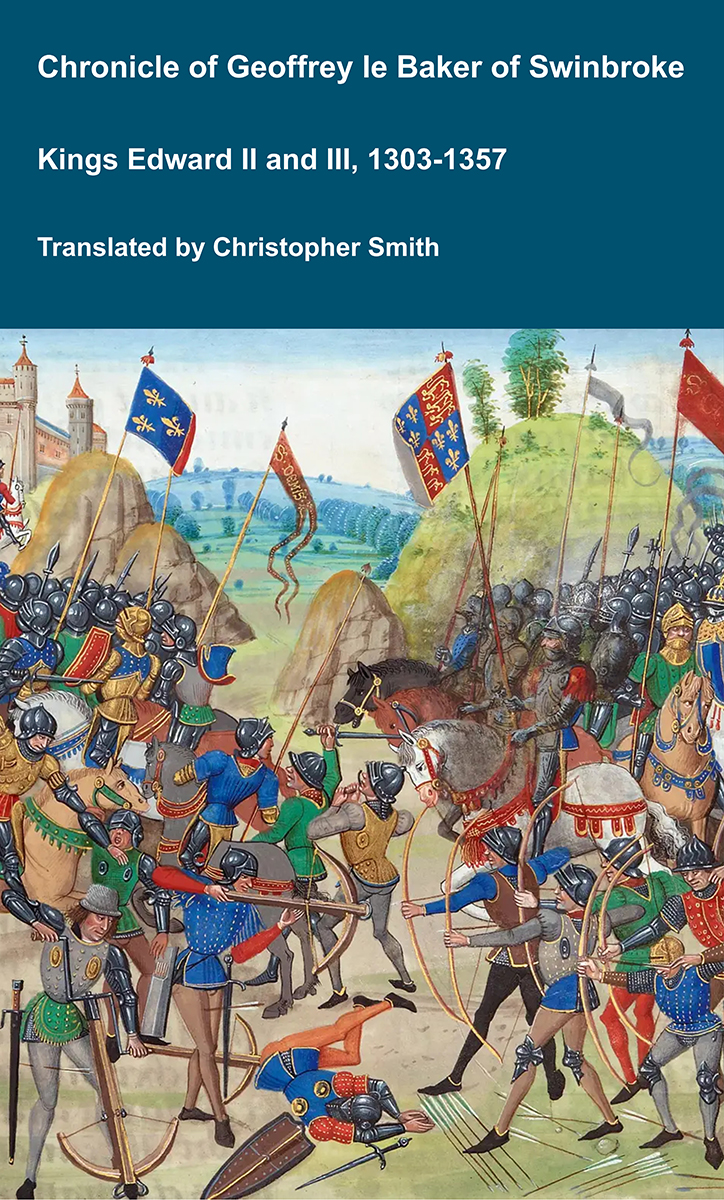
Chronicle of Geoffrey le Baker of Swinbroke
Baker was a secular clerk from Swinbroke, now Swinbrook, an Oxfordshire village two miles east of Burford. His Chronicle describes the events of the period 1303-1356: Gaveston, Bannockburn, Boroughbridge, the murder of King Edward II, the Scottish Wars, Sluys, Crécy, the Black Death, Winchelsea and Poitiers. To quote Herbert Bruce 'it possesses a vigorous and characteristic style, and its value for particular events between 1303 and 1356 has been recognised by its editor and by subsequent writers'. The book provides remarkable detail about the events it describes. Baker's text has been augmented with hundreds of notes, including extracts from other contemporary chronicles, such as the Annales Londonienses, Annales Paulini, Murimuth, Lanercost, Avesbury, Guisborough and Froissart to enrich the reader's understanding. The translation takes as its source the 'Chronicon Galfridi le Baker de Swynebroke' published in 1889, edited by Edward Maunde Thompson.
Available at Amazon in eBook and Paperback format.
In September 1333 Bishop Richard de Bury [aged 46] was appointed Bishop of Durham.
On 8th May 1345 Bishop Thomas of Hatfield [aged 35] was elected Bishop of Durham.
On 7th August 1345 Bishop Thomas of Hatfield [aged 35] was consecrated Bishop of Durham.
On 9th September 1381 Bishop John Fordham was elected Bishop of Durham.
On 5th January 1382 Bishop John Fordham was consecrated Bishop of Durham.
In 1437 Bishop Robert Neville was appointed Bishop of Durham.
On 25th September 1457 Archbishop Lawrence Booth [aged 37] was appointed Bishop of Durham.
On 31st July 1476 Bishop William Dudley [aged 51] was appointed Bishop of Durham.
In 1494 Bishop Richard Foxe [aged 46] was elected Bishop of Durham.
On 21st February 1499 Edmund Tudor 1st Duke of Somerset was born to King Henry VII of England and Ireland [aged 42] and Elizabeth York Queen Consort England [aged 33] at the Palace of Placentia, Greenwich [Map] being their sixth child. On 24th February 1499 he was christened at the Church of the Observant Friars, Greenwich [Map]. His godparents were Margaret Beaufort Countess Richmond [aged 55], Edward Stafford 3rd Duke of Buckingham [aged 21] and Bishop Richard Foxe [aged 51], then Bishop of Durham. He is believed to have been created 1st Duke Somerset on the same day although there is no documentation. He died aged one in 1500.


On 27th June 1502 Bishop William Senhouse was translated to Bishop of Durham.
In 1509 Bishop Thomas Ruthall [aged 37] was appointed Bishop of Durham by King Henry VIII of England and Ireland [aged 17].
Chronicle of a Bourgeois of Valenciennes
Récits d’un bourgeois de Valenciennes aka The Chronicle of a Bourgeois of Valenciennes is a vivid 14th-century vernacular chronicle written by an anonymous urban chronicler from Valenciennes in the County of Hainaut. It survives in a manuscript that describes local and regional history from about 1253 to 1366, blending chronology, narrative episodes, and eyewitness-style accounts of political, military, and social events in medieval France, Flanders, and the Low Countries. The work begins with a chronological framework of events affecting Valenciennes and its region under rulers such as King Philip VI of France and the shifting allegiances of local nobility. It includes accounts of conflicts, sieges, diplomatic manoeuvres, and the impact of broader struggles like the Hundred Years’ War on urban life in Hainaut. Written from the perspective of a burgher (bourgeois) rather than a monastery or royal court, the chronicle offers a rare lay viewpoint on high politics and warfare, reflecting how merchants, townspeople, and civic institutions experienced the turbulence of the 13th and 14th centuries. Its narrative style combines straightforward reporting of events with moral and civic observations, making it a valuable source for readers interested in medieval urban society, regional politics, and the lived experience of war and governance in pre-modern Europe.
Available at Amazon in eBook and Paperback format.
On 25th March 1530 Bishop Cuthbert Tunstall [aged 56] was translated to Bishop of Durham.
Henry Machyn's Diary. 28th September 1559. The xxviij day of September, was Myghellmas-evyn, was the old bysshope of Durram doctur Dunstall [aged 85] was deposyd of hys bysshope-pryke of Durram, be-cause he shuld not reseyff the rentes for that quarter.
Henry Machyn's Diary. 29th February 1560. The xxix of Feybruary was bered in sant Martens parryche the wyff [aged 40] of master (blank) Cage [aged 45] sarter [salter], and he gayff xx ... gownes and xij mantyll frys gownes unto xij pore women, and xij clarkes syngyng; and master Pylkyngton [aged 40] dyd pryche, the nuw byshope of Wynchastur [Note. He was elected Bishop of Winchester but he declined it. He was subsequently elected Bishop of Durham], and after a dolle of money, a j d. a-pesse.
On 26th December 1560 Bishop James Pilkington [aged 40] was elected Bishop of Durham which position he held until his death in 1576.
On 2nd March 1561 Bishop James Pilkington [aged 41] was consecrated Bishop of Durham.
On 10th April 1561 Bishop James Pilkington [aged 41] was enthroned Bishop of Durham.
In 1617 Archbishop Richard Neale [aged 54] was elected Bishop of Durham.
In June 1632 Bishop Thomas Morton [aged 68] was appointed Bishop of Durham. Parliament deprived him of the see in 1647.
On 5th November 1660 Bishop John Cosins [aged 65] was elected Bishop of Durham.
On 2nd December 1660 Bishop John Cosins [aged 66] was consecrated Bishop of Durham.
On 8th December 1660 Bishop John Cosins [aged 66] was enthroned Bishop of Durham.
The Deeds of the Dukes of Normandy
The Gesta Normannorum Ducum [The Deeds of the Dukes of Normandy] is a landmark medieval chronicle tracing the rise and fall of the Norman dynasty from its early roots through the pivotal events surrounding the Norman Conquest of England. Originally penned in Latin by the monk William of Jumièges shortly before 1060 and later expanded at the behest of William the Conqueror, the work chronicles the deeds, politics, battles, and leadership of the Norman dukes, especially William’s own claim to the English throne. The narrative combines earlier historical sources with firsthand information and oral testimony to present an authoritative account of Normandy’s transformation from a Viking settlement into one of medieval Europe’s most powerful realms. William’s history emphasizes the legitimacy, military prowess, and governance of the Norman line, framing their expansion, including the conquest of England, as both divinely sanctioned and noble in purpose. Later chroniclers such as Orderic Vitalis and Robert of Torigni continued the history, extending the coverage into the 12th century, providing broader context on ducal rule and its impact. Today this classic work remains a foundational source for understanding Norman identity, medieval statesmanship, and the historical forces that reshaped England and Western Europe between 800AD and 1100AD.
Available at Amazon in eBook and Paperback format.
John Evelyn's Diary. 14th November 1668. To London, invited to the consecration of that excellent person, the Dean of Ripon, Dr. Wilkins [aged 54], now made Bishop of Chester; it was at Ely House, the Archbishop of Canterbury [aged 70], Dr. Cosin [aged 73], Bishop of Durham, the Bishops of Ely [aged 77], Salisbury, Rochester [aged 43], and others officiating. Dr. Tillotson [aged 38] preached. Then, we went to a sumptuous dinner in the hall, where were the Duke of Buckingham [aged 40], Judges, Secretaries of State, Lord-Keeper, Council, Noblemen, and innumerable other company, who were honorers of this incomparable man, universally beloved by all who knew him.


In 1674 Bishop Nathaniel Crew 3rd Baron Crew [aged 40] was appointed Bishop of Durham.


John Evelyn's Diary. 1st March 1686. Came Sir Gilbert Gerrard to treate with me about his sonn's marrying my daughter Susanna [aged 17]. The father being obnoxious, and in some suspicion and displeasure of the King [aged 52], I would receive no proposal till his Ma* had given me leave, wch he was pleas'd to do; but after severall meetings we brake off on his not being willing to secure any thing competent for my daughter's children; besides that I found most of his estate was in ye coal pits as far off as Newcastle, and on leases from the Bishop of Durham, who had power to make concurrent leases, with other difficulties.


In 1722 Bishop William Talbot [aged 64] was appointed Bishop of Durham.
Before 9th October 1750 Bishop Joseph Butler [aged 58] was translated to Bishop of Durham.
On 9th October 1750 Bishop Joseph Butler [aged 58] was enthroned Bishop of Durham by proxy.
In 1771 Bishop John Egerton [aged 49] was appointed Bishop of Durham.
On 25th June 1791 Bishop Shute Barrington [aged 57] was elected Bishop of Durham.


In 1826 Bishop William van Mildert [aged 60] was translated to Bishop of Durham.
In 1837 Bishop Edward Maltby [aged 66] was elected Bishop of Durham.
Chronicle of Geoffrey le Baker of Swinbroke
Baker was a secular clerk from Swinbroke, now Swinbrook, an Oxfordshire village two miles east of Burford. His Chronicle describes the events of the period 1303-1356: Gaveston, Bannockburn, Boroughbridge, the murder of King Edward II, the Scottish Wars, Sluys, Crécy, the Black Death, Winchelsea and Poitiers. To quote Herbert Bruce 'it possesses a vigorous and characteristic style, and its value for particular events between 1303 and 1356 has been recognised by its editor and by subsequent writers'. The book provides remarkable detail about the events it describes. Baker's text has been augmented with hundreds of notes, including extracts from other contemporary chronicles, such as the Annales Londonienses, Annales Paulini, Murimuth, Lanercost, Avesbury, Guisborough and Froissart to enrich the reader's understanding. The translation takes as its source the 'Chronicon Galfridi le Baker de Swynebroke' published in 1889, edited by Edward Maunde Thompson.
Available at Amazon in eBook and Paperback format.
In 1856 Archbishop Charles Longley [aged 61] was consecrated Bishop of Durham.


In 1861 Bishop Charles Baring [aged 53] was appointed Bishop of Durham.
In 1875 Bishop Joseph Barber Lightfoot [aged 46] was consecrated Bishop of Durham.
On 15th May 1875 Bishop Joseph Barber Lightfoot [aged 47] was enthroned as Bishop of Durham.
On 6th July 1984 Bishop David Jenkins [aged 59] was consecrated Bishop of Durham.