

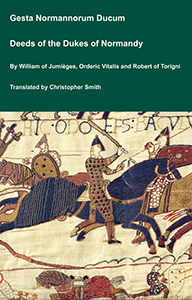
The Deeds of the Dukes of Normandy
The Gesta Normannorum Ducum [The Deeds of the Dukes of Normandy] is a landmark medieval chronicle tracing the rise and fall of the Norman dynasty from its early roots through the pivotal events surrounding the Norman Conquest of England. Originally penned in Latin by the monk William of Jumièges shortly before 1060 and later expanded at the behest of William the Conqueror, the work chronicles the deeds, politics, battles, and leadership of the Norman dukes, especially William’s own claim to the English throne. The narrative combines earlier historical sources with firsthand information and oral testimony to present an authoritative account of Normandy’s transformation from a Viking settlement into one of medieval Europe’s most powerful realms. William’s history emphasizes the legitimacy, military prowess, and governance of the Norman line, framing their expansion, including the conquest of England, as both divinely sanctioned and noble in purpose. Later chroniclers such as Orderic Vitalis and Robert of Torigni continued the history, extending the coverage into the 12th century, providing broader context on ducal rule and its impact. Today this classic work remains a foundational source for understanding Norman identity, medieval statesmanship, and the historical forces that reshaped England and Western Europe between 800AD and 1100AD.
Available at Amazon in eBook and Paperback format.
Bishop of Exeter is in Bishop. See Exeter Cathedral [Map].
On 11th August 1107 Bishop William Warelwast was elected Bishop of Exeter.
On 10th February 1194 Bishop Henry Marshal (age 46) was appointed Bishop of Exeter.
Around 13th April 1214 Bishop Simon Apulia was elected Bishop of Exeter.
On 5th October 1214 Bishop Simon Apulia was consecrated as Bishop of Exeter.
Around 1220 Bishop Walter Branscombe was elected Bishop of Exeter.
On 23rd February 1258 Bishop Walter Branscombe (age 38) was elected Bishop of Exeter.
On 10th March 1258 Bishop Walter Branscombe (age 38) was ordained priest and was consecrated Bishop of Exeter by Archbishop Boniface Savoy (age 51).
On 14th April 1258 Bishop Walter Branscombe (age 38) was enthroned Bishop of Exeter at Exeter Cathedral [Map].
In 1308 Bishop Walter Stapledon (age 46) was appointed Bishop of Exeter.
William of Worcester's Chronicle of England
William of Worcester, born around 1415, and died around 1482 was secretary to John Fastolf, the renowned soldier of the Hundred Years War, during which time he collected documents, letters, and wrote a record of events. Following their return to England in 1440 William was witness to major events. Twice in his chronicle he uses the first person: 1. when writing about the murder of Thomas, 7th Baron Scales, in 1460, he writes '… and I saw him lying naked in the cemetery near the porch of the church of St. Mary Overie in Southwark …' and 2. describing King Edward IV's entry into London in 1461 he writes '… proclaimed that all the people themselves were to recognize and acknowledge Edward as king. I was present and heard this, and immediately went down with them into the city'. William’s Chronicle is rich in detail. It is the source of much information about the Wars of the Roses, including the term 'Diabolical Marriage' to describe the marriage of Queen Elizabeth Woodville’s brother John’s marriage to Katherine, Dowager Duchess of Norfolk, he aged twenty, she sixty-five or more, and the story about a paper crown being placed in mockery on the severed head of Richard, 3rd Duke of York.
Available at Amazon in eBook and Paperback format.
On 5th December 1326 Bishop James Berkeley was appointed Bishop of Exeter; see 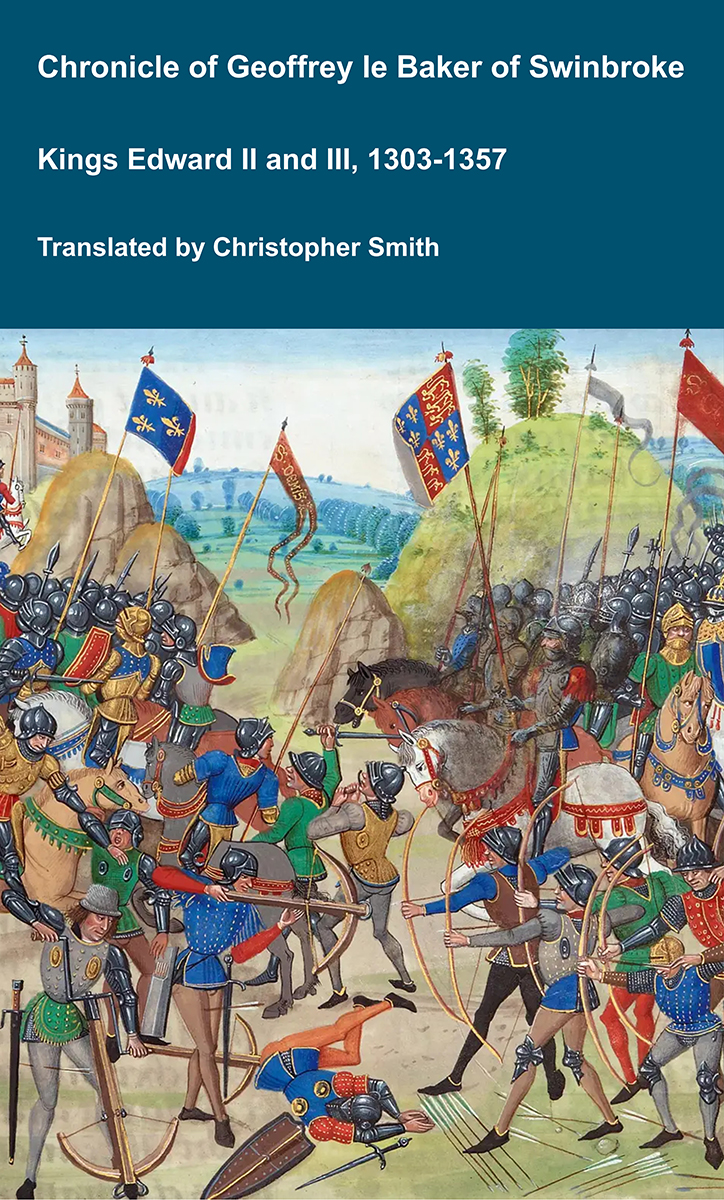 Chronicle of Geoffrey le Baker.
On 10th August 1327 Bishop John Grandison 3rd Baron Grandison (age 35) was appointed Bishop of Exeter.
On 18th October 1327 Bishop John Grandison 3rd Baron Grandison (age 35) was consecrated Bishop of Exeter.
On 5th March 1370 Bishop Thomas de Brantingham was appointed Bishop of Exeter.
On 12th May 1370 Bishop Thomas de Brantingham was consecrated Bishop of Exeter.
On 15th January 1395 Bishop Edmund Stafford (age 51) was appointed Bishop of Exeter.
In 1458 Archbishop George Neville (age 26) was appointed Bishop of Exeter.
On 3rd December 1458 Archbishop George Neville (age 26) was consecrated as Bishop of Exeter.
On 15th March 1465 Bishop John Booth was appointed Bishop of Exeter.
In 1478 Bishop Peter Courtenay was appointed Bishop of Exeter.
On 29th January 1487 Bishop Richard Foxe (age 39) was elected Bishop of Exeter. He was consecrate on 8th April 1487.
Chronicle of Geoffrey le Baker of Swinbroke
Baker was a secular clerk from Swinbroke, now Swinbrook, an Oxfordshire village two miles east of Burford. His Chronicle describes the events of the period 1303-1356: Gaveston, Bannockburn, Boroughbridge, the murder of King Edward II, the Scottish Wars, Sluys, Crécy, the Black Death, Winchelsea and Poitiers. To quote Herbert Bruce 'it possesses a vigorous and characteristic style, and its value for particular events between 1303 and 1356 has been recognised by its editor and by subsequent writers'. The book provides remarkable detail about the events it describes. Baker's text has been augmented with hundreds of notes, including extracts from other contemporary chronicles, such as the Annales Londonienses, Annales Paulini, Murimuth, Lanercost, Avesbury, Guisborough and Froissart to enrich the reader's understanding. The translation takes as its source the 'Chronicon Galfridi le Baker de Swynebroke' published in 1889, edited by Edward Maunde Thompson.
Available at Amazon in eBook and Paperback format.
On 1st October 1492 Bishop Oliver King (age 60) was appointed Bishop of Exeter.
On 1st October 1492 Bishop William Smyth (age 32) was appointed Bishop of Lichfield and Coventry.
On 3rd February 1493 Bishop Oliver King (age 61) was consecrated Bishop of Exeter.
On 6th November 1495 Bishop Richard Redman was translated to Bishop of Exeter.
On 24th November 1504 Bishop Hugh Oldham (age 52) was elected Bishop of Exeter.
On 12th January 1505 Bishop Hugh Oldham (age 53) was consecrated Bishop of Exeter.
In 1519 Bishop John Vesey aka Harman (age 57) was appointed Bishop of Exeter.
On 4th September 1555 Bishop Edmund "Bloody" Bonner of London (age 55) consecrated an Archbishop and two Bishops at St Paul's Cathedral [Map]:
Archbishop Hugh Curwen (age 55) was consecrated Archbishop of Dublin.
Bishop James Turbeville was consecrated Bishop of Exeter.
Bishop William Glynne (age 51) was consecrated Bishop of Bangor.
On 20th May 1560 Bishop William Alley (age 50) was elected Bishop of Exeter on the recommendation of Queen Elizabeth I of England and Ireland (age 26). Henry Machyn in his diary of 02 Apr 1560 refers to Bishop William Alley as being 'bishop elect of Exeter'.


On 14th July 1560 Bishop William Alley (age 50) was consecrated Bishop of Exeter.
In 1627 Bishop Joseph Hall (age 52) was appointed Bishop of Exeter.
On 3rd November 1660 Bishop John Gauden was elected Bishop of Exeter.
William of Worcester's Chronicle of England
William of Worcester, born around 1415, and died around 1482 was secretary to John Fastolf, the renowned soldier of the Hundred Years War, during which time he collected documents, letters, and wrote a record of events. Following their return to England in 1440 William was witness to major events. Twice in his chronicle he uses the first person: 1. when writing about the murder of Thomas, 7th Baron Scales, in 1460, he writes '… and I saw him lying naked in the cemetery near the porch of the church of St. Mary Overie in Southwark …' and 2. describing King Edward IV's entry into London in 1461 he writes '… proclaimed that all the people themselves were to recognize and acknowledge Edward as king. I was present and heard this, and immediately went down with them into the city'. William’s Chronicle is rich in detail. It is the source of much information about the Wars of the Roses, including the term 'Diabolical Marriage' to describe the marriage of Queen Elizabeth Woodville’s brother John’s marriage to Katherine, Dowager Duchess of Norfolk, he aged twenty, she sixty-five or more, and the story about a paper crown being placed in mockery on the severed head of Richard, 3rd Duke of York.
Available at Amazon in eBook and Paperback format.
On 2nd December 1660 Bishop John Gauden was consecrated Bishop of Exeter.
In 1667 Anthony Sparrow (age 55) was appointed Bishop of Exeter.
In 1676 Archbishop Thomas Lamplugh (age 61) was appointed Bishop of Exeter.

In 1689 Bishop Jonathan Trelawny 3rd Baronet (age 38) was appointed Bishop of Exeter.
In 1717 Archdeacon Lancelot Blackburne (age 58) was appointed Bishop of Exeter.

In 1724 Bishop Stephen Weston (age 59) was appointed Bishop of Exeter.
In 1762 Bishop Frederick Keppel (age 33) was appointed Bishop of Exeter.
In 1792 Bishop William Buller (age 57) was elected Bishop of Exeter.
In March 1797 Bishop Reginald Courtenay (age 55) was appointed Bishop of Exeter.

In 1803 Bishop John Fisher (age 55) was consecrated Bishop of Exeter.
Abbot John Whethamstede’s Chronicle of the Abbey of St Albans
Abbot John Whethamstede's Register aka Chronicle of his second term at the Abbey of St Albans, 1451-1461, is a remarkable text that describes his first-hand experience of the beginning of the Wars of the Roses including the First and Second Battles of St Albans, 1455 and 1461, respectively, their cause, and their consequences, not least on the Abbey itself. His text also includes Loveday, Blore Heath, Northampton, the Act of Accord, Wakefield, and Towton, and ends with the Coronation of King Edward IV. In addition to the events of the Wars of the Roses, Abbot John, or his scribes who wrote the Chronicle, include details in the life of the Abbey such as charters, letters, land exchanges, visits by legates, and disputes, which provide a rich insight into the day-to-day life of the Abbey, and the challenges faced by its Abbot.
Available at Amazon in eBook and Paperback format.
In 1807 Bishop George Pelham (age 40) was translated to Bishop of Exeter.
In 1820 Bishop William Carey (age 50) was appointed Bishop of Exeter.

In 1885 Bishop Edward Bickersteth (age 59) was appointed Bishop of Exeter.
In 1916 Bishop Rupert Gascoyne-Cecil (age 52) was appointed Bishop of Exeter.