


Chronicle of a Bourgeois of Valenciennes
Récits d’un bourgeois de Valenciennes aka The Chronicle of a Bourgeois of Valenciennes is a vivid 14th-century vernacular chronicle written by an anonymous urban chronicler from Valenciennes in the County of Hainaut. It survives in a manuscript that describes local and regional history from about 1253 to 1366, blending chronology, narrative episodes, and eyewitness-style accounts of political, military, and social events in medieval France, Flanders, and the Low Countries. The work begins with a chronological framework of events affecting Valenciennes and its region under rulers such as King Philip VI of France and the shifting allegiances of local nobility. It includes accounts of conflicts, sieges, diplomatic manoeuvres, and the impact of broader struggles like the Hundred Years’ War on urban life in Hainaut. Written from the perspective of a burgher (bourgeois) rather than a monastery or royal court, the chronicle offers a rare lay viewpoint on high politics and warfare, reflecting how merchants, townspeople, and civic institutions experienced the turbulence of the 13th and 14th centuries. Its narrative style combines straightforward reporting of events with moral and civic observations, making it a valuable source for readers interested in medieval urban society, regional politics, and the lived experience of war and governance in pre-modern Europe.
Available at Amazon in eBook and Paperback format.
Bishop of Hexham is in Bishop. See Hexham Abbey [Map].
In 678 Bishop Eata of Hexham was appointed Bishop of Hexham.
In 678 Eata Prior Melrose was appointed Bishop of Hexham.
In 681 Bishop Trumbert was consecrated Bishop of Hexham.
In 685 Saint Cuthbert (age 51) was consecrated Bishop of Hexham at York [Map].
In 687 Bishop John of Beverley was consecrated Bishop of Hexham.
Anglo-Saxon Chronicle. 710. This year Acca (age 50), priest of Wilferth, succeeded to the bishopric that Wilferth ere held; and Alderman Bertfrith fought with the Picts between Heugh and Carau. Ina (age 40) also, and Nun his relative, fought with Grant, king of the Welsh; and the same year Hibbald was slain.
On 8th September 734 Bishop Frithbert was consecrated Bishop of Hexham.
On or before 24th April 767 Bishop Alchmund of Hexham was appointed Bishop of Hexham.
On 2nd October 780 Bishop Tilbeorht was consecrated Bishop of Hexham.
Anglo-Saxon Chronicle. Bishop Cynewulf retired to Holy-island; Elmund, Bishop of Hexham, died on the seventh day before the ides of September [7th September 781], and Tilbert was consecrated in his stead, on the sixth day before the nones of October [2nd October 780]; Hibbald was consecrated Bishop of Holy-island at Sockbury; and King Elwald sent to Rome for a pall in behoof of Archbishop Eanbald.
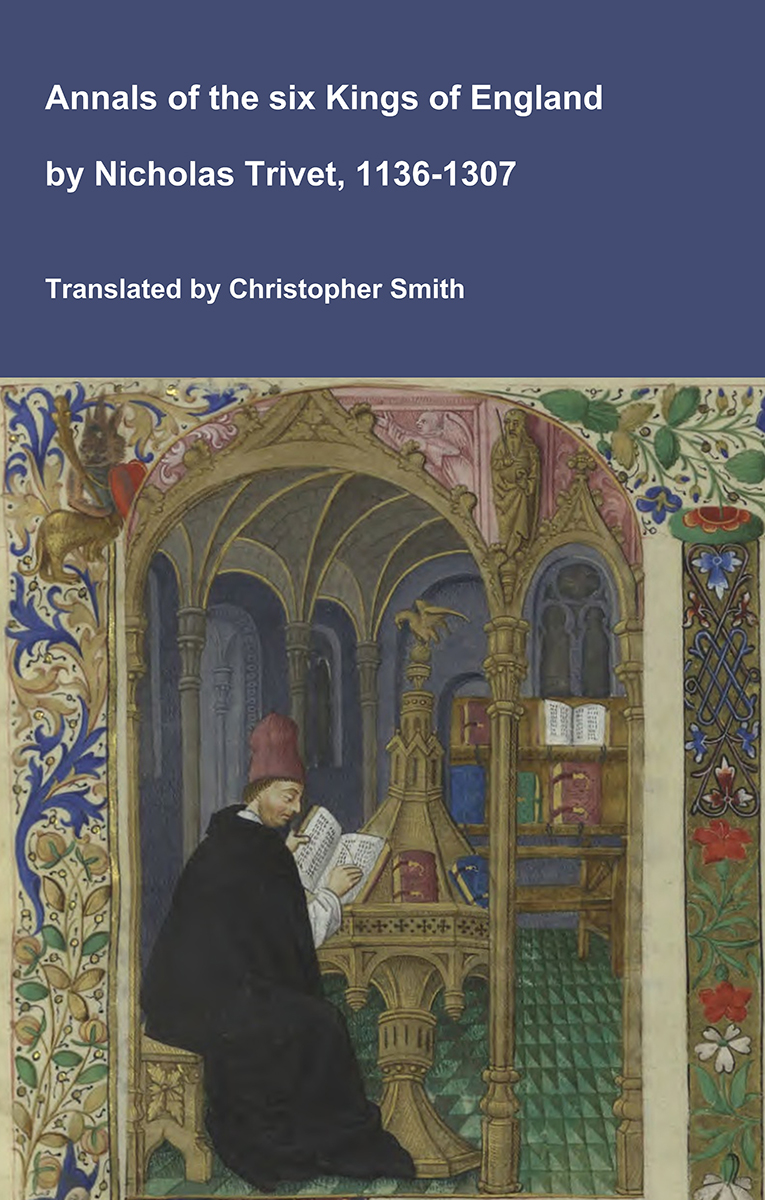
Annals of the six Kings of England by Nicholas Trivet
Translation of the Annals of the Six Kings of England by that traces the rise and rule of the Angevin aka Plantagenet dynasty from the mid-12th to early 14th century. Written by the Dominican scholar Nicholas Trivet, the work offers a vivid account of English history from the reign of King Stephen through to the death of King Edward I, blending political narrative with moral reflection. Covering the reigns of six monarchs—from Stephen to Edward I—the chronicle explores royal authority, rebellion, war, and the shifting balance between crown, church, and nobility. Trivet provides detailed insight into defining moments such as baronial conflicts, Anglo-French rivalry, and the consolidation of royal power under Edward I, whose reign he describes with particular immediacy. The Annals combines careful year-by-year reporting with thoughtful interpretation, presenting history not merely as a sequence of events but as a moral and political lesson. Ideal for readers interested in medieval history, kingship, and the origins of the English state, this chronicle remains a valuable and accessible window into the turbulent world of the Plantagenet kings.
Available at Amazon in eBook and Paperback format.
In 800 Bishop Eanbert was consecrated Bishop of Hexham.