

The History of William Marshal was commissioned by his son shortly after William’s death in 1219 to celebrate the Marshal’s remarkable life; it is an authentic, contemporary voice. The manuscript was discovered in 1861 by French historian Paul Meyer. Meyer published the manuscript in its original Anglo-French in 1891 in two books. This book is a line by line translation of the first of Meyer’s books; lines 1-10152. Book 1 of the History begins in 1139 and ends in 1194. It describes the events of the Anarchy, the role of William’s father John, John’s marriages, William’s childhood, his role as a hostage at the siege of Newbury, his injury and imprisonment in Poitou where he met Eleanor of Aquitaine and his life as a knight errant. It continues with the accusation against him of an improper relationship with Margaret, wife of Henry the Young King, his exile, and return, the death of Henry the Young King, the rebellion of Richard, the future King Richard I, war with France, the death of King Henry II, and the capture of King Richard, and the rebellion of John, the future King John. It ends with the release of King Richard and the death of John Marshal.
Available at Amazon in eBook and Paperback format.
Bishop of Lincoln is in Bishop. See Lincoln Cathedral [Map].
In 1093 Bishop Roger Bloet was elected Bishop of Lincoln.
Chronicon ex Chronicis by Florence and John of Worcester. 3rd June 1123. Henry, king of England, went over sea after the feast of Whitsuntide [3rd June]. William [aged 53], archbishop of Canterbury, having received the pallium from pope Calixtus, and Thurstan [aged 53], archbishop of York, with their companions, on their return from Rome, paid a visit to the king, who was still in Normandy: after a short stay, archbishop William came back to England, and, on the eleventh of the calends of August [22nd July], at Canterbury, consecrated Alexander as bishop of Lincoln; and, on the seventh of the calends of September [26th August], in the church of St. Paul the Apostle, at London, consecrated Godfrey, the queen's chancellor, to the bishopric of Bath.
On 13th December 1148 Bishop Robert de Chesney was elected Bishop of Lincoln.
On 19th December 1148 Bishop Robert de Chesney was consecrated Bishop of Lincoln by Archbishop Theobald of Bec [aged 58] at Canterbury Cathedral [Map]. He had been ordained as a Priest the day before.
In 1173 Archbishop Geoffrey Plantagenet [aged 21] was appointed Bishop of Lincoln.
On 11th May 1183 Archbishop Walter de Coutances was elected Bishop of Lincoln being selected by King Henry "Curtmantle" II of England [aged 50] over three other candidates.
On 3rd July 1183 Archbishop Walter de Coutances was consecrated Bishop of Lincoln at Angers Cathedral [Map] by Archbishop Richard of Dover.
On 11th December 1183 Archbishop Walter de Coutances was enthroned Bishop of Lincoln.
On 21st November 1186 Bishop Hugh of Lincoln [aged 46] was consecrated Bishop of Lincoln.
William of Worcester's Chronicle of England
William of Worcester, born around 1415, and died around 1482 was secretary to John Fastolf, the renowned soldier of the Hundred Years War, during which time he collected documents, letters, and wrote a record of events. Following their return to England in 1440 William was witness to major events. Twice in his chronicle he uses the first person: 1. when writing about the murder of Thomas, 7th Baron Scales, in 1460, he writes '… and I saw him lying naked in the cemetery near the porch of the church of St. Mary Overie in Southwark …' and 2. describing King Edward IV's entry into London in 1461 he writes '… proclaimed that all the people themselves were to recognize and acknowledge Edward as king. I was present and heard this, and immediately went down with them into the city'. William’s Chronicle is rich in detail. It is the source of much information about the Wars of the Roses, including the term 'Diabolical Marriage' to describe the marriage of Queen Elizabeth Woodville’s brother John’s marriage to Katherine, Dowager Duchess of Norfolk, he aged twenty, she sixty-five or more, and the story about a paper crown being placed in mockery on the severed head of Richard, 3rd Duke of York.
Available at Amazon in eBook and Paperback format.
On 17th June 1235 Bishop Robert Grosseteste [aged 67] was consecrated Bishop of Lincoln.
On 6th February 1280 Bishop Oliver Sutton [aged 61] was elected Bishop of Lincoln.
On 19th May 1280 Bishop Oliver Sutton [aged 61] was consecrated Bishop of Lincoln at Lambeth Palace [Map].
On 8th September 1280 Bishop Oliver Sutton [aged 61] was enthroned Bishop of Lincoln at Lincoln Cathedral [Map].
On 15th January 1300 Bishop John D'Aldreby was elected Bishop of Lincoln.
On 12th June 1300 Bishop John D'Aldreby was consecrated Bishop of Lincoln at Canterbury Cathedral [Map].
On 27th May 1320 Bishop Henry Burghesh [aged 28] was appointed Bishop of Lincoln due to the influence of his uncle Bartholomew Badlesmere 1st Baron Badlesmere [aged 44] despite the chapter having already elected a new bishop.
On 20th July 1320 Bishop Henry Burghesh [aged 28] was consecrated Bishop of Lincoln.
Around 1st March 1341 Bishop Thomas Bek [aged 59] was elected Bishop of Lincoln.
On 7th July 1342 Bishop Thomas Bek [aged 60] was consecrated Bishop of Lincoln.
On 27th February 1398 Cardinal Henry Beaufort [aged 23] was appointed Bishop of Lincoln.
On 20th November 1419 Bishop Richard Fleming [aged 32] was nominated by papal provision to be Bishop of Lincoln.
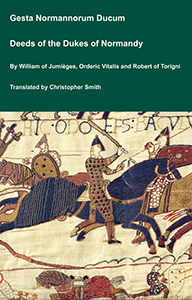
The Deeds of the Dukes of Normandy
The Gesta Normannorum Ducum [The Deeds of the Dukes of Normandy] is a landmark medieval chronicle tracing the rise and fall of the Norman dynasty from its early roots through the pivotal events surrounding the Norman Conquest of England. Originally penned in Latin by the monk William of Jumièges shortly before 1060 and later expanded at the behest of William the Conqueror, the work chronicles the deeds, politics, battles, and leadership of the Norman dukes, especially William’s own claim to the English throne. The narrative combines earlier historical sources with firsthand information and oral testimony to present an authoritative account of Normandy’s transformation from a Viking settlement into one of medieval Europe’s most powerful realms. William’s history emphasizes the legitimacy, military prowess, and governance of the Norman line, framing their expansion, including the conquest of England, as both divinely sanctioned and noble in purpose. Later chroniclers such as Orderic Vitalis and Robert of Torigni continued the history, extending the coverage into the 12th century, providing broader context on ducal rule and its impact. Today this classic work remains a foundational source for understanding Norman identity, medieval statesmanship, and the historical forces that reshaped England and Western Europe between 800AD and 1100AD.
Available at Amazon in eBook and Paperback format.
On 28th April 1420 Bishop Richard Fleming [aged 33] was consecrated Bishop of Lincoln by Martin V in Florence.
On 30th April 1431 Bishop William Grey aka Gray was translated to Bishop of Lincoln.
In 1450 Bishop Marmaduke Lumley was appointed Bishop of Lincoln.
On 24th August 1458 Bishop Richard of Gravesend was elected Bishop of Lincoln.
In 1472 Archbishop Thomas Rotherham [aged 48] was appointed Bishop of Lincoln.
On 7th July 1480 Bishop John Russell was appointed Bishop of Lincoln.
On 6th November 1496 Bishop William Smyth [aged 36] was translated to Bishop of Lincoln.
In 1514 Bishop William Atwater [aged 74] was appointed Bishop of Lincoln.
In 5th May 1521 Bishop John Longland [aged 48] was consecrated Bishop of Lincoln by Archbishop William Warham [aged 71] assisted by Bishop John Fisher [aged 51], Bishop Nicholas West [aged 60] and Bishop John Vesey aka Harman [aged 59].


On 7th January 1527 Bishop Robert King was appointed suffragan Bishop of Lincoln.
Chronicle of Walter of Guisborough
A canon regular of the Augustinian Guisborough Priory, Yorkshire, formerly known as The Chronicle of Walter of Hemingburgh, describes the period from 1066 to 1346. Before 1274 the Chronicle is based on other works. Thereafter, the Chronicle is original, and a remarkable source for the events of the time. This book provides a translation of the Chronicle from that date. The Latin source for our translation is the 1849 work edited by Hans Claude Hamilton. Hamilton, in his preface, says: 'In the present work we behold perhaps one of the finest samples of our early chronicles, both as regards the value of the events recorded, and the correctness with which they are detailed; Nor will the pleasing style of composition be lightly passed over by those capable of seeing reflected from it the tokens of a vigorous and cultivated mind, and a favourable specimen of the learning and taste of the age in which it was framed.'
Available at Amazon in eBook and Paperback format.
In 1547 Bishop Henry Holbeach [aged 70] was elected Bishop of Lincoln.
In 1552 Bishop John Taylor [aged 49] was elected Bishop of Lincoln.
On 1st April 1554 the Lord Chancellor Bishop Edmund "Bloody" Bonner of London [aged 54], assisted by Bishop Stephen Gardiner [aged 71], Bishop Nicholas Ridley [aged 54] and Bishop Cuthbert Tunstall [aged 80], consecrated seven bishops at Southwark Cathedral [Map]:
Bishop George Cotes was consecrated Bishop of Chester.
Bishop Gilbert Bourne was consecrated Bishop of Bath and Wells.
Bishop James Brooks [aged 41] was consecrated Bishop of Gloucester.
Bishop Maurice Griffiths [aged 47] was consecrated Bishop of Rochester.
Bishop Henry Morgan was consecrated Bishop of St David's.
Bishop John White [aged 44] was consecrated Bishop of Lincoln.
Bishop Robert Parfew aka Warton was consecrated Bishop of Hereford.
Henry Machyn's Diary. 1st April 1554. [The first day of April my lord chancellor [aged 54] did consecrate six new bishops at St. Mary Overy's [Map], before the high altar; and a goodly mass was said. And when all] was done thay yede unto my lord ch[ancellor's,] for ther was as grett a dener as youe ha[ve seen.] Thes be the bysshopes names that wher consecrated, [doctor] Whyt [aged 44], warden of Wynchastur, the bysshope of Ly[ncoln]; doctur Borne, bysshope of Bathe; doctur Morgan, bishop of sant Davys; doctur Brokes [aged 41], bysshope of Gloss [ter]; doctur Cottes, bysshope of Westtchastur; bysshope of sant Asse changyd to be bysshope of Arfford; master [Griffith] [aged 47] parsun of sant Magnus bysshope of Rochastur.
On 15th April 1556 Bishop Thomas Watson [aged 41] was elected Bishop of Lincoln.
On 15th August 1557 Bishop Thomas Watson [aged 42] was consecrated Bishop of Lincoln by Archbishop Nicholas Heath [aged 56].
On 25th November 1559 Bishop Nicholas Bullingham [aged 39] was elected Bishop of Lincoln.
On 21st January 1560 two Bishops were consecrated...
Bishop Nicholas Bullingham [aged 40] was consecrated Bishop of Lincoln.
Archbishop Thomas Young [aged 53] was consecrated Bishop of St David's at Lambeth Palace [Map] by Archbishop Matthew Parker [aged 55].
In 1584 Bishop William Wickham [aged 45] was appointed Bishop of Lincoln.
In 1614 Archbishop Richard Neale [aged 51] was elected Bishop of Lincoln.
In 1621 Archbishop John Williams [aged 38] was appointed Bishop of Lincoln by King James I [aged 54].


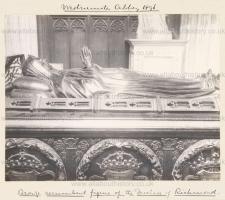
John Evelyn's Diary. 31st August 1654. Trinity College [Map] is said by some to be the fairest quadrangle of any university in Europe; but in truth is far inferior to that of Christ Church, in Oxford; the hall is ample and of stone, the fountain in the quadrangle is graceful, the chapel and library fair. There they showed us the prophetic manuscript of the famous Grebner, but the passage and emblem which they would apply to our late King, is manifestly relating to the Swedish; in truth, it seems to be a mere fantastic rhapsody, however the title may bespeak strange revelations. There is an office in manuscript with fine miniatures, and some other antiquities, given by the Countess of Richmond, mother of Henry VIII, and the before-mentioned Archbishop Williams, when Bishop of Lincoln. The library is pretty well stored. The Greek Professor had me into another large quadrangle cloistered and well built, and gave us a handsome collation in his own chamber.
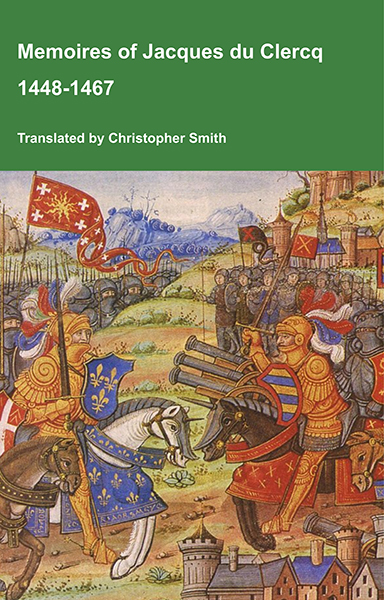
This is a translation of the 'Memoires of Jacques du Clercq', published in 1823 in two volumes, edited by Frederic, Baron de Reissenberg. In his introduction Reissenberg writes: 'Jacques du Clercq tells us that he was born in 1424, and that he was a licentiate in law and a counsellor to Philip the Good, Duke of Burgundy, in the castellany of Douai, Lille, and Orchies. It appears that he established his residence at Arras. In 1446, he married the daughter of Baldwin de la Lacherie, a gentleman who lived in Lille. We read in the fifth book of his Memoirs that his father, also named Jacques du Clercq, had married a lady of the Le Camelin family, from Compiègne. His ancestors, always attached to the counts of Flanders, had constantly served them, whether in their councils or in their armies.' The Memoires cover a period of nineteen years beginning in in 1448, ending in in 1467. It appears that the author had intended to extend the Memoirs beyond that date; no doubt illness or death prevented him from carrying out this plan. As Reissenberg writes the 'merit of this work lies in the simplicity of its narrative, in its tone of good faith, and in a certain air of frankness which naturally wins the reader’s confidence.' Du Clercq ranges from events of national and international importance, including events of the Wars of the Roses in England, to simple, everyday local events such as marriages, robberies, murders, trials and deaths, including that of his own father in Book 5; one of his last entries.
Available at Amazon in eBook and Paperback format.

John Evelyn's Diary. 18th December 1659. Preached that famous divine, Dr. Sanderson [aged 72] (since Bishop of Lincoln), now eighty years old, on Jer. xxx. 13, concerning the evil of forsaking God.
In 1660 Bishop Robert Sanderson [aged 72] was appointed Bishop of Lincoln.
On 3rd October 1660 Bishop Robert Saunderson [aged 73] was elected Bishop of Lincoln.
On 28th November 1660 Bishop Robert Saunderson [aged 73] was consecrated Bishop of Lincoln.
On 17th September 1667 Bishop William Fuller [aged 59] was elected Bishop of Lincoln.
Before 27th June 1675 Bishop Thomas Barlow [aged 67] was elected Bishop of Lincoln.
On 27th June 1675 Bishop Thomas Barlow [aged 67] was consecrated Bishop of Lincoln by Bishop George Morley [aged 77] at the Chapel at the Palace of the Bishop of Ely, Holborn rather than Lambeth Palace [Map] since Gilbert Sheldon [aged 77], the Archbishop of Canterbury, was opposed to his election.
John Evelyn's Diary. 27th June 1675. At Ely House, I went to the consecration of my worthy friend, the learned Dr. Barlow [aged 51], Warden of Queen's College, Oxford, now made Bishop of Lincoln. After it succeeded a magnificent feast, where were the Duke of Ormond [aged 64], Earl of Lauderdale [aged 59], the Lord Treasurer [aged 43], Lord Keeper, etc.
In 1691 Archbishop Thomas Tenison [aged 54] was appointed Bishop of Lincoln.
John Evelyn's Diary. 12th January 1692. My granddaughter was christened by Dr. Tenison [aged 55], now Bishop of Lincoln, in Trinity Church (assumed to be a reference to the new church described on 18 Jul 1691), being the first that was christened there. She was named Jane.
The History of William Marshal was commissioned by his son shortly after William’s death in 1219 to celebrate the Marshal’s remarkable life; it is an authentic, contemporary voice. The manuscript was discovered in 1861 by French historian Paul Meyer. Meyer published the manuscript in its original Anglo-French in 1891 in two books. This book is a line by line translation of the first of Meyer’s books; lines 1-10152. Book 1 of the History begins in 1139 and ends in 1194. It describes the events of the Anarchy, the role of William’s father John, John’s marriages, William’s childhood, his role as a hostage at the siege of Newbury, his injury and imprisonment in Poitou where he met Eleanor of Aquitaine and his life as a knight errant. It continues with the accusation against him of an improper relationship with Margaret, wife of Henry the Young King, his exile, and return, the death of Henry the Young King, the rebellion of Richard, the future King Richard I, war with France, the death of King Henry II, and the capture of King Richard, and the rebellion of John, the future King John. It ends with the release of King Richard and the death of John Marshal.
Available at Amazon in eBook and Paperback format.
John Evelyn's Diary. 9th December 1694. I had news that my dear and worthy friend, Dr. Tenison [aged 58], Bishop of Lincoln, was made Archbishop of Canterbury, for which I thank God and rejoice, he being most worthy of it, for his learning, piety, and prudence.

On 10th March 1695 Bishop James Gardiner [aged 58] was consecrated Bishop of Lincoln by Archbishop Thomas Tenison [aged 58] [who had formerly been Bishop of Lincoln before becoming Archbishop of Canterbury].

In 1705 Archbishop William Wake [aged 47] was consecrated Bishop of Lincoln.
In 1716 Bishop Edmund Gibson [aged 47] was appointed In Bishop of Lincoln.
In 1820 Bishop George Pelham [aged 53] was translated to Bishop of Lincoln.
In 1827 Bishop John Kaye [aged 43] was translated to Bishop of Lincoln in which office he served for twenty-six years until his death in 1853.
On 22nd February 1869 Bishop Christopher Wordsworth [aged 61] was appointed Bishop of Lincoln.
On 24th February 1869 Bishop Christopher Wordsworth [aged 61] was ordained and consecrated Bishop of Lincoln by Archbishop Campbell Tait.
In 1933 Bishop Nugent Hicks [aged 61] was appointed Bishop of Lincoln.
On 12th June 1946 Bishop Leslie Owen [aged 60] was nominated Bishop of Lincoln which office he held for ten months.