

Henrici Quinti, Angliæ Regis, Gesta, is a first-hand account of the Agincourt Campaign, and subsequent events to his death in 1422. The author of the first part was a Chaplain in King Henry's retinue who was present from King Henry's departure at Southampton in 1415, at the siege of Harfleur, the battle of Agincourt, and the celebrations on King Henry's return to London. The second part, by another writer, relates the events that took place including the negotiations at Troye, Henry's marriage and his death in 1422.
Available at Amazon in eBook and Paperback format.
Bishop of London is in Bishop.
In 604 Bishop Mellitus was appointed Bishop of London.
Anglo-Saxon Chronicle. 604. This year Augustine [aged 64] consecrated two bishops, Mellitus and Justus. Mellitus he sent to preach baptism to the East-Saxons. Their king was called Seabert, the son of Ricola, Ethelbert's [aged 54] sister, whom Ethelbert placed there as king. Ethelbert also gave Mellitus the bishopric of London; and to Justus he gave the bishopric of Rochester, which is twenty-four miles from Canterbury, Kent [Map].
Anglo-Saxon Chronicle. 616. This year died Ethelbert [aged 66], king of Kent, the first of English kings that received baptism: he was the son of Ermenric. He reigned fifty-six winters, and was succeeded by his son Eadbald. And in this same year had elapsed from the beginning of the world five thousand six hundred and eighteen winters. This Eadbald renounced his baptism, and lived in a heathen manner; so that he took to wife the relict of his father. Then Laurentius, who was archbishop in Kent, meant to depart southward over sea, and abandon everything. But there came to him in the night the apostle Peter, and severely chastised him19, because he would so desert the flock of God. And he charged him to go to the king, and teach him the right belief. And he did so; and the king returned to the right belief. In this king's days the same Laurentius, who was archbishop in Kent after Augustine, departed this life on the second of February, and was buried near Augustine. The holy Augustine in his lifetime invested him bishop, to the end that the church of Christ, which yet was new in England, should at no time after his decease be without an archbishop. After him Mellitus, who was first Bishop of London, succeeded to the archbishopric. The people of London, where Mellitus was before, were then heathens: and within five winters of this time, during the reign of Eadbald, Mellitus died. To him succeeded Justus, who was Bishop of Rochester, whereto he consecrated Romanus bishop.
Note 19. Literally, "swinged, or scourged him." Both Bede and Alfred begin by recording the matter as a vision, or a dream; whence the transition is easy to a matter of fact, as here stated by the Norman interpolators of the "Saxon Annals".
In 666 Bishop Wine of London was consecrated Bishop of London.
In 675 Bishop Earconwald was appointed Bishop of London.
In 693 Bishop Waldhere was consecrated Bishop of London.
Between 705 and 716 Bishop Ingwald was appointed Bishop of London.
Between 867 and 896 Bishop Heahstan was appointed Bishop of London.
In 958 Archbishop Dunstan [aged 49] was appointed Bishop of London.
Anglo-Saxon Chronicle. 959. This year died King Edwy, on the calends of October; and Edgar [aged 16] his brother took to the government of the West-Saxons, Mercians, and Northumbrians. He was then sixteen years old. It was in this year he sent after St. Dunstan [aged 50], and gave him the bishopric of Worcester; and afterwards the bishopric of London. In his days it prosper'd well; and God him gave, that he dwelt in peace the while that he lived. Whate'er he did, whate'er he plan'd, he earn'd his thrift. He also rear'd God's glory wide, and God's law lov'd, with peace to man, above the kings that went before in man's remembrance. God so him sped, that kings and earls to all his claims submissive bow'd; and to his will without a blow he wielded all as pleased himself. Esteem'd he was both far and wide in distant lands; because he prized the name of God, and God's law traced, God's glory rear'd, both far and wide, on every side. Wisely he sought in council oft his people's good, before his God, before the world. One misdeed he did, too much however, that foreign tastes he loved too much; and heathen modes into this land he brought too fast; outlandish men hither enticed; and to this earth attracted crowds of vicious men. But God him grant, that his good deeds be weightier far than his misdeeds, to his soul's redemption on the judgment-day.
In 1051 Bishop William of Normandy was consecrated Bishop of London.
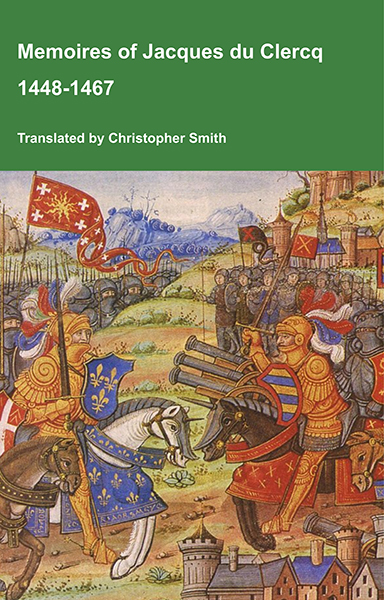
This is a translation of the 'Memoires of Jacques du Clercq', published in 1823 in two volumes, edited by Frederic, Baron de Reissenberg. In his introduction Reissenberg writes: 'Jacques du Clercq tells us that he was born in 1424, and that he was a licentiate in law and a counsellor to Philip the Good, Duke of Burgundy, in the castellany of Douai, Lille, and Orchies. It appears that he established his residence at Arras. In 1446, he married the daughter of Baldwin de la Lacherie, a gentleman who lived in Lille. We read in the fifth book of his Memoirs that his father, also named Jacques du Clercq, had married a lady of the Le Camelin family, from Compiègne. His ancestors, always attached to the counts of Flanders, had constantly served them, whether in their councils or in their armies.' The Memoires cover a period of nineteen years beginning in in 1448, ending in in 1467. It appears that the author had intended to extend the Memoirs beyond that date; no doubt illness or death prevented him from carrying out this plan. As Reissenberg writes the 'merit of this work lies in the simplicity of its narrative, in its tone of good faith, and in a certain air of frankness which naturally wins the reader’s confidence.' Du Clercq ranges from events of national and international importance, including events of the Wars of the Roses in England, to simple, everyday local events such as marriages, robberies, murders, trials and deaths, including that of his own father in Book 5; one of his last entries.
Available at Amazon in eBook and Paperback format.
On 25th December 1085 Bishop Maurice was appointed Bishop of London.
In 1108 Bishop Richard de Belmeis was appointed Bishop of London.
Chronicon ex Chronicis by Florence and John of Worcester. 22nd February 1128. A man of worth and advanced years, who was a canon of the church of Lyons, was elected bishop of London; for Richard, bishop of that city, was dead, and this person, named Gilbert, and surnamed The Universal1, was appointed in his stead by king Henry and archbishop William, with the assent of the clergy and people. He was consecrated by the archbishop himself, in the mother church of Canterbury, on Sunday, the eleventh of the calends of February (22nd January). Sigefrid, bishop of Chichester, and John, bishop of Rochester, assisted and took part in the ceremony, in the presence of the abbots, and other great and noble persons, assembled at Canterbury on the occasion; his profession having been first made in the same way his predecessors had done, by which he promised canonical submission and obedience in all things to the archbishop and his successors. Urban [aged 52], bishop of Glamorgan or Llandaff, considering that he had not been justly dealt with in regard to certain questions with Bernard, bishop of St. David's, which he had litigated in the council of the preceding year, crossed the sea, after the feast of the Purification of St. Mary [2nd February], and proceeding to Rome, laid the cause of his journey, supported by clear attestations from his own diocese, before the apostolical pope. The pope lent a favourable ear to his pretensions and statements, and addressed letters to king Henry and archbishop William, and the other bishops of England, enjoining them by his apostolical authority to suffer no opposition from any one to Urban's just demands.
Note 1. Gilbert the Universal, so called from his extensive learning. See his character shortly drawn in Henry of Huntingdon's caustic style. "Letter to Walter," p.310 of his works in the Antiq. Lib.
On 6th March 1163 Bishop Gilbert Foliot was translated to Bishop of London.
On 28th April 1163 Bishop Gilbert Foliot was enthroned as Bishop of London.
On 15th September 1189 King Richard "Lionheart" I of England [aged 32] held a Council meeting at Pipewell [Map] at which he appointed a number of Bishops:
Bishop William Longchamp was elected Bishop of Ely.
Bishop Godfrey Lucy was elected Bishop of Winchester.
Bishop Richard Fitzneal [aged 59] was elected Bishop of London.
Archbishop Hubert Walter [aged 29] was elected Bishop of Salisbury.
On 31st December 1189 two of Richard I's new bishops were consecrated...
Bishop William Longchamp was consecrated Bishop of Ely.
Bishop Richard Fitzneal [aged 59] was consecrated Bishop of London.
In 1228 Bishop Roger Niger was appointed Bishop of London.
On 10th June 1229 Bishop Roger Niger was consecrated Bishop of London.
In 1241 Bishop Fulk Basset [aged 52] was elected Bishop of London; an election confirmed by King Henry III of England [aged 33] in January 1242.
On 9th October 1244 Bishop Fulk Basset [aged 55] was consecrated Bishop of London with King Henry III of England [aged 37] making a sizeable contribution to his consecration feast. The delay in his consecration was due to a vacancy in the archiepiscopal see of Canterbury
The Deeds of the Dukes of Normandy
The Gesta Normannorum Ducum [The Deeds of the Dukes of Normandy] is a landmark medieval chronicle tracing the rise and fall of the Norman dynasty from its early roots through the pivotal events surrounding the Norman Conquest of England. Originally penned in Latin by the monk William of Jumièges shortly before 1060 and later expanded at the behest of William the Conqueror, the work chronicles the deeds, politics, battles, and leadership of the Norman dukes, especially William’s own claim to the English throne. The narrative combines earlier historical sources with firsthand information and oral testimony to present an authoritative account of Normandy’s transformation from a Viking settlement into one of medieval Europe’s most powerful realms. William’s history emphasizes the legitimacy, military prowess, and governance of the Norman line, framing their expansion, including the conquest of England, as both divinely sanctioned and noble in purpose. Later chroniclers such as Orderic Vitalis and Robert of Torigni continued the history, extending the coverage into the 12th century, providing broader context on ducal rule and its impact. Today this classic work remains a foundational source for understanding Norman identity, medieval statesmanship, and the historical forces that reshaped England and Western Europe between 800AD and 1100AD.
Available at Amazon in eBook and Paperback format.
On 11th August 1280 Bishop Richard of Gravesend was consecrated Bishop of London.
On 30th January 1306 Bishop Ralph Baldock was consecrated Bishop of London.
On 17th August 1313 Bishop Gilbert Segrave [aged 47] was elected Bishop of London.
On 25th November 1313 Bishop Gilbert Segrave [aged 47] was consecrated as Bishop of London by Bishop Henry Woodlock.
On 1st September 1318 Bishop Stephen of Gravesend was elected Bishop of London.
On 3rd May 1338 Bishop Richard de Wentworth was elected Bishop of London.
On 12th March 1340 Bishop Ralph Stratford [aged 40] was consecrated Bishop of London.
On 22nd October 1361 Archbishop Simon Sudbury [aged 45] was appointed Bishop of London.
On 12th September 1375 Archbishop William Courtenay [aged 33] was translated to Bishop of London.
On 5th January 1382 Bishop Robert Braybrooke was appointed Bishop of London.
On 10th November 1405 Archbishop Roger Walden was elected Bishop of London.
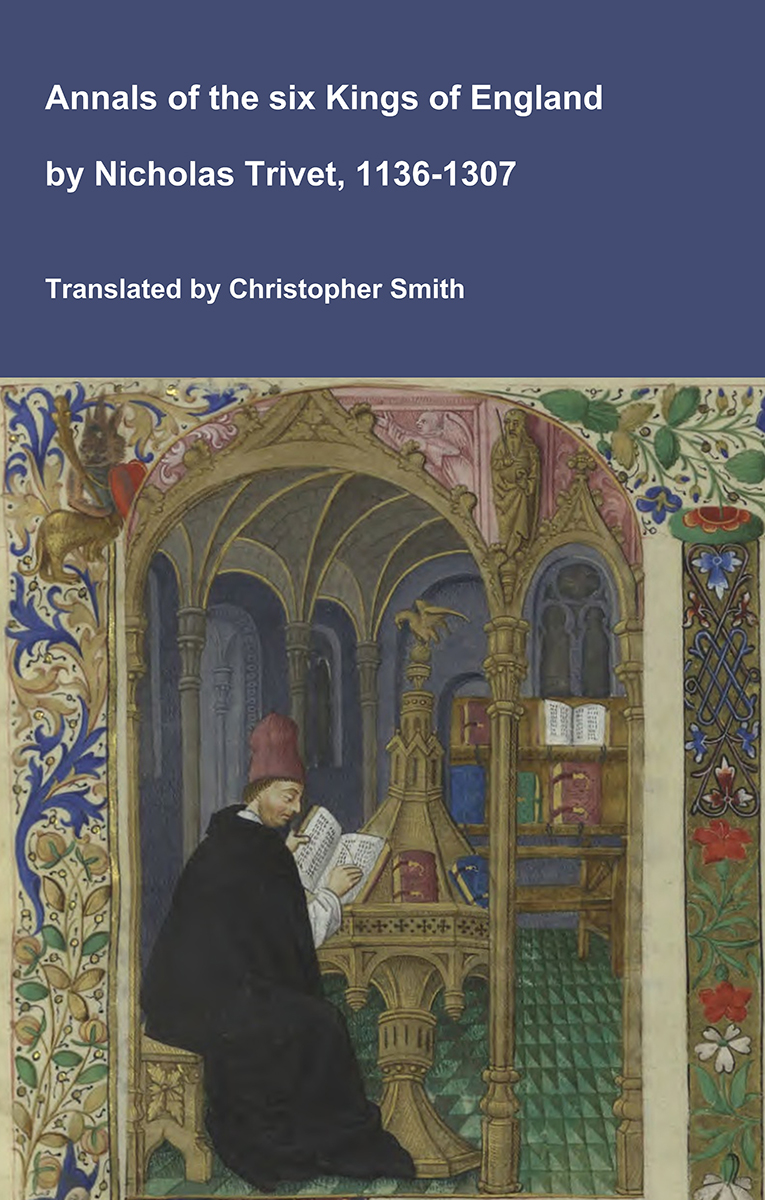
Annals of the six Kings of England by Nicholas Trivet
Translation of the Annals of the Six Kings of England by that traces the rise and rule of the Angevin aka Plantagenet dynasty from the mid-12th to early 14th century. Written by the Dominican scholar Nicholas Trivet, the work offers a vivid account of English history from the reign of King Stephen through to the death of King Edward I, blending political narrative with moral reflection. Covering the reigns of six monarchs—from Stephen to Edward I—the chronicle explores royal authority, rebellion, war, and the shifting balance between crown, church, and nobility. Trivet provides detailed insight into defining moments such as baronial conflicts, Anglo-French rivalry, and the consolidation of royal power under Edward I, whose reign he describes with particular immediacy. The Annals combines careful year-by-year reporting with thoughtful interpretation, presenting history not merely as a sequence of events but as a moral and political lesson. Ideal for readers interested in medieval history, kingship, and the origins of the English state, this chronicle remains a valuable and accessible window into the turbulent world of the Plantagenet kings.
Available at Amazon in eBook and Paperback format.
On 22nd June 1407 Bishop Richard Clifford was translated to Bishop of London.
On 20th July 1425 Bishop William Grey aka Gray was appointed Bishop of London.
On 26th May 1426 Bishop William Grey aka Gray was consecrated Bishop of London.
In 1431 Bishop Robert Fitzhugh was appointed Bishop of London.
Chronicle of Gregory. 16th September 1433. And that same year a-non aftyr the xij day, the xxix day of Janyver was the Lord Fehewe [aged 34] is brothyr a was stallyd Byschoppe of London.
On 8th February 1450 Bishop Thomas Kempe [aged 60] was consecrated as Bishop of London.
On 21st August 1489 Bishop Richard Hill was elected Bishop of London, Dean Chapel Royal.
On 15th November 1489 Bishop Richard Hill was consecrated Bishop of London.
On 20th October 1501 Archbishop William Warham [aged 51] was appointed Bishop of London.


In 1504 Bishop William Barnes was appointed Bishop of London.
Chronicle of Walter of Guisborough
A canon regular of the Augustinian Guisborough Priory, Yorkshire, formerly known as The Chronicle of Walter of Hemingburgh, describes the period from 1066 to 1346. Before 1274 the Chronicle is based on other works. Thereafter, the Chronicle is original, and a remarkable source for the events of the time. This book provides a translation of the Chronicle from that date. The Latin source for our translation is the 1849 work edited by Hans Claude Hamilton. Hamilton, in his preface, says: 'In the present work we behold perhaps one of the finest samples of our early chronicles, both as regards the value of the events recorded, and the correctness with which they are detailed; Nor will the pleasing style of composition be lightly passed over by those capable of seeing reflected from it the tokens of a vigorous and cultivated mind, and a favourable specimen of the learning and taste of the age in which it was framed.'
Available at Amazon in eBook and Paperback format.
Around 5th June 1506 Bishop Richard Fitzjames was translated to Bishop of London.
Before 1514 Bishop John Young [aged 50] was appointed as suffragan Bishop of London.
In 1522 Bishop Cuthbert Tunstall [aged 48] was appointed Bishop of London.
In 1530 Bishop John Stokesley [aged 55] was appointed Bishop of London.
In 1539 Bishop Edmund "Bloody" Bonner of London [aged 39] was appointed Bishop of London.
In 1553 Bishop Edmund "Bloody" Bonner of London [aged 53] was appointed Bishop of London.
In 1559 five new Bishops were consecrated including:
Archbishop Edwin Sandes [aged 40] was consecrated Bishop of Worcester.
Bishop William Barlow [aged 61] was consecrated Bishop of Chichester.
Archbishop Edmund Grindal [aged 40] was consecrated Bishop of London.
After July 1559 Archbishop Edmund Grindal [aged 40] was elected Bishop of London.
In 1570 Archbishop Edwin Sandes [aged 51] was consecrated Bishop of London.

On 10th January 1595 Bishop Richard Fletcher [aged 50] was translated to Bishop of London.
On 15th July 1628 Archbishop William Laud [aged 54] was appointed Bishop of London.


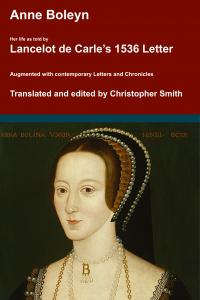
Anne Boleyn. Her Life as told by Lancelot de Carle's 1536 Letter.
In 1536, two weeks after the execution of Anne Boleyn, her brother George and four others, Lancelot du Carle, wrote an extraordinary letter that described Anne's life, and her trial and execution, to which he was a witness. This book presents a new translation of that letter, with additional material from other contemporary sources such as Letters, Hall's and Wriothesley's Chronicles, the pamphlets of Wynkyn the Worde, the Memorial of George Constantyne, the Portuguese Letter and the Baga de Secrets, all of which are provided in Appendices.
Available at Amazon in eBook and Paperback format.
In October 1633 Archbishop William Juxon [aged 51] was appointed Bishop of London.
In 1663 Bishop Humphrey Henchman [aged 71] was translated to Bishop of London.

In 1675 Bishop Henry Compton [aged 43] was appointed Bishop of London.

John Evelyn's Diary. 3rd September 1676. Dined at Captain Graham's, where I became acquainted with Dr. Compton [aged 44] (brother to the Earl of Northampton [aged 54]), now Bishop of London, and Mr. North, son to the Lord North, brother to the Lord Chief-Justice and Clerk of the Closet, a most hopeful young man. The Bishop had once been a soldier, had also traveled in Italy, and became a most sober, grave, and excellent prelate.
In 1723 Bishop Edmund Gibson [aged 54] was consecrated in Bishop of London.
In 1764 Bishop Richard Terrick [aged 54] was elected Bishop of London.
In 1897 Bishop Mandell Crichton [aged 53] was consecrated Bishop of London.
In 1945 Bishop John William Wand [aged 59] was translated to Bishop of London.