

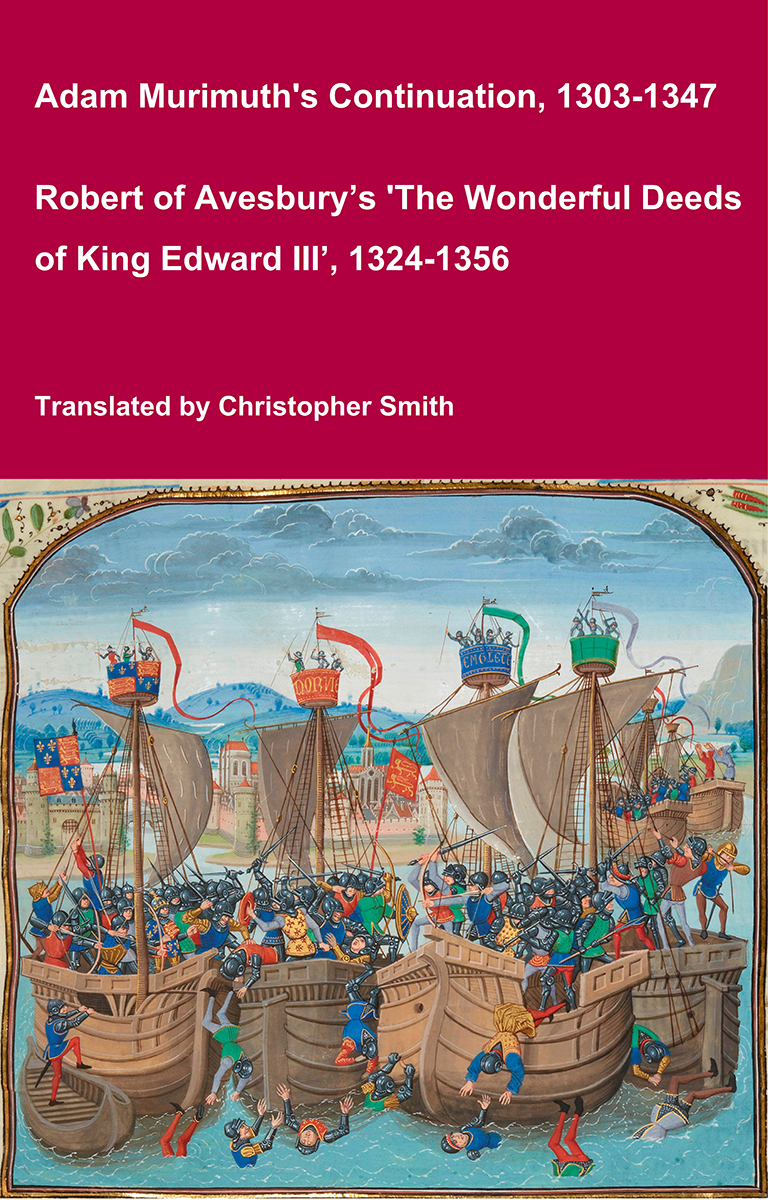
Adam Murimuth's Continuation and Robert of Avesbury’s 'The Wonderful Deeds of King Edward III'
This volume brings together two of the most important contemporary chronicles for the reign of Edward III and the opening phases of the Hundred Years’ War. Written in Latin by English clerical observers, these texts provide a vivid and authoritative window into the political, diplomatic, and military history of fourteenth-century England and its continental ambitions. Adam Murimuth Continuatio's Chronicarum continues an earlier chronicle into the mid-fourteenth century, offering concise but valuable notices on royal policy, foreign relations, and ecclesiastical affairs. Its annalistic structure makes it especially useful for establishing chronology and tracing the development of events year by year. Complementing it, Robert of Avesbury’s De gestis mirabilibus regis Edwardi tertii is a rich documentary chronicle preserving letters, treaties, and official records alongside narrative passages. It is an indispensable source for understanding Edward III’s claim to the French crown, the conduct of war, and the mechanisms of medieval diplomacy. Together, these works offer scholars, students, and enthusiasts a reliable and unembellished account of a transformative period in English and European history. Essential for anyone interested in medieval chronicles, the Hundred Years’ War, or the reign of Edward III.
Available at Amazon in eBook and Paperback format.
Bishop of Norwich is in Bishop. See Norwich Cathedral [Map].
In 1096 Bishop Herbert of Losinga commissioned the building of Norwich Cathedral [Map] and was appointed Bishop of Norwich.
Chronicon ex Chronicis by Florence and John of Worcester. 12th June 1121. After a few days, one named Everard, attached to the king's chapel, was elected bishop of Norwich, and consecrated at Canterbury [Map] by archbishop Ralph on the second of the ides [the 12th] of June; Arnulph, bishop of Rochester, Richard, bishop of Hereford, and Robert, bishop of Coventry, having met for the purpose.
In 1147 Bishop William Turbeville (age 52) was appointed Bishop of Norwich.
Around 7th September 1200 Bishop John de Gray was appointed Bishop of Norwich.
On 20th December 1226 Bishop Thomas Blunville was consecrated Bishop of Norwich.
On 4th February 1335 Bishop Thomas Percy was appointed Bishop of Norwich.
On 23rd January 1344 Bishop William Bateman (age 46) was elected Bishop of Norwich.
On 3rd April 1370 Bishop Henry Despencer (age 29) was appointed Bishop of Norwich.
In 1413 Bishop Richard Courtenay was appointed Bishop of Norwich.
On 21st September 1437 Bishop Thomas Brunce (age 49) was collated to Bishop of Norwich.
Abbot John Whethamstede’s Chronicle of the Abbey of St Albans
Abbot John Whethamstede's Register aka Chronicle of his second term at the Abbey of St Albans, 1451-1461, is a remarkable text that describes his first-hand experience of the beginning of the Wars of the Roses including the First and Second Battles of St Albans, 1455 and 1461, respectively, their cause, and their consequences, not least on the Abbey itself. His text also includes Loveday, Blore Heath, Northampton, the Act of Accord, Wakefield, and Towton, and ends with the Coronation of King Edward IV. In addition to the events of the Wars of the Roses, Abbot John, or his scribes who wrote the Chronicle, include details in the life of the Abbey such as charters, letters, land exchanges, visits by legates, and disputes, which provide a rich insight into the day-to-day life of the Abbey, and the challenges faced by its Abbot.
Available at Amazon in eBook and Paperback format.
On 17th July 1472 Bishop James Goldwell was elected Bishop of Norwich.
On 4th October 1472 Bishop James Goldwell was consecrated Bishop of Norwich at Saints Blaise and Charles in Catinari Church.
In 1501 Bishop Richard Nix aka Nykke (age 54) was appointed Bishop of Norwich.
On 13th April 1560 Bishop John Parkhurst (age 48) was elected Bishop of Norwich.
In September 1560 Bishop John Parkhurst (age 48) was installed as Bishop of Norwich.
In 1585 Bishop Edmund Scambler (age 65) was translated to Bishop of Norwich.

In 1611 Bishop John King (age 52) was appointed Bishop of Norwich.
In 1618 Bishop Thomas Morton (age 53) was appointed Bishop of Norwich.
On 22nd January 1629 Bishop Francis White (age 65) was elected Bishop of Norwich.
In 1635 Bishop Matthew Wren (age 49) was appointed Bishop of Norwich.
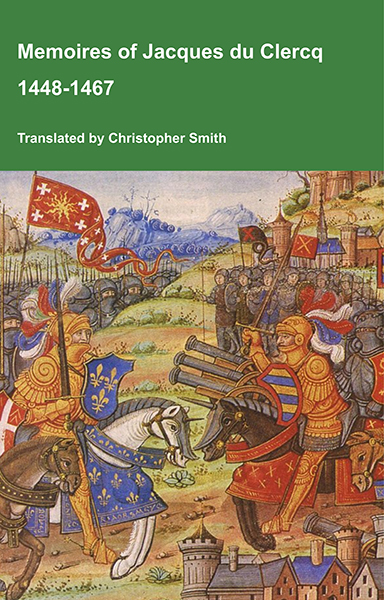
This is a translation of the 'Memoires of Jacques du Clercq', published in 1823 in two volumes, edited by Frederic, Baron de Reissenberg. In his introduction Reissenberg writes: 'Jacques du Clercq tells us that he was born in 1424, and that he was a licentiate in law and a counsellor to Philip the Good, Duke of Burgundy, in the castellany of Douai, Lille, and Orchies. It appears that he established his residence at Arras. In 1446, he married the daughter of Baldwin de la Lacherie, a gentleman who lived in Lille. We read in the fifth book of his Memoirs that his father, also named Jacques du Clercq, had married a lady of the Le Camelin family, from Compiègne. His ancestors, always attached to the counts of Flanders, had constantly served them, whether in their councils or in their armies.' The Memoires cover a period of nineteen years beginning in in 1448, ending in in 1467. It appears that the author had intended to extend the Memoirs beyond that date; no doubt illness or death prevented him from carrying out this plan. As Reissenberg writes the 'merit of this work lies in the simplicity of its narrative, in its tone of good faith, and in a certain air of frankness which naturally wins the reader’s confidence.' Du Clercq ranges from events of national and international importance, including events of the Wars of the Roses in England, to simple, everyday local events such as marriages, robberies, murders, trials and deaths, including that of his own father in Book 5; one of his last entries.
Available at Amazon in eBook and Paperback format.
In 1641 Bishop Joseph Hall (age 66) was translated to Bishop of Norwich.
John Evelyn's Diary. 2nd December 1657. Dr. Raynolds (age 58) (since Bishop of Norwich) preached before the company at St. Andrew Under-shaft [Map], on Nehemiah xiii. 31, showing, by the example of Nehemiah, all the perfections of a trusty person in public affairs, with many good precepts apposite to the occasion, ending with a prayer for God's blessing on the company and the undertaking.
In 1685 Bishop William Lloyd (age 48) was appointed Bishop of Norwich.
In 1691 Bishop John Moore (age 45) was appointed Bishop of Norwich.
John Evelyn's Diary. 5th June 1698. Dr. White, late Bishop of Norwich, who had been ejected for not complying with Government, was buried in St. Gregory's Churchyard, or vault, at St. Paul's. His hearse was accompanied by two non-juror bishops, Dr. Turner of Ely, and Dr. Lloyd, with forty other non-juror clergymen, who would not stay the Office of the burial, because the Dean of St. Paul's had appointed a conforming minister to read the Office; at which all much wondered, there being nothing in that Office which mentioned the present King.
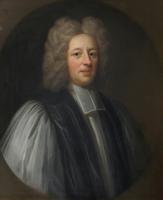
In 1721 Bishop Thomas Green (age 63) was appointed Bishop of Norwich.
On 13th October 1749 Bishop Thomas Hayter (age 47) was elected Bishop of Norwich.
On 3rd December 1749 Bishop Thomas Hayter (age 47) was consecrated Bishop of Norwich.
In 1783 Bishop Lewis Bagot (age 42) was appointed Bishop of Norwich.
In 1837 Bishop Edward Stanley (age 57) was appointed Bishop of Norwich.
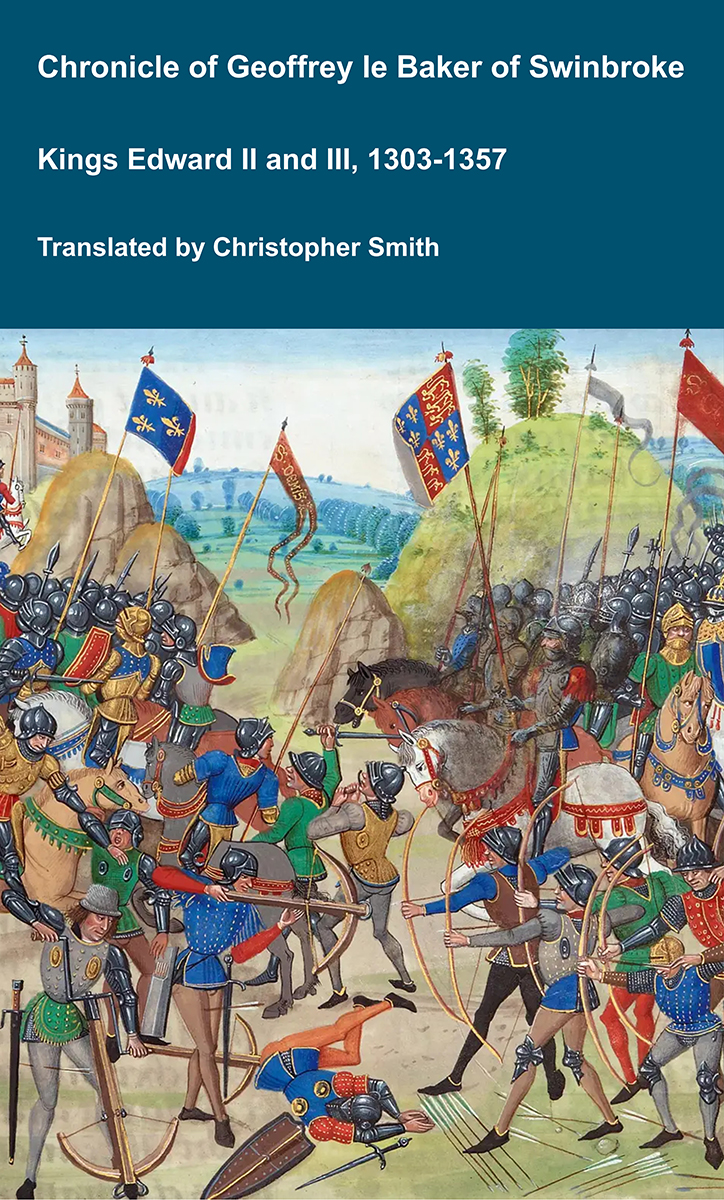
Chronicle of Geoffrey le Baker of Swinbroke
Baker was a secular clerk from Swinbroke, now Swinbrook, an Oxfordshire village two miles east of Burford. His Chronicle describes the events of the period 1303-1356: Gaveston, Bannockburn, Boroughbridge, the murder of King Edward II, the Scottish Wars, Sluys, Crécy, the Black Death, Winchelsea and Poitiers. To quote Herbert Bruce 'it possesses a vigorous and characteristic style, and its value for particular events between 1303 and 1356 has been recognised by its editor and by subsequent writers'. The book provides remarkable detail about the events it describes. Baker's text has been augmented with hundreds of notes, including extracts from other contemporary chronicles, such as the Annales Londonienses, Annales Paulini, Murimuth, Lanercost, Avesbury, Guisborough and Froissart to enrich the reader's understanding. The translation takes as its source the 'Chronicon Galfridi le Baker de Swynebroke' published in 1889, edited by Edward Maunde Thompson.
Available at Amazon in eBook and Paperback format.
In 1942 Bishop Percy Herbert (age 56) was appointed Bishop of Norwich whic office he held until 1959.
In or after 672 Bishop Bedwinus was consecrated the first Bishop of Elmham after its creation following the division of the Bishop of Dunwich aka East Anglia.
Before 824 Bishop Humbertus was consecrated Bishop of Elmham.
In 1043 Archbishop Stigand was appointed Bishop of Elmham.
In 1047 Bishop Æthelmaer was consecrated Bishop of Elmham.
In 1070 Herfast Bishop Chancellor was consecrated Bishop of Elmham.
Flowers of History. After 4th April 1070. Moreover, the whole Anglican Church held a great council in Easter week, at Winchester, Hampshire [Map], by the management of the king, where many of the things which concerned the kingdom were changed. At that council too, Stigand, archbishop of Canterbury, was ignominiously degraded, and his brother, Aylmer, bishop of East Anglia, and many other bishops and abbots were deposed at the same time. Aegelwin, bishop of Durham, alone, of all the prelates of England, seeing the unjust oppression of his brethren, and sympathizing with them, and feeling zeal for God, went of his own accord into banishment from England, wishing to entangle the oppressors in the knot of excommunication. Stigand was succeeded by Lanfranc (age 65), a monk, a man of elegant learning, and adorned with many and various other accomplishments, who, among other magnificent works, composed a treatise on the Sacrament of the Altar, confirming the Catholic Faith. Aylmer was succeeded by Arfast, the king's chaplain; and he transferred the seat of his diocese to Thetford.
Around 27th May 1072 Herfast Bishop Chancellor moved the seat of the see of the Bishop of Thetford to Thetford, Norfolk [Map] becoming the Bishop of Thetford.