

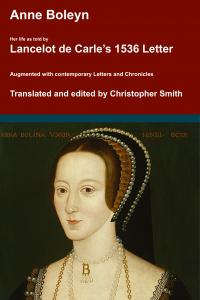
Anne Boleyn. Her Life as told by Lancelot de Carle's 1536 Letter.
In 1536, two weeks after the execution of Anne Boleyn, her brother George and four others, Lancelot du Carle, wrote an extraordinary letter that described Anne's life, and her trial and execution, to which he was a witness. This book presents a new translation of that letter, with additional material from other contemporary sources such as Letters, Hall's and Wriothesley's Chronicles, the pamphlets of Wynkyn the Worde, the Memorial of George Constantyne, the Portuguese Letter and the Baga de Secrets, all of which are provided in Appendices.
Available at Amazon in eBook and Paperback format.
Bishop of Salisbury is in Bishop. See Salisbury Cathedral [Map].
Chronicon ex Chronicis by Florence and John of Worcester. 24th June 1070. The feast of St. John the Baptist being near, earl Asbiorn sailed to Denmark with the fleet which had wintered in the Humber; but his brother Sweyn [aged 51] outlawed him, because he had accepted money from king William [aged 42], to the great regret of the Danes. Edric, surnamed the Forester, a man of the most resolute courage, of whom we have spoken before, was reconciled with king William. After this, the king summoned from Normandy Lanfranc [aged 65], abbot of Caen, a Lombard by birth, a man of unbounded learning, master of the liberal arts, and of both sacred and secular literature, and of the greatest prudence in counsel and the administration of worldly affairs; and on the day of the Assumption of St. Mary, appointed him archbishop of Canterbury, causing him to be consecrated at Canterbury on the feast of St. John the Baptist, being Sunday. He was consecrated by Giso, bishop of Wells, and Walter, bishop of Hereford, who were both ordained at Rome by pope Nicholas, when Aldred, archbishop of York, received the pallium,—for he evaded being ordained by Stigand, who then held the archbishopric of Canterbury, knowing him not to have received the pallium canonically. Bishop Heriman, who had already transferred the seat of his bishopric from Sherbourne to Salisbury, also assisted at his consecration, with some others. Afterwards, Lanfranc consecrated Thomas, archbishop of York. The suit of the reverend Wulfstan [aged 62], bishop of Worcester, was again prosecuted, there being now a bishop who could advocate the cause of the church of York; and the affair was, by the aid of God's grace, decided at a council held at a place called Pedred, before the king, archbishop Lanfranc, and the bishops, abbots, earls, and lords of all England. All the groundless assertions by which Thomas and his abettors strove to humble the church of Worcester, and reduce her to subjection and servitude to the church of York, were, by God's just judgement, entirely refuted and negatived by written documents, so that Wulfstan not only recovered the possessions he claimed, but, by God's goodness, and the king's assent, regained for his see all the immunities and privileges freely granted to it by its first founders, the holy king Ethered, Oshere, sub-king of the Hwiccas, and the other kings of Mercia, Cenred, Ethelbald, Offa, Kenulf, Edward the Elder, Athelstan, Edmund, Edred, and Edgar.
Around 3rd June 1078 Bishop Osmund 1st Earl Dorset was consecrated Bishop of Salisbury by Archbishop Lanfranc [aged 73].
On 29th September 1102 Bishop Roger of Salisbury was appointed Bishop of Salisbury.
On 11th August 1107 Bishop Roger of Salisbury was consecrated Bishop of Salisbury.
In 1142 Bishop Jocelin de Bohun [aged 31] was appointed Bishop of Salisbury.
On 15th September 1189 King Richard "Lionheart" I of England [aged 32] held a Council meeting at Pipewell [Map] at which he appointed a number of Bishops:
Bishop William Longchamp was elected Bishop of Ely.
Bishop Godfrey Lucy was elected Bishop of Winchester.
Bishop Richard Fitzneal [aged 59] was elected Bishop of London.
Archbishop Hubert Walter [aged 29] was elected Bishop of Salisbury.
On 22nd October 1189 two of Richard's new Bishops were consecrated...
Bishop Godfrey Lucy was consecrated Bishop of Winchester.
Archbishop Hubert Walter [aged 29] was consecrated Bishop of Salisbury.
On 5th May 1194 Bishop Herbert Poore was appointed Bishop of Salisbury.
On 27th June 1217 Bishop Richard Poore was appointed Bishop of Salisbury.
On 25th September 1228 Bishop Robert Bingham [aged 48] was elected Bishop of Salisbury.
Jean de Waurin's Chronicle of England Volume 6 Books 3-6: The Wars of the Roses
Jean de Waurin was a French Chronicler, from the Artois region, who was born around 1400, and died around 1474. Waurin’s Chronicle of England, Volume 6, covering the period 1450 to 1471, from which we have selected and translated Chapters relating to the Wars of the Roses, provides a vivid, original, contemporary description of key events some of which he witnessed first-hand, some of which he was told by the key people involved with whom Waurin had a personal relationship.
Available at Amazon in eBook and Paperback format.
Around 23rd February 1271 Bishop Robert Wickhampton was elected Bishop of Salisbury.
On 13th May 1274 Bishop Robert Wickhampton was consecrated Bishop of Salisbury.
On 26th June 1284 Bishop Walter Scammel was elected Bishop of Salisbury.
On 22nd October 1284 Bishop Walter Scammel was consecrated Bishop of Salisbury by Archbishop John Peckham [aged 54]. See Annals of Dunstable.
On 4th January 1285 Bishop Walter Scammel was enthroned Bishop of Salisbury.
In 1291 Bishop Nicholas Longespée was appointed Bishop of Salisbury.
On 25th October 1395 Bishop Richard Mitford was translated to Bishop of Salisbury.
In 1427 Bishop Robert Neville was appointed Bishop of Salisbury.
On 11th February 1438 Bishop William Ayscough [aged 43] was elected Bishop of Salisbury.
On 20th July 1438 Bishop William Ayscough [aged 43] was elected Bishop of Salisbury.
In 1450 Bishop Richard Beauchamp [aged 29] was appointed Bishop of Salisbury.
On 21st April 1482 Bishop Lionel Woodville [aged 35] was consecrated as Bishop of Salisbury.
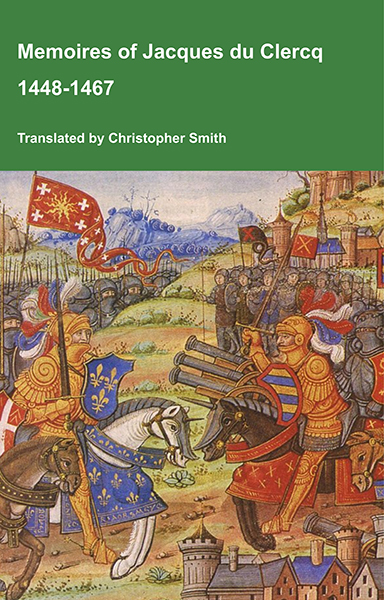
This is a translation of the 'Memoires of Jacques du Clercq', published in 1823 in two volumes, edited by Frederic, Baron de Reissenberg. In his introduction Reissenberg writes: 'Jacques du Clercq tells us that he was born in 1424, and that he was a licentiate in law and a counsellor to Philip the Good, Duke of Burgundy, in the castellany of Douai, Lille, and Orchies. It appears that he established his residence at Arras. In 1446, he married the daughter of Baldwin de la Lacherie, a gentleman who lived in Lille. We read in the fifth book of his Memoirs that his father, also named Jacques du Clercq, had married a lady of the Le Camelin family, from Compiègne. His ancestors, always attached to the counts of Flanders, had constantly served them, whether in their councils or in their armies.' The Memoires cover a period of nineteen years beginning in in 1448, ending in in 1467. It appears that the author had intended to extend the Memoirs beyond that date; no doubt illness or death prevented him from carrying out this plan. As Reissenberg writes the 'merit of this work lies in the simplicity of its narrative, in its tone of good faith, and in a certain air of frankness which naturally wins the reader’s confidence.' Du Clercq ranges from events of national and international importance, including events of the Wars of the Roses in England, to simple, everyday local events such as marriages, robberies, murders, trials and deaths, including that of his own father in Book 5; one of his last entries.
Available at Amazon in eBook and Paperback format.
On 8th February 1485 Bishop Thomas Langton was translated to Bishop of Salisbury.
On 13th November 1493 Bishop John Blythe [aged 33] was appointed Bishop of Salisbury.
On 23rd February 1494 Bishop John Blythe [aged 34] was consecrated Bishop of Salisbury.
On 7th December 1499 Archbishop Henry Deane was appointed Bishop of Salisbury.
On 10th January 1502 Bishop Edmund Tuchet [aged 59] was appointed Bishop of Salisbury.
On 22nd February 1535 Bishop Nicholas Shaxton [aged 50] was elected Bishop of Salisbury.
In 1560 Bishop John Jewel [aged 37] was consecrated as Bishop of Salisbury.
In 1571 Bishop Edmund Gheast [aged 57] was appointed Bishop of Salisbury.
In 1618 Bishop Martin Fortherby [aged 58] was appointed Bishop of Salisbury.
In 1621 Bishop John Davenant [aged 48] was appointed Bishop of Salisbury.

In 1641 Bishop Brian Duppa [aged 51] was elected Bishop of Salisbury.
Jean de Waurin's Chronicle of England Volume 6 Books 3-6: The Wars of the Roses
Jean de Waurin was a French Chronicler, from the Artois region, who was born around 1400, and died around 1474. Waurin’s Chronicle of England, Volume 6, covering the period 1450 to 1471, from which we have selected and translated Chapters relating to the Wars of the Roses, provides a vivid, original, contemporary description of key events some of which he witnessed first-hand, some of which he was told by the key people involved with whom Waurin had a personal relationship.
Available at Amazon in eBook and Paperback format.
On 31st December 1665 Bishop Alexander Hyde [aged 73] was appointed Bishop of Salisbury.
In 1689 Bishop Gilbert Burnet [aged 45] was consecrated Bishop of Salisbury.


John Evelyn's Diary. 11th April 1689. I saw the procession to and from the Abbey Church of Westminster [Map], with the great feast in Westminster Hall [Map], at the coronation of King William and Queen Mary. What was different from former coronations, was some alteration in the coronation oath. Dr. Burnet [aged 45], now made Bishop of Sarum, preached with great applause. The Parliament men had scaffolds and places which took up the one whole side of the Hall [Map]. When the King [aged 38] and Queen [aged 26] had dined, the ceremony of the Champion, and other services by tenure were performed. The Parliament men were feasted in the Exchequer chamber, and had each of them a gold medal given them, worth five-and-forty shillings. On the one side were the effigies of the King and Queen inclining one to the other; on the reverse was Jupiter throwing a bolt at Phäeton the words, "Ne totus absumatur": which was but dull, seeing they might have had out of the poet something as apposite. The sculpture was very mean.


John Evelyn's Diary. 9th June 1689. Visited Dr. Burnet [aged 45], now Bishop of Sarum; got him to let Mr. Kneller [aged 42] draw his picture.
John Evelyn's Diary. 9th March 1690. Preached at Whitehall Dr. Burnet [aged 46], late Bishop of Sarum, on Heb. iv. 13, anatomically describing the texture of the eye; and that, as it received such innumerable sorts of spies through so very small a passage to the brain, and that without the least confusion or trouble, and accordingly judged and reflected on them; so God who made this sensory, did with the greatest ease and at once see all that was done through the vast universe, even to the very thought as well as action. This similitude he continued with much perspicuity and aptness; and applied it accordingly, for the admonishing us how uprightly we ought to live and behave ourselves before such an all-seeing Deity; and how we were to conceive of other his attributes, which we could have no idea of than by comparing them by what we were able to conceive of the nature and power of things, which were the objects of our senses; and therefore it was that in Scripture we attribute those actions and affections of God by the same of man, not as adequately or in any proportion like them, but as the only expedient to make some resemblance of his divine perfections; as when the Scripture says, "God will remember the sins of the penitent no more:" not as if God could forget anything, but as intimating he would pass by such penitents and receive them to mercy.
On 23rd April 1715 Bishop William Talbot [aged 57] was appointed Bishop of Salisbury.
On 4th May 1761 Bishop John Thomas [aged 64] was elected Bishop of Salisbury.
On 14th August 1782 Bishop Shute Barrington [aged 48] was elected Bishop of Salisbury.


On 27th August 1782 Bishop Shute Barrington [aged 48] was translated to Bishop of Salisbury upon the confirmation of the election at St Mary-le-Bow Church, Cheapside [Map].

In 1807 Bishop John Fisher [aged 59] was translated to Bishop of Salisbury which office he held until his death in 1825.
In 1854 Bishop Walter Kerr Hamilton [aged 45] was elected Bishop of Salisbury.
This is a translation of the 'Memoires of Jacques du Clercq', published in 1823 in two volumes, edited by Frederic, Baron de Reissenberg. In his introduction Reissenberg writes: 'Jacques du Clercq tells us that he was born in 1424, and that he was a licentiate in law and a counsellor to Philip the Good, Duke of Burgundy, in the castellany of Douai, Lille, and Orchies. It appears that he established his residence at Arras. In 1446, he married the daughter of Baldwin de la Lacherie, a gentleman who lived in Lille. We read in the fifth book of his Memoirs that his father, also named Jacques du Clercq, had married a lady of the Le Camelin family, from Compiègne. His ancestors, always attached to the counts of Flanders, had constantly served them, whether in their councils or in their armies.' The Memoires cover a period of nineteen years beginning in in 1448, ending in in 1467. It appears that the author had intended to extend the Memoirs beyond that date; no doubt illness or death prevented him from carrying out this plan. As Reissenberg writes the 'merit of this work lies in the simplicity of its narrative, in its tone of good faith, and in a certain air of frankness which naturally wins the reader’s confidence.' Du Clercq ranges from events of national and international importance, including events of the Wars of the Roses in England, to simple, everyday local events such as marriages, robberies, murders, trials and deaths, including that of his own father in Book 5; one of his last entries.
Available at Amazon in eBook and Paperback format.
In 1869 Bishop George Moberly [aged 65] was appointed Bishop of Salisbury.
In 1885 Bishop John Wordsworth [aged 42] was elected Bishop of Salisbury.