

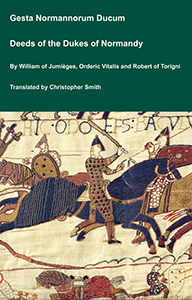
The Deeds of the Dukes of Normandy
The Gesta Normannorum Ducum [The Deeds of the Dukes of Normandy] is a landmark medieval chronicle tracing the rise and fall of the Norman dynasty from its early roots through the pivotal events surrounding the Norman Conquest of England. Originally penned in Latin by the monk William of Jumièges shortly before 1060 and later expanded at the behest of William the Conqueror, the work chronicles the deeds, politics, battles, and leadership of the Norman dukes, especially William’s own claim to the English throne. The narrative combines earlier historical sources with firsthand information and oral testimony to present an authoritative account of Normandy’s transformation from a Viking settlement into one of medieval Europe’s most powerful realms. William’s history emphasizes the legitimacy, military prowess, and governance of the Norman line, framing their expansion, including the conquest of England, as both divinely sanctioned and noble in purpose. Later chroniclers such as Orderic Vitalis and Robert of Torigni continued the history, extending the coverage into the 12th century, providing broader context on ducal rule and its impact. Today this classic work remains a foundational source for understanding Norman identity, medieval statesmanship, and the historical forces that reshaped England and Western Europe between 800AD and 1100AD.
Available at Amazon in eBook and Paperback format.
Captain of Calais is in Captain.
In 1348 John Beauchamp 1st Baron Beauchamp Warwick [aged 32] was appointed Captain of Calais.
In 1353 Reginald Cobham 1st Baron Cobham [aged 58] was appointed Captain of Calais.
In 1390 Philip Vache [aged 42] was appointed Captain of Calais.
In January 1455 Edmund Beaufort 1st or 2nd Duke of Somerset [aged 49] was appointed Captain of Calais.
After 25th May 1455 Richard "Kingmaker" Neville Earl Warwick, 6th Earl Salisbury [aged 26] was appointed Captain of Calais.
After November 1459 Henry Beaufort 2nd or 3rd Duke of Somerset [aged 23] was appointed Captain of Calais.
The History of King Richard the Third by Thomas More. King Edward in his life, although this dissension between his friends somewhat irked him, yet in his good health he somewhat the less regarded it because he thought whatsoever business should fall between them, he should always be able to rule both parties. But in his last sickness, when he perceived his natural strength so sore enfeebled that he despaired all recovery, then he, considering the youth of his children, suspecting nothing less than what would happen, and well foreseeing that many harms might grow by family debates while the youth of his children lacked discretion of themselves, and good counsel of their friends-because either party should counsel for their own advantage and by pleasant advice win themselves favor, rather than by profitable advertisement do the children good-he called some of them before him who were at variance, and especially, the Lord Marquis Dorset [aged 30], the Queen's [aged 48] son by her first husband, and Lord Hastings [Note. Text says Richard? Should be William!], a noble man, then Lord Chamberlain, against whom the Queen specially grudged for that great favour the King showed him, and also because she thought him secretly familiar with the King in wanton company. Her kindred also bore him dislike, as well for that the King had made him Captain of Calais (which office the Lord Rivers, brother to the Queen, claimed because of the King's former promise), and for diverse other great gifts which he received that they looked for.
On 11th March 1485 John York [aged 14] was appointed Captain of Calais.
In 1519 Edward Guildford [aged 45] was appointed Marshall of Calais.
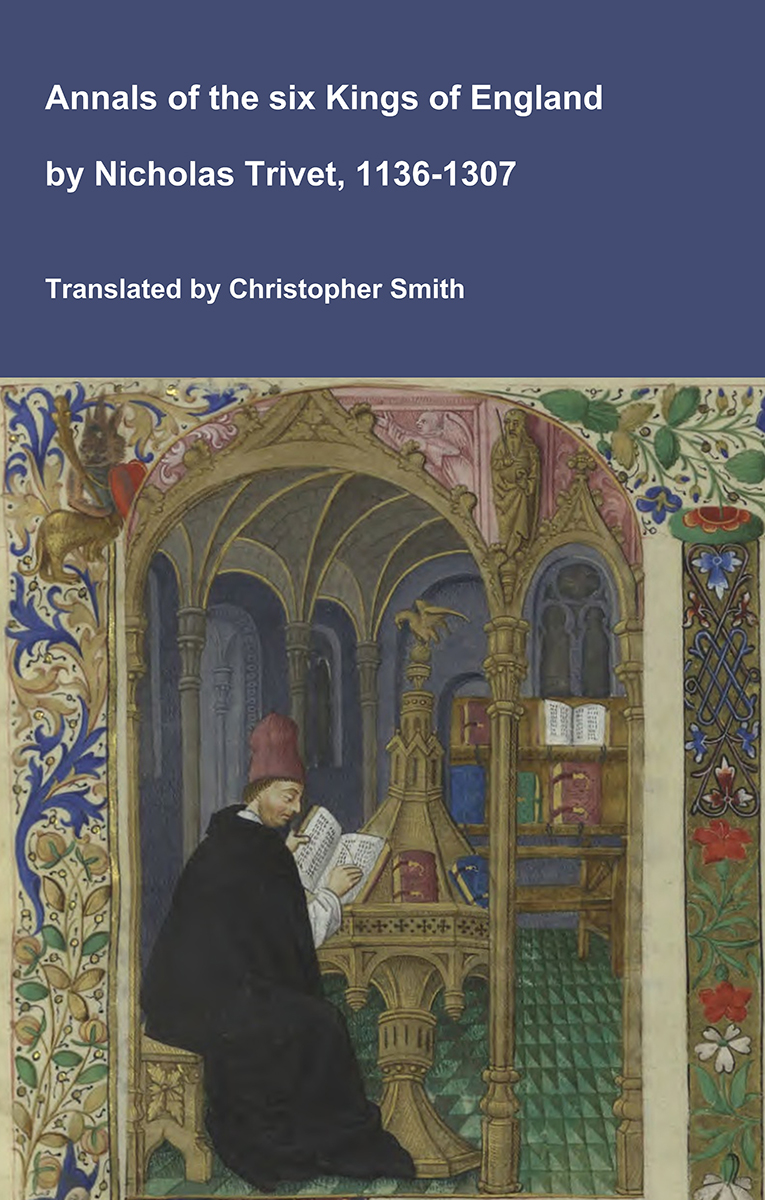
Annals of the six Kings of England by Nicholas Trivet
Translation of the Annals of the Six Kings of England by that traces the rise and rule of the Angevin aka Plantagenet dynasty from the mid-12th to early 14th century. Written by the Dominican scholar Nicholas Trivet, the work offers a vivid account of English history from the reign of King Stephen through to the death of King Edward I, blending political narrative with moral reflection. Covering the reigns of six monarchs—from Stephen to Edward I—the chronicle explores royal authority, rebellion, war, and the shifting balance between crown, church, and nobility. Trivet provides detailed insight into defining moments such as baronial conflicts, Anglo-French rivalry, and the consolidation of royal power under Edward I, whose reign he describes with particular immediacy. The Annals combines careful year-by-year reporting with thoughtful interpretation, presenting history not merely as a sequence of events but as a moral and political lesson. Ideal for readers interested in medieval history, kingship, and the origins of the English state, this chronicle remains a valuable and accessible window into the turbulent world of the Plantagenet kings.
Available at Amazon in eBook and Paperback format.
John Pole was appointed Captain of Calais.
Edmund de la Pole was appointed Captain of Calais.
Richard Carew was appointed Captain of Calais.
Richard Woodville was appointed High Sheriff of Kent and Captain of Calais.