

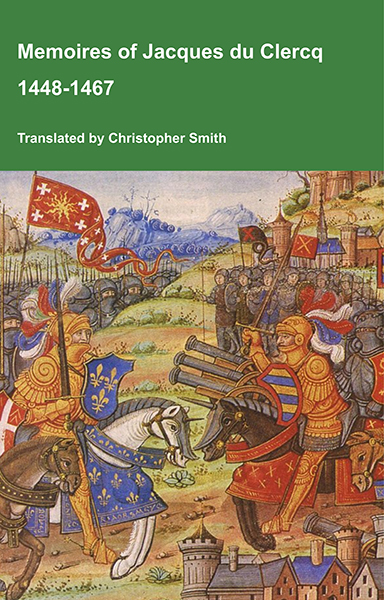
This is a translation of the 'Memoires of Jacques du Clercq', published in 1823 in two volumes, edited by Frederic, Baron de Reissenberg. In his introduction Reissenberg writes: 'Jacques du Clercq tells us that he was born in 1424, and that he was a licentiate in law and a counsellor to Philip the Good, Duke of Burgundy, in the castellany of Douai, Lille, and Orchies. It appears that he established his residence at Arras. In 1446, he married the daughter of Baldwin de la Lacherie, a gentleman who lived in Lille. We read in the fifth book of his Memoirs that his father, also named Jacques du Clercq, had married a lady of the Le Camelin family, from Compiègne. His ancestors, always attached to the counts of Flanders, had constantly served them, whether in their councils or in their armies.' The Memoires cover a period of nineteen years beginning in in 1448, ending in in 1467. It appears that the author had intended to extend the Memoirs beyond that date; no doubt illness or death prevented him from carrying out this plan. As Reissenberg writes the 'merit of this work lies in the simplicity of its narrative, in its tone of good faith, and in a certain air of frankness which naturally wins the reader’s confidence.' Du Clercq ranges from events of national and international importance, including events of the Wars of the Roses in England, to simple, everyday local events such as marriages, robberies, murders, trials and deaths, including that of his own father in Book 5; one of his last entries.
Available at Amazon in eBook and Paperback format.
Chancellor of the Duchy of Lancaster is in Duchy of Lancaster.
On 3rd July 1442 William Tresham was appointed Chancellor of the Duchy of Lancaster.
Around April 1497 Cornish rose in rebellion against taxes being raised by King Henry VII of England and Ireland (age 40) to support his wars against Scotland and against changes to the operation and privileges of the Cornish tin mining industry. The rebel army of 15,000 sought to replace Henry's ministers who they saw as responsible for the taxation: Cardinal John Morton (age 77) and Reginald Bray (age 57), the Chancellor of the Duchy of Lancaster. The army travelled from Cornwall through Devon and Somerset attempting, unsuccessfully, to recruit more men. At Wells, Somerset [Map] they were joined by James Tuchet 7th Baron Audley, 4th Baron Tuchet (age 34) who took on command. The rebel army then travelled through Salisbury and Winchester, Hampshire [Map].
When Henry became aware of the rebel army he diverted his main army led by Giles Daubeney 1st Baron Daubeney (age 46) to meet the rebels. Daubeny's army camped at Hounslow Heath [Map] on 13th June 1497.


On 18th February 1504 Richard Empson (age 54) was appointed Chancellor of the Duchy of Lancaster.
Before 11th September 1504 John Mordaunt (age 48) was appointed Chancellor of the Duchy of Lancaster.
In 1510 Henry Marney 1st Baron Marney (age 63) was appointed 269th Knight of the Garter, Chancellor of the Duchy of Lancaster, Lord Privy Seal, Vice-Chamberlain of the Household, Warden of the Stannaries and Captain of the Yeoman of the Guard by King Henry VIII of England and Ireland (age 18).
In 1524 Richard Wingfield (age 55) was appointed Chancellor of the Duchy of Lancaster.
In 1542 John Gage (age 62) was appointed Chancellor of the Duchy of Lancaster.

In 1547 William Paget 1st Baron Paget Beaudasert (age 41) was appointed Chancellor of the Duchy of Lancaster.
In 1590 Thomas Heneage (age 58) was appointed Chancellor of the Duchy of Lancaster.
In 1605 Thomas Parry (age 64) was appointed Chancellor of the Duchy of Lancaster.
In 1664 Thomas Ingram (age 49) was appointed Chancellor of the Duchy of Lancaster which positin he held for life.
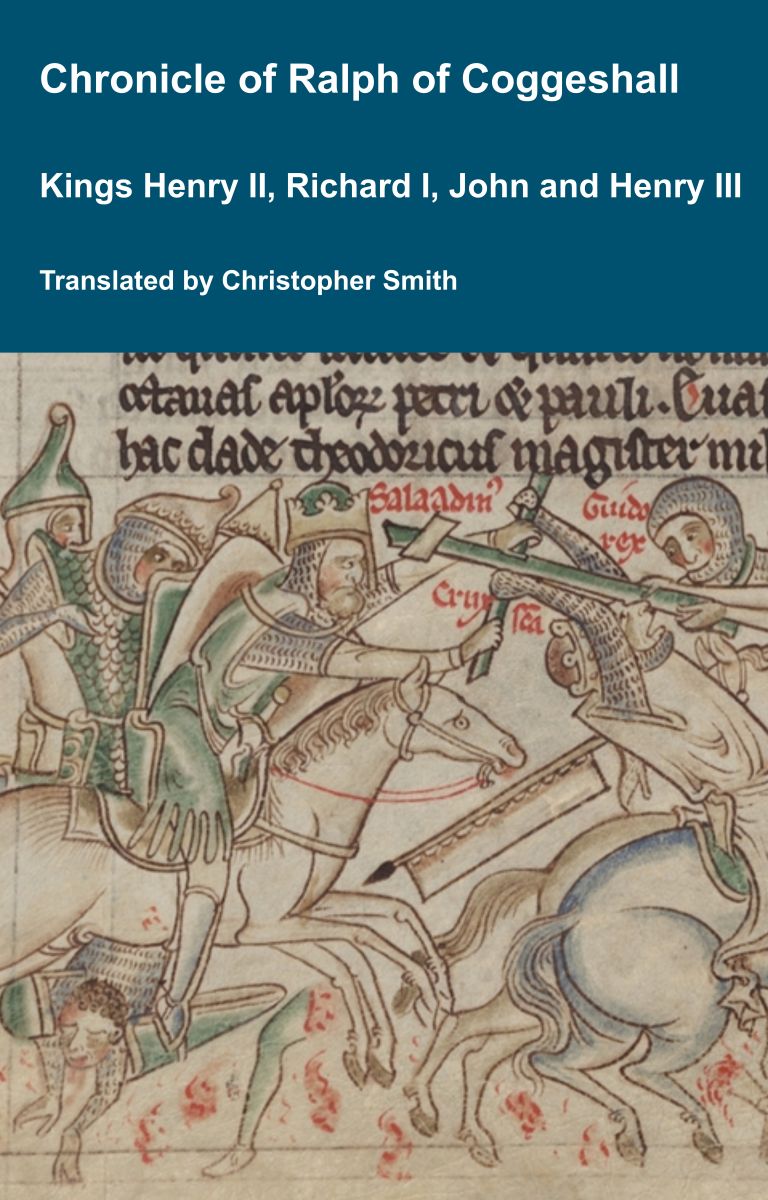
Chronicle of Abbot Ralph of Coggeshall
The Chronicle of Abbot Ralph of Coggeshall (Chronicon Anglicanum) is an indispensable medieval history that brings to life centuries of English and European affairs through the eyes of a learned Cistercian monk. Ralph of Coggeshall, abbot of the Abbey of Coggeshall in Essex in the early 13th century, continued and expanded his community’s chronicle, documenting events from the Norman Conquest of 1066 into the tumultuous reign of King Henry III. Blending eyewitness testimony, careful compilation, and the monastic commitment to record-keeping, this chronicle offers a rare narrative of political intrigue, royal power struggles, and social upheaval in England and beyond. Ralph’s work captures the reigns of pivotal figures such as Richard I and King John, providing invaluable insights into their characters, decisions, and the forces that shaped medieval rule. More than a simple annal, Chronicon Anglicanum conveys the texture of medieval life and governance, making it a rich source for scholars and readers fascinated by English history, monastic authorship, and the shaping of the medieval world.
Available at Amazon in eBook and Paperback format.
In 1672 Robert Carr 3rd Baronet (age 35) was appointed Chancellor of the Duchy of Lancaster.
In 1710 William Berkeley 4th Baron Berkeley (age 46) was appointed Chancellor of the Duchy of Lancaster.

In 1727 John Manners 3rd Duke Rutland (age 30) was appointed Chancellor of the Duchy of Lancaster.
In 1803 Thomas Pelham 2nd Earl Chichester (age 46) was appointed Chancellor of the Duchy of Lancaster.
In 1850 George Howard 7th Earl Carlisle (age 47) was appointed Chancellor of the Duchy of Lancaster which office he held until 1852.
In 1886 Edward Heneage 1st Baron Heneage (age 45) was appointed Chancellor of the Duchy of Lancaster.