

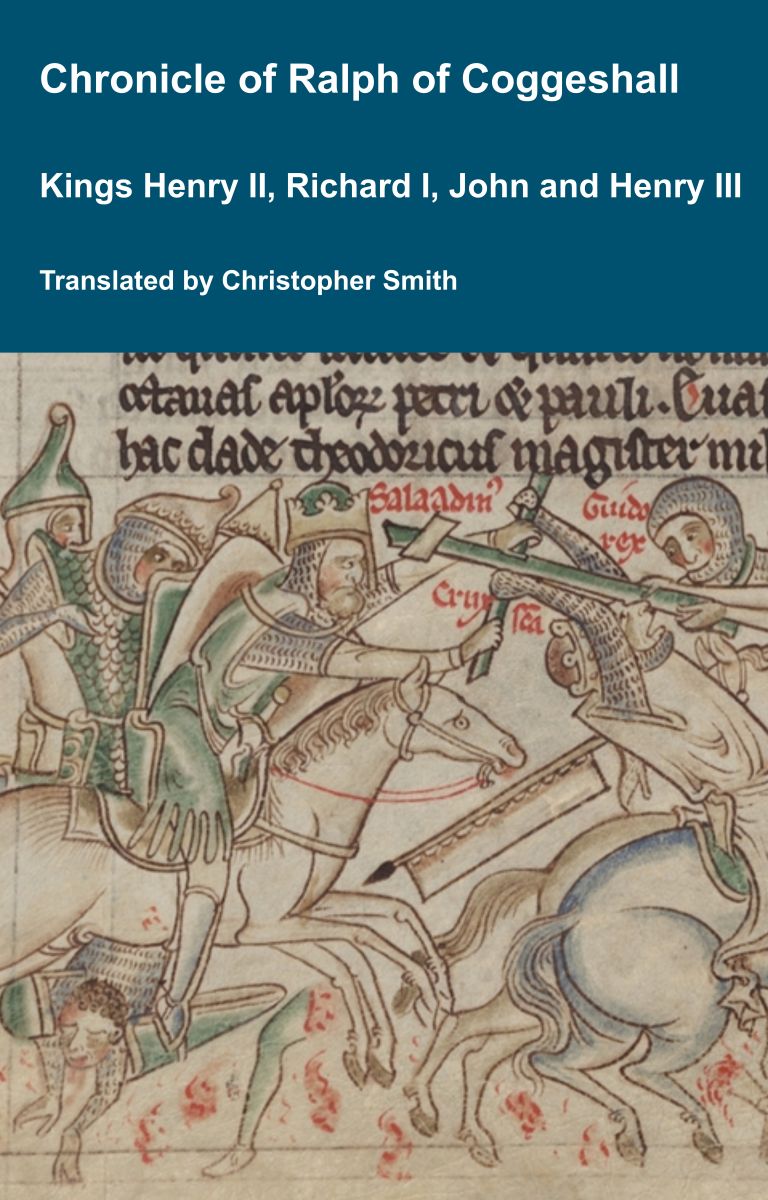
Chronicle of Abbot Ralph of Coggeshall
The Chronicle of Abbot Ralph of Coggeshall (Chronicon Anglicanum) is an indispensable medieval history that brings to life centuries of English and European affairs through the eyes of a learned Cistercian monk. Ralph of Coggeshall, abbot of the Abbey of Coggeshall in Essex in the early 13th century, continued and expanded his community’s chronicle, documenting events from the Norman Conquest of 1066 into the tumultuous reign of King Henry III. Blending eyewitness testimony, careful compilation, and the monastic commitment to record-keeping, this chronicle offers a rare narrative of political intrigue, royal power struggles, and social upheaval in England and beyond. Ralph’s work captures the reigns of pivotal figures such as Richard I and King John, providing invaluable insights into their characters, decisions, and the forces that shaped medieval rule. More than a simple annal, Chronicon Anglicanum conveys the texture of medieval life and governance, making it a rich source for scholars and readers fascinated by English history, monastic authorship, and the shaping of the medieval world.
Available at Amazon in eBook and Paperback format.
Common Pleas is in Miscellaneous.
John Evelyn's Diary. 25th June 1696. A trial in the Common Pleas between the Lady Purbeck Temple and Mr. Temple, a nephew of Sir Purbeck, concerning a deed set up to take place of several wills. This deed was proved to be forged. The cause went on my lady's side. This concerning my son-in-law, Draper, I stayed almost all day at Court. A great supper was given to the jury, being persons of the best condition in Buckinghamshire.
On 9th October 1591 Richard Brownlow [aged 38] was appointed Chief Prothonotary of the Court of Common Pleas which office he held until heis death which made him a very wealthy.
In June 1668 Hugh May [aged 46] was appointed Comptroller of the King's Works and Clerk to the Recognizances.
In 1514 Lewis Pollard [aged 49] was appointed Judge of the Common Pleas which office he held until 1526.
In 1520 Richard Broke was appointed Judge of the Common Pleas.
On 5th November 1545 John Hynde [aged 65] was appointed Judge of the Common Pleas.
On 10th May 1625 Henry Yelverton [aged 58] was appointed the fifth Judge of the Common Pleas.
In 1686 John Powell [aged 54] was appointed Judge of the Common Pleas.
On 10th November 1345 William de Shareshull [aged 55] was appointed Second Justice of the Common Pleas.
In 1483 Roger Townshend [aged 58] was appointed Third Justice of the Common Pleas followin the promotion of John Catesby [aged 50] [presumably to Second Justice of the Common Pleas].
Chronicle of Walter of Guisborough
A canon regular of the Augustinian Guisborough Priory, Yorkshire, formerly known as The Chronicle of Walter of Hemingburgh, describes the period from 1066 to 1346. Before 1274 the Chronicle is based on other works. Thereafter, the Chronicle is original, and a remarkable source for the events of the time. This book provides a translation of the Chronicle from that date. The Latin source for our translation is the 1849 work edited by Hans Claude Hamilton. Hamilton, in his preface, says: 'In the present work we behold perhaps one of the finest samples of our early chronicles, both as regards the value of the events recorded, and the correctness with which they are detailed; Nor will the pleasing style of composition be lightly passed over by those capable of seeing reflected from it the tokens of a vigorous and cultivated mind, and a favourable specimen of the learning and taste of the age in which it was framed.'
Available at Amazon in eBook and Paperback format.
In 1484 Roger Townshend [aged 59] was appointed Second Justice of the Common Pleas after the death of John Catesby [aged 51].
In 1483 Roger Townshend [aged 58] was appointed Third Justice of the Common Pleas followin the promotion of John Catesby [aged 50] [presumably to Second Justice of the Common Pleas].