

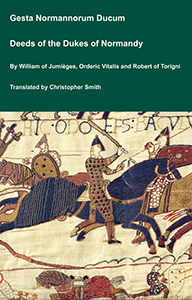
The Deeds of the Dukes of Normandy
The Gesta Normannorum Ducum [The Deeds of the Dukes of Normandy] is a landmark medieval chronicle tracing the rise and fall of the Norman dynasty from its early roots through the pivotal events surrounding the Norman Conquest of England. Originally penned in Latin by the monk William of Jumièges shortly before 1060 and later expanded at the behest of William the Conqueror, the work chronicles the deeds, politics, battles, and leadership of the Norman dukes, especially William’s own claim to the English throne. The narrative combines earlier historical sources with firsthand information and oral testimony to present an authoritative account of Normandy’s transformation from a Viking settlement into one of medieval Europe’s most powerful realms. William’s history emphasizes the legitimacy, military prowess, and governance of the Norman line, framing their expansion, including the conquest of England, as both divinely sanctioned and noble in purpose. Later chroniclers such as Orderic Vitalis and Robert of Torigni continued the history, extending the coverage into the 12th century, providing broader context on ducal rule and its impact. Today this classic work remains a foundational source for understanding Norman identity, medieval statesmanship, and the historical forces that reshaped England and Western Europe between 800AD and 1100AD.
Available at Amazon in eBook and Paperback format.
Created Baronetesses of England is in Baronetcies of England.
A Baronet is a Commoner. Baronets are eligible for election to the House of Commons. Baronets are not part of the Peerage.
Baronetcies did occur before 1600, but very rarely. The title appears to have been equivalent to Banneret.
In 1611 King James I of England and Ireland and VI of Scotland granted letters patent to two hundred gentlemen, of good birth with an income of at least £1,000 a year, in return for which each was required to pay for the upkeep of thirty soldiers for three years. These Baronets were created on 22 May 1611, 29 Jun 1611, 24 Sep 1611 and 25 Nov 1611.
Wives of Baronets are referred to as "Lady"; they are not Baronetesses. Most Baronetcies descend through the male line only hence Baronetesses are rare. See Created Baronetesses of England.


On 19th December 1635 Mary Witham 1st Baronetess Bolles [aged 56] was created 1st Lady Bolles by King Charles I of England, Scotland and Ireland [aged 35] with remainder to her heirs male and assignees. The only creation of a Baronetess in history. Bolles the name of her late husband Thomas Bolles who had died nine months before.


