


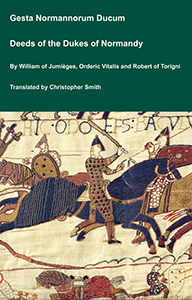
The Deeds of the Dukes of Normandy
The Gesta Normannorum Ducum [The Deeds of the Dukes of Normandy] is a landmark medieval chronicle tracing the rise and fall of the Norman dynasty from its early roots through the pivotal events surrounding the Norman Conquest of England. Originally penned in Latin by the monk William of Jumièges shortly before 1060 and later expanded at the behest of William the Conqueror, the work chronicles the deeds, politics, battles, and leadership of the Norman dukes, especially William’s own claim to the English throne. The narrative combines earlier historical sources with firsthand information and oral testimony to present an authoritative account of Normandy’s transformation from a Viking settlement into one of medieval Europe’s most powerful realms. William’s history emphasizes the legitimacy, military prowess, and governance of the Norman line, framing their expansion, including the conquest of England, as both divinely sanctioned and noble in purpose. Later chroniclers such as Orderic Vitalis and Robert of Torigni continued the history, extending the coverage into the 12th century, providing broader context on ducal rule and its impact. Today this classic work remains a foundational source for understanding Norman identity, medieval statesmanship, and the historical forces that reshaped England and Western Europe between 800AD and 1100AD.
Available at Amazon in eBook and Paperback format.
Dean of Canterbury is in Dean. See Canterbury Cathedral [Map].
Before 1020 Archbishop Æthelnoth was appointed Dean of Canterbury.
Anglo-Saxon Chronicle. 1020. This year came King Knute (age 25) back to England; and there was at Easter a great council at Cirencester, Gloucestershire [Map], where Alderman Ethelward was outlawed, and Edwy, king of the churls. This year went the king to Assingdon; with Earl Thurkyll, and Archbishop Wulfstan, and other bishops, and also abbots, and many monks with them; and he ordered to be built there a minster of stone and lime, for the souls of the men who were there slain, and gave it to his own priest, whose name was Stigand; and they consecrated the minster at Assingdon. And Ethelnoth the monk, who had been dean at Christ's church, was the same year on the ides of November consecrated Bishop of Christ's church by Archbishop Wulfstan.
In 1615 Charles Fotherby (age 66) was appointed Dean of Canterbury.
On 3rd January 1644 Dean Thomas Turner (age 53) was appointed Dean of Canterbury.

In 1672 Archbishop John Tillotson (age 41) was appointed Dean of Canterbury.
In 1689 Archbishop John Sharp (age 43) was appointed Dean of Canterbury.
John Evelyn's Diary. 8th March 1689. Dr. Tillotson (age 58), Dean of Canterbury, made an excellent discourse on Matt. v. 44, exhorting to charity and forgiveness of enemies; I suppose purposely, the new Parliament being furious about impeaching those who were obnoxious, and as their custom has ever been, going on violently, without reserve, or modification, while wise men were of opinion the most notorious offenders being named and excepted, an Act of Amnesty would be more seasonable, to pacify the minds of men in so general a discontent of the nation, especially of those who did not expect to see the government assumed without any regard to the absent King, or proving a spontaneous abdication, or that the birth of the Prince of Wales was an imposture; five of the Bishops also still refusing to take the new oath.
In 1734 Dean John Lynch (age 36) was appointed Dean of Canterbury.
On 19th September 1771 Archbishop John Moore (age 41) was appointed Dean of Canterbury.
Abbot John Whethamstede’s Chronicle of the Abbey of St Albans
Abbot John Whethamstede's Register aka Chronicle of his second term at the Abbey of St Albans, 1451-1461, is a remarkable text that describes his first-hand experience of the beginning of the Wars of the Roses including the First and Second Battles of St Albans, 1455 and 1461, respectively, their cause, and their consequences, not least on the Abbey itself. His text also includes Loveday, Blore Heath, Northampton, the Act of Accord, Wakefield, and Towton, and ends with the Coronation of King Edward IV. In addition to the events of the Wars of the Roses, Abbot John, or his scribes who wrote the Chronicle, include details in the life of the Abbey such as charters, letters, land exchanges, visits by legates, and disputes, which provide a rich insight into the day-to-day life of the Abbey, and the challenges faced by its Abbot.
Available at Amazon in eBook and Paperback format.
In 1790 Bishop William Buller (age 55) was translated to Dean of Canterbury.