

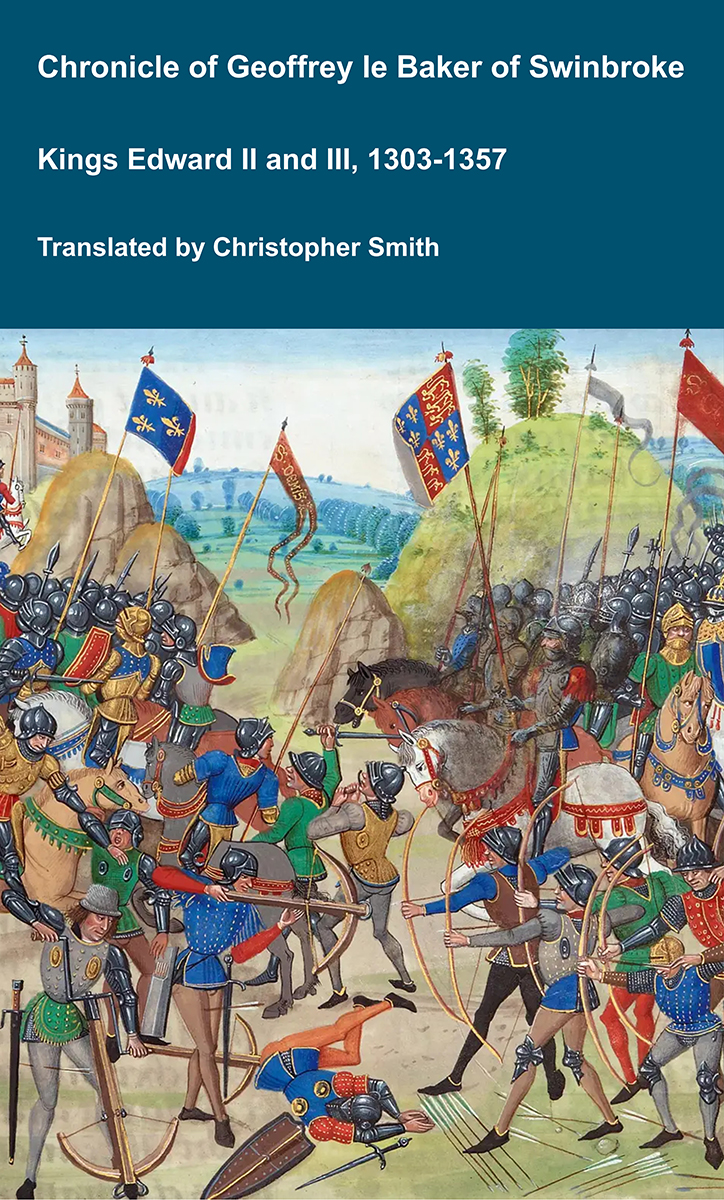
Chronicle of Geoffrey le Baker of Swinbroke
Baker was a secular clerk from Swinbroke, now Swinbrook, an Oxfordshire village two miles east of Burford. His Chronicle describes the events of the period 1303-1356: Gaveston, Bannockburn, Boroughbridge, the murder of King Edward II, the Scottish Wars, Sluys, Crécy, the Black Death, Winchelsea and Poitiers. To quote Herbert Bruce 'it possesses a vigorous and characteristic style, and its value for particular events between 1303 and 1356 has been recognised by its editor and by subsequent writers'. The book provides remarkable detail about the events it describes. Baker's text has been augmented with hundreds of notes, including extracts from other contemporary chronicles, such as the Annales Londonienses, Annales Paulini, Murimuth, Lanercost, Avesbury, Guisborough and Froissart to enrich the reader's understanding. The translation takes as its source the 'Chronicon Galfridi le Baker de Swynebroke' published in 1889, edited by Edward Maunde Thompson.
Available at Amazon in eBook and Paperback format.
Groom of the Stool is in Grooms.
In 1509 William Compton [aged 27] was appointed Groom of the Stool to King Henry VIII of England and Ireland [aged 17].
In 1526 Henry Norreys [aged 44] was appointed Groom of the Stool.

John Evelyn's Diary. 17th June 1683. I visited my Lady Arlington [aged 49], groom of the stole to her Majesty [aged 44], who being hardly set down to supper, word was brought her that the Queen was going into the park to walk, it being now near eleven at night; the alarm caused the Countess to rise in all haste, and leave her supper to us.
In 1685 Robert Leke 3rd Earl Scarsdale [aged 30] was appointed Groom of the Stool.
John Evelyn's Diary. 17th February 1685. This morning his Ma* [aged 51] restor'd the staffe and key to Lord Arlington [aged 67], Chamberlaine; to Mr. Savell [aged 43], Vice-chamberlaine; to Lords Newport [aged 64] and Malnard [aged 62], Treasurer and Comptroler of the Household; Lord Godolphin [aged 39] made Chamberlaine to ye Queene [aged 26]; Lord Peterborow [aged 63] Groome of ye Stole in place of the Earle of Bath [aged 56]; the Treasurer's staff to the Earle of Rochester [aged 42]; and his brother the Earle of Clarendon Lord Privie Seale in place of the Marquis of Halifax [aged 51], who was made President of the Council; the Secretarys of State remaining as before.
John Evelyn's Diary. 23rd January 1686. I din'd at my Lady Arlington's [aged 52], groome of the stole to the Queene Dowager [aged 47], at Somerset House [Map], where din'd the Countesses of Devonshire [aged 40], Dover [aged 76], &c. in all 11 ladys of quality, no man but myselfe being there.
John Evelyn's Diary. 5th December 1686. I dined at my Lady Arlington's [aged 52], Groom of the Stole to the Queen Dowager [aged 48] at Somerset House [Map], where dined divers French noblemen, driven out of their country by the persecution.
On 22nd April 1689 Elizabeth Butler Countess Derby [aged 29] was appointed Principal Lady in Waiting to Mary Stewart II Queen England Scotland and Ireland [aged 26] as well as Groom of the Stool and Mistress of the Robes attracting a salary of £1200 per annum (£800 and £400 respectively).


John Evelyn's Diary. 8th December 1700. Great alterations of officers at Court, and elsewhere, - Lord Chief Justice Treby died; he was a learned man in his profession, of which we have now few, never fewer; the Chancery requiring so little skill in deep law-learning, if the practicer can talk eloquently in that Court; so that probably few care to study the law to any purpose. Lord Marlborough [aged 50] Master of the Ordnance, in place of Lord Romney [aged 59] made Groom of the Stole. The Earl of Rochester [aged 58] goes Lord Lieutenant of Ireland.


In 1761 Francis Hastings 10th Earl Huntingdon [aged 31] was appointed Groom of the Stool which position he held until 1770.
Chronicle of a Bourgeois of Valenciennes
Récits d’un bourgeois de Valenciennes aka The Chronicle of a Bourgeois of Valenciennes is a vivid 14th-century vernacular chronicle written by an anonymous urban chronicler from Valenciennes in the County of Hainaut. It survives in a manuscript that describes local and regional history from about 1253 to 1366, blending chronology, narrative episodes, and eyewitness-style accounts of political, military, and social events in medieval France, Flanders, and the Low Countries. The work begins with a chronological framework of events affecting Valenciennes and its region under rulers such as King Philip VI of France and the shifting allegiances of local nobility. It includes accounts of conflicts, sieges, diplomatic manoeuvres, and the impact of broader struggles like the Hundred Years’ War on urban life in Hainaut. Written from the perspective of a burgher (bourgeois) rather than a monastery or royal court, the chronicle offers a rare lay viewpoint on high politics and warfare, reflecting how merchants, townspeople, and civic institutions experienced the turbulence of the 13th and 14th centuries. Its narrative style combines straightforward reporting of events with moral and civic observations, making it a valuable source for readers interested in medieval urban society, regional politics, and the lived experience of war and governance in pre-modern Europe.
Available at Amazon in eBook and Paperback format.
In 1812 Charles Burroughs-Paulet 13th Marquess Winchester [aged 47] was appointed Groom of the Stool to King George III [aged 73]. He held this office through the reigns of King George IV [aged 49] and King William IV [aged 46] until King William's death in 1837.
Thomas Heneage was appointed Groom of the Stool to King Henry VIII of England and Ireland.