

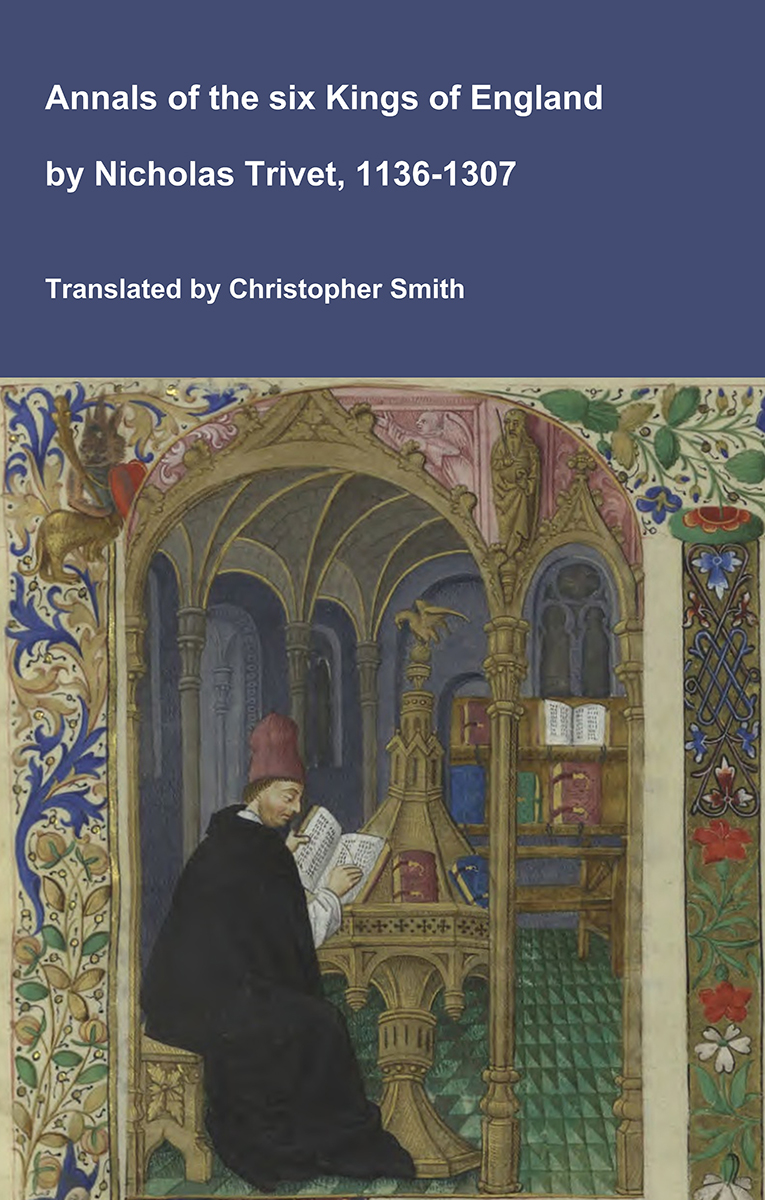
Annals of the six Kings of England by Nicholas Trivet
Translation of the Annals of the Six Kings of England by that traces the rise and rule of the Angevin aka Plantagenet dynasty from the mid-12th to early 14th century. Written by the Dominican scholar Nicholas Trivet, the work offers a vivid account of English history from the reign of King Stephen through to the death of King Edward I, blending political narrative with moral reflection. Covering the reigns of six monarchs—from Stephen to Edward I—the chronicle explores royal authority, rebellion, war, and the shifting balance between crown, church, and nobility. Trivet provides detailed insight into defining moments such as baronial conflicts, Anglo-French rivalry, and the consolidation of royal power under Edward I, whose reign he describes with particular immediacy. The Annals combines careful year-by-year reporting with thoughtful interpretation, presenting history not merely as a sequence of events but as a moral and political lesson. Ideal for readers interested in medieval history, kingship, and the origins of the English state, this chronicle remains a valuable and accessible window into the turbulent world of the Plantagenet kings.
Available at Amazon in eBook and Paperback format.
Keeper is in Royal Household.
In December 1263 Roger Leybourne was appointed Keeper Kent Surrey and Sussex, Warden of the Cinque Ports and High Sheriff of Kent.
On 20th November 1415 Edward Courtenay was appointed Keeper New Forest.
After 4th August 1265 Roger Leybourne was appointed Keeper Westmoreland.
On 4th February 1600 John Leigh had a grant of the office of Keeper of Home Park in Kent and Master of the Wild Beasts.
In 1612 Walter Cope was appointed Keeper of Hyde Park.
On 18th May 1509 John Marney 2nd Baron Marney was appointed Keeper of Rochester Castle.
In or before 1551 William Pickering was appointed Keeper of Keeper of Sheriff Hutton Park and Constable of Sheriff Hutton Castle.
On 14th December 1595 Anne Morgan Baroness Hunsdon was appointed Keeper of Somerset House.
From 1391 to 1398 Bishop Guy Mone Aka Mohun was appointed Keeper of the Jewels.
In 1599 Catherine Knyvet Countess Suffolk was appointed Keeper of the Jewels to Anne of Denmark Queen Consort Scotland England and Ireland.


In 1668 William Chiffinch was appointed Keeper of the King's Private Closet.
In 1661 Henry Bennet 1st Earl Arlington was appointed Keeper of the Privy Purse.


Samuel Pepys' Diary. 26th July 1662. Thence to Mrs. Sarah, and there looked over my Lord's lodgings, which are very pretty; and White Hall garden and the Bowling-ally (where lords and ladies are now at bowles), in brave condition. Mrs. Sarah told me how the falling out between my Baroness Castlemaine's and her Lord was about christening of the child lately1, which he would have, and had done by a priest: and, some days after, she had it again christened by a minister; the King, and Lord of Oxford, and Duchesse of Suffolk, being witnesses: and christened with a proviso, that it had not already been christened. Since that she left her Lord, carrying away every thing in the house; so much as every dish, and cloth, and servant but the porter. He is gone discontented into France, they say, to enter a monastery; and now she is coming back again to her house in Kingstreet. But I hear that the Queen did prick her out of the list presented her by the King;2 desiring that she might have that favour done her, or that he would send her from whence she come: and that the King was angry and the Queen discontented a whole day and night upon it; but that the King hath promised to have nothing to do with her hereafter. But I cannot believe that the King can fling her off so, he loving her too well: and so I writ this night to my Lady to be my opinion; she calling her my lady, and the lady I admire. Here I find that my Lord hath lost the garden to his lodgings, and that it is turning into a tennis-court. Hence by water to the Wardrobe to see how all do there, and so home to supper and to bed.
Note 1. The boy was born in June at Baroness Castlemaine's house in King Street. By the direction of Lord Castlemaine, who had become a Roman Catholic, the child was baptized by a priest, and this led to a final separation between husband and wife. Some days afterwards the child was again baptized by the rector of St. Margaret's, Westminster, in presence of the godparents, the King, Aubrey De Vere, Earl of Oxford, and Barbara, Countess of Suffolk, first Lady of the Bedchamber to the Queen and Baroness Castlemaine's aunt. The entry in the register of St. Margaret's is as follows: "1662 June 18 Charles Palmer Ld Limbricke, s. to ye right honorble Roger Earl of Castlemaine by Barbara" (Steinman's "Memoir of Barbara, Duchess of Cleveland", 1871, p. 33). The child was afterwards called Charles Fitzroy, and was created Duke of Southampton in 1674. He succeeded his mother in the dukedom of Cleveland in 1709, and died 1730.
Note 2. By the King's command Lord Clarendon, much against his inclination, had twice visited his royal mistress with a view of inducing her, by persuasions which he could not justify, to give way to the King's determination to have Baroness Castlemaine's of her household.... Lord Clarendon has given a full account of all that transpired between himself, the King and the Queen, on this very unpleasant business ('Continuation of Life of Clarendon,' 1759, ff. 168-178). Steinman's Memoir of Duchess of Cleveland, p. 35. The day at length arrived when Baroness Castlemaine's was to be formally admitted a Lady of the Bedchamber. The royal warrant, addressed to the Lord Chamberlain, bears date June 1, 1663, and includes with that of her ladyship, the names of the Duchess of Buckingham, the Countesses of Chesterfield and Bath, and the Countess Mareshall. A separate warrant of the same day directs his lordship to admit the Countess of Suffolk as Groom of the Stole and first Lady of the Bedchamber, to which undividable offices she had, with the additional ones of Mistress of the Robes and Keeper of the Privy Purse, been nominated by a warrant dated April 2, 1662, wherein the reception of her oath is expressly deferred until the Queen's household shall be established. We here are furnished with the evidence that Charles would not sign the warrants for the five until Catherine had withdrawn her objection to his favourite one. Addenda to Steinman's Memoir of Duchess of Cleveland (privately printed), 1874, p. i.
In 1711 Abigail Hill Baroness Masham was appointed Keeper of the Privy Purse which office she held until 1714 when Queen Anne died.
In 1760 James Brudenell 5th Earl Cardigan was appointed Keeper of the Privy Purse.
Edward Neville was appointed Keeper of the Sewer to King Henry VIII of England and Ireland.
In 1307 Archbishop William Melton was appointed Controller of the Wardrobe.
In 1341 Bishop William Evendon was appointed Keeper of the Great Wardrobe which office he held until 1344.
From 1390 to 1398 Bishop Richard Clifford was appointed Keeper of the Great Wardrobe.
On 26th October 1446 Thomas Tuddenham was appointed Keeper of the Great Wardrobe.