

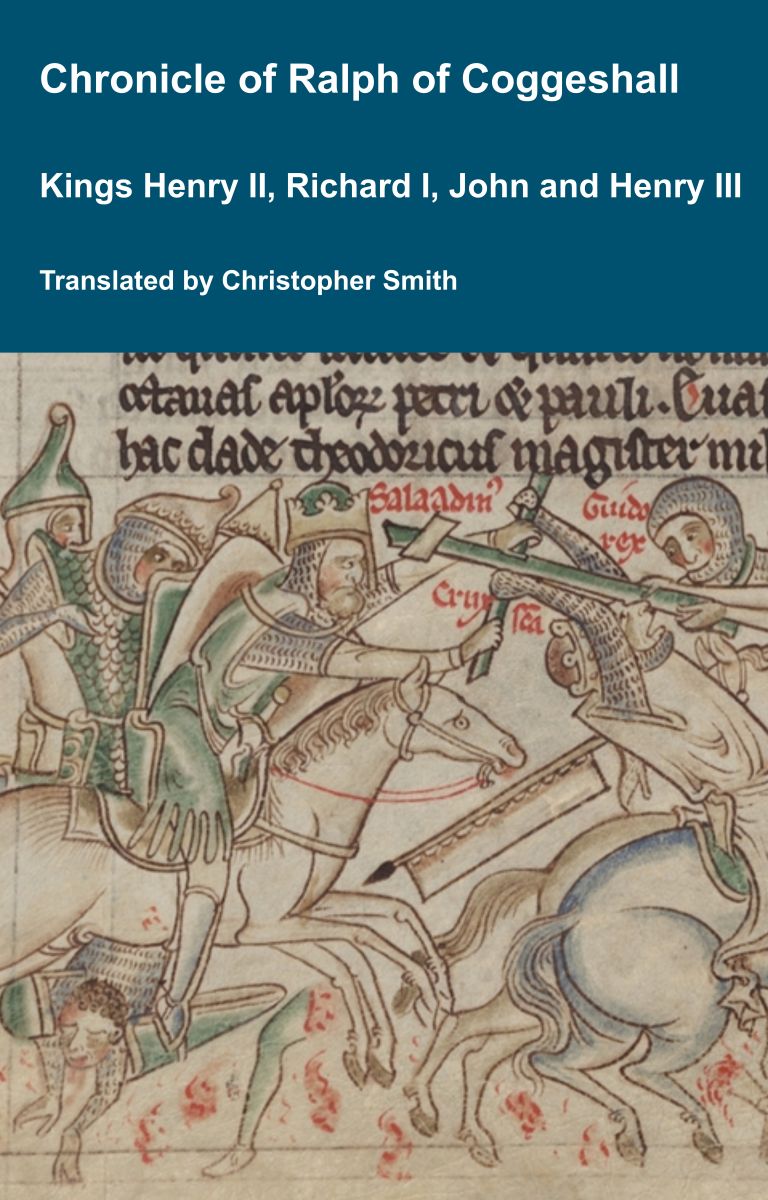
Chronicle of Abbot Ralph of Coggeshall
The Chronicle of Abbot Ralph of Coggeshall (Chronicon Anglicanum) is an indispensable medieval history that brings to life centuries of English and European affairs through the eyes of a learned Cistercian monk. Ralph of Coggeshall, abbot of the Abbey of Coggeshall in Essex in the early 13th century, continued and expanded his community’s chronicle, documenting events from the Norman Conquest of 1066 into the tumultuous reign of King Henry III. Blending eyewitness testimony, careful compilation, and the monastic commitment to record-keeping, this chronicle offers a rare narrative of political intrigue, royal power struggles, and social upheaval in England and beyond. Ralph’s work captures the reigns of pivotal figures such as Richard I and King John, providing invaluable insights into their characters, decisions, and the forces that shaped medieval rule. More than a simple annal, Chronicon Anglicanum conveys the texture of medieval life and governance, making it a rich source for scholars and readers fascinated by English history, monastic authorship, and the shaping of the medieval world.
Available at Amazon in eBook and Paperback format.
Lady of the Bedchamber is in Ladies.
After 1486 Elizabeth Tilney Countess of Surrey [aged 42] was appointed Lady of the Bedchamber to Elizabeth York Queen Consort England [aged 19].


After 1549 Lettice Knollys Countess Essex and Leicester [aged 5] was appointed Lady of the Bedchamber to Queen Elizabeth I of England and Ireland [aged 15].

Around 1567 Bess of Hardwick [aged 40] was appointed Lady of the Bedchamber to Queen Elizabeth I of England and Ireland [aged 33].
Around 1578 Bridget Chaworth [aged 36] was appointed Lady of the Bedchamber to Queen Elizabeth I of England and Ireland [aged 44] who she served for twenty-five years.
In 1580 Anne Vavasour [aged 20] was appointed Lady of the Bedchamber to Queen Elizabeth [aged 46].


Around 1589 Margaret Radclyffe of Ordsall Hall [aged 16] was appointed Lady of the Bedchamber to Queen Elizabeth I of England and Ireland [aged 55]. Elizabeth had become enamoured of her when she and her twin brother Alexander Radclyffe of Ordsall Hall [aged 16] were arrived at Court. The arrival of the two young Person so wondrously alike in their striking physical beauty created something of a mild sensation. She soon became chief among Elizabeth's ladies.
In 1603 Anne Keilway Baroness Harington [aged 49] and her daughter Lucy Harrington Countess Bedford [aged 23] travelled to Scotland to gain favour with the new Queen Anne of Denmark Queen Consort Scotland England and Ireland [aged 28]. She was subsequently appointed Lady of the Bedchamber and governess to Princess Elizabeth Stewart Queen Bohemia [aged 6].


After the death of Queen Elizabeth I of England and Ireland [deceased] on 24th March 1603 Bridget Chaworth [aged 61] served as Lady of the Bedchamber to Anne of Denmark Queen Consort Scotland England and Ireland [aged 28].
In 1660 Barbara Villiers Countess Suffolk [aged 37] was appointed Lady of the Bedchamber to Catherine of Braganza Queen Consort England [aged 21] which position she held until 1681.


Around 1660 Elizabeth Trentham Viscountess Cullen [aged 20] was appointed Lady of the Bedchamber to Catherine of Braganza Queen Consort England [aged 21].


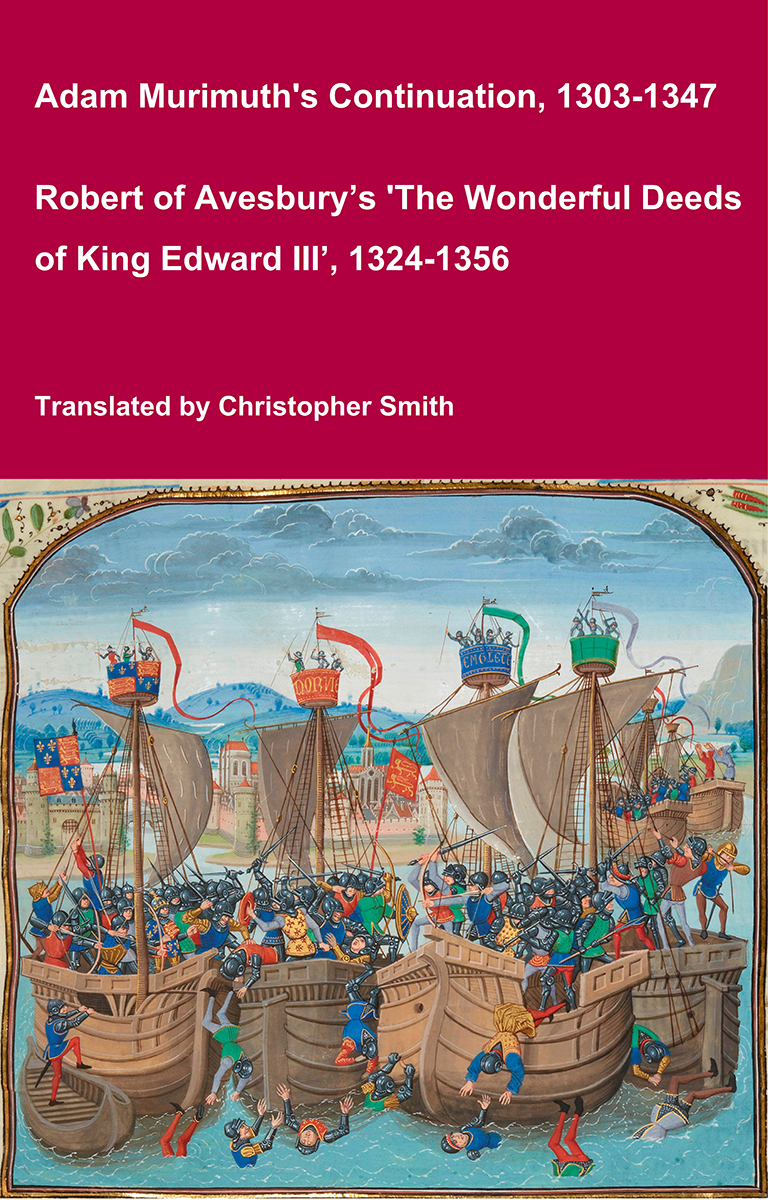
Adam Murimuth's Continuation and Robert of Avesbury’s 'The Wonderful Deeds of King Edward III'
This volume brings together two of the most important contemporary chronicles for the reign of Edward III and the opening phases of the Hundred Years’ War. Written in Latin by English clerical observers, these texts provide a vivid and authoritative window into the political, diplomatic, and military history of fourteenth-century England and its continental ambitions. Adam Murimuth Continuatio's Chronicarum continues an earlier chronicle into the mid-fourteenth century, offering concise but valuable notices on royal policy, foreign relations, and ecclesiastical affairs. Its annalistic structure makes it especially useful for establishing chronology and tracing the development of events year by year. Complementing it, Robert of Avesbury’s De gestis mirabilibus regis Edwardi tertii is a rich documentary chronicle preserving letters, treaties, and official records alongside narrative passages. It is an indispensable source for understanding Edward III’s claim to the French crown, the conduct of war, and the mechanisms of medieval diplomacy. Together, these works offer scholars, students, and enthusiasts a reliable and unembellished account of a transformative period in English and European history. Essential for anyone interested in medieval chronicles, the Hundred Years’ War, or the reign of Edward III.
Available at Amazon in eBook and Paperback format.
Samuel Pepys' Diary. 26th July 1662. Thence to Mrs. Sarah, and there looked over my Lord's lodgings, which are very pretty; and White Hall garden and the Bowling-ally (where lords and ladies are now at bowles), in brave condition. Mrs. Sarah told me how the falling out between my Baroness Castlemaine's [aged 21] and her Lord was about christening of the child lately1, which he would have, and had done by a priest: and, some days after, she had it again christened by a minister; the King [aged 32], and Lord of Oxford, and Duchesse of Suffolk, being witnesses: and christened with a proviso, that it had not already been christened. Since that she left her Lord, carrying away every thing in the house; so much as every dish, and cloth, and servant but the porter. He is gone discontented into France, they say, to enter a monastery; and now she is coming back again to her house in Kingstreet. But I hear that the Queen [aged 23] did prick her out of the list presented her by the King;2 desiring that she might have that favour done her, or that he would send her from whence she come: and that the King was angry and the Queen discontented a whole day and night upon it; but that the King hath promised to have nothing to do with her hereafter. But I cannot believe that the King can fling her off so, he loving her too well: and so I writ this night to my Lady to be my opinion; she calling her my lady, and the lady I admire. Here I find that my Lord hath lost the garden to his lodgings, and that it is turning into a tennis-court. Hence by water to the Wardrobe to see how all do there, and so home to supper and to bed.
Note 1. The boy was born in June at Baroness Castlemaine's house in King Street. By the direction of Lord Castlemaine, who had become a Roman Catholic, the child was baptized by a priest, and this led to a final separation between husband and wife. Some days afterwards the child was again baptized by the rector of St. Margaret's, Westminster [Map], in presence of the godparents, the King, Aubrey De Vere [aged 35], Earl of Oxford, and Barbara, Countess of Suffolk [aged 40], first Lady of the Bedchamber to the Queen and Baroness Castlemaine's aunt. The entry in the register of St. Margaret's [Map] is as follows: "1662 June 18 Charles Palmer Ld Limbricke, s. to ye right honorble Roger Earl of Castlemaine by Barbara" (Steinman's "Memoir of Barbara, Duchess of Cleveland", 1871, p. 33). The child was afterwards called Charles Fitzroy, and was created Duke of Southampton in 1674. He succeeded his mother in the dukedom of Cleveland in 1709, and died 1730.
Note 2. By the King's command Lord Clarendon [aged 54], much against his inclination, had twice visited his royal mistress with a view of inducing her, by persuasions which he could not justify, to give way to the King's determination to have Baroness Castlemaine's of her household.... Lord Clarendon has given a full account of all that transpired between himself, the King and the Queen, on this very unpleasant business ('Continuation of Life of Clarendon,' 1759, ff. 168-178). Steinman's Memoir of Duchess of Cleveland, p. 35. The day at length arrived when Baroness Castlemaine's was to be formally admitted a Lady of the Bedchamber. The royal warrant, addressed to the Lord Chamberlain [aged 61], bears date June 1, 1663, and includes with that of her ladyship, the names of the Duchess of Buckingham [aged 24], the Countesses of Chesterfield and Bath [aged 22], and the Countess Mareshall. A separate warrant of the same day directs his lordship to admit the Countess of Suffolk as Groom of the Stole and first Lady of the Bedchamber, to which undividable offices she had, with the additional ones of Mistress of the Robes and Keeper of the Privy Purse, been nominated by a warrant dated April 2, 1662, wherein the reception of her oath is expressly deferred until the Queen's household shall be established. We here are furnished with the evidence that Charles would not sign the warrants for the five until Catherine had withdrawn her objection to his favourite one. Addenda to Steinman's Memoir of Duchess of Cleveland (privately printed), 1874, p. i.
 Become a Member via our Buy Me a Coffee page to read more.

In 1663 Mary Fairfax Duchess Buckingham [aged 24] was appointed Lady of the Bedchamber to Catherine of Braganza Queen Consort England [aged 24] which position she held until 1693.

Samuel Pepys' Diary. 6th July 1668. Thence I to the playhouse, and saw a piece of the play, and glad to see Betterton [aged 32]; and so with wife and Deb. to Spring-garden, and eat a lobster, and so home in the evening and to bed. Great doings at Paris, I hear, with their triumphs for their late conquests! The Duchesse of Richmond [aged 20] sworn last week of the Queen's [aged 29] Bedchamber, and the King [aged 38] minding little else but what he used to do-about his women.
Before 16th June 1685 Elizabeth Sands was appointed Lady of the Bedchamber to Queen Elizabeth I of England and Ireland.
In 1714 Henrietta Hobart Countess Suffolk [aged 25] was appointed Lady of the Bedchamber to Caroline Hohenzollern Queen Consort England [aged 30].


Before 1715 Camilla Colville Countess Tankerville [aged 17] was appointed Lady of the Bedchamber to Caroline Hohenzollern Queen Consort England [aged 31].
In 1761 Elizabeth Gunning Duchess Hamilton and Argyll [aged 27] was appointed Lady of the Bedchamber to Charlotte Mecklenburg Strelitz Queen Consort England [aged 16].


Before 1813 Mary Taylour [aged 30] was appointed Lady of the Bedchamber to Princess Augusta Charlotte Hanover [aged 75].


Before September 1823 Elizabeth Boughton Baroness Templetown [aged 70] was appointed Lady of the Bedchamber to Princess Amelia Hanover.
In 1837 Pyne Crosbie Lady of the Bedchamber [aged 57] was appointed Lady of the Bedchamber to Queen Victoria of the United Kingdom [aged 17].


In 1854 Jane Conyngham Baroness Churchill [aged 27] was appointed Lady of the Bedchamber to Queen Victoria of the United Kingdom [aged 34].
Chronicle of a Bourgeois of Valenciennes
Récits d’un bourgeois de Valenciennes aka The Chronicle of a Bourgeois of Valenciennes is a vivid 14th-century vernacular chronicle written by an anonymous urban chronicler from Valenciennes in the County of Hainaut. It survives in a manuscript that describes local and regional history from about 1253 to 1366, blending chronology, narrative episodes, and eyewitness-style accounts of political, military, and social events in medieval France, Flanders, and the Low Countries. The work begins with a chronological framework of events affecting Valenciennes and its region under rulers such as King Philip VI of France and the shifting allegiances of local nobility. It includes accounts of conflicts, sieges, diplomatic manoeuvres, and the impact of broader struggles like the Hundred Years’ War on urban life in Hainaut. Written from the perspective of a burgher (bourgeois) rather than a monastery or royal court, the chronicle offers a rare lay viewpoint on high politics and warfare, reflecting how merchants, townspeople, and civic institutions experienced the turbulence of the 13th and 14th centuries. Its narrative style combines straightforward reporting of events with moral and civic observations, making it a valuable source for readers interested in medieval urban society, regional politics, and the lived experience of war and governance in pre-modern Europe.
Available at Amazon in eBook and Paperback format.
In 1863 Charlotte Knollys [aged 27] was appointed Lady of the Bedchamber to Alexandra Princess Wales [aged 18].


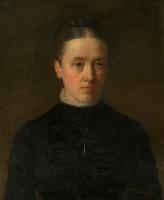
In 1877 Horatia Stopford [aged 42] was appointed Lady of the Bedchamber to Queen Victoria [aged 57]
The Times. 24th December 1895. The Duke of Leeds [deceased] died at Hornby Castle [Map], yesterday morning at 5 o'clock. He recently contracted a severe chill, which led to an attack of bronchitis. He took to his bed about a week ago and gradually sank. George Godolphin Osborne, ninth Duke of Leeds in the peerage of England, Marquis of Carmarthen, Earl of Danby, Viscount Latimer, and Baron Osbome of Kiveton, all in the peerage of England; Viscount Osbome and Viscount Dunblane in the peerage of Scotland; and Baron Godolphin of Paraham Royal, in the Peerage of the United Kingdom, a baronet, and a Prince or the Holy Roman Empire, was born in Paris in 1828, the eldest son of the eighth duke. He married, in 1861, the Hon. Fanny Georgiana Pitt [aged 58], daughter of the fourth Baron Rivers, who was born in 1836 and was Lady of the Bedchamber to the Princess of Wales from 1863 to 1873. He was appointed captain in the North Yorks Militia in 1852, and resigued in 1859, but was reappoined in 1861. He succeeded to the family honours in 1872, and has issue living three sons and five daughters. The family descends from Sir Edward Osborne, knight, who was Vice-President of the Council of the North in 1629 and Lieutenant-General of the forces raised there against the Parliamentary Army in 1841. His son was Treasurer of the Navy and Lord High Chancellor, and as Earl of Danby was impeeched by the Commons in 1679. The fifth duke married Amelia, in her own right Baroness Conyers, but this title left the main line in 1859 on the death of the seventh duke. The late duke was nephew of the late Rev. Lord Sydney Godolphin Osborne, who wrote much over the familiar signature "S.G.O.," and brother of Lord Francis George Godolphin Osborne [aged 65], who was rector of Great Elm, but joined the Church of Rome in 1875. The Duke of Leeds is succeeded by his eldest surviving son [aged 33], the Marquis of Carmarthen, who was born in 1862, was educated at Eton and Trinity College, Cambridge, and was formerly a lieutenant in the Yorkshire Hussars. Lord Carmarthen unsuccessfully contested the Newmarket Division of Cambridgeshire as a Conservative in 1886, and has sat since July, 1887, for the Brixton Division of Lambeth, in which constituency his sucoession to the peerage now creates a vacancy. Lord Carmarthen was an assistant Private Secretary to the Secretary for the Colonies (Lord Knutsford) from 1886 to 1888. He was appointed Treasurer of the Household on the formation of the present Ministry. He married, in 1884, Lady Katherine Frances Lambton [aged 33], daughter of the second Earl of Durham, and has issue four daughters.


Become a Member via our Buy Me a Coffee page to read more.
In 1901 Alice Maude Olivia Montagu Countess Derby [aged 38] was appointed Lady of the Bedchamber to Alexandra of Denmark Queen Consort England [aged 56].
In 1953 Rose Gwendolen Louisa McDonnell [aged 43] was appointed Lady of the Bedchamber to Queen Elizabeth II of the United Kingdom [aged 26].
Agnes Launcekrona Duchess Ireland was appointed Lady of the Bedchamber to Anne of Bohemia Queen Consort England.
Susan Villiers Countess Denbigh was appointed Lady of the Bedchamber to Henrietta Maria Bourbon Queen Consort England.


Anne Bourchier Baroness Dacre of Gilsland was appointed Lady of the Bedchamber to Catherine of Aragon Queen Consort England.

