

Chronicle of Walter of Guisborough
A canon regular of the Augustinian Guisborough Priory, Yorkshire, formerly known as The Chronicle of Walter of Hemingburgh, describes the period from 1066 to 1346. Before 1274 the Chronicle is based on other works. Thereafter, the Chronicle is original, and a remarkable source for the events of the time. This book provides a translation of the Chronicle from that date. The Latin source for our translation is the 1849 work edited by Hans Claude Hamilton. Hamilton, in his preface, says: 'In the present work we behold perhaps one of the finest samples of our early chronicles, both as regards the value of the events recorded, and the correctness with which they are detailed; Nor will the pleasing style of composition be lightly passed over by those capable of seeing reflected from it the tokens of a vigorous and cultivated mind, and a favourable specimen of the learning and taste of the age in which it was framed.'
Available at Amazon in eBook and Paperback format.
Lord is in Commoners Titles.

Henry Chaplin A Memoir: Youth I. It must have been immediately after the marriage of Diana Chaplin [aged 18], and probably in honour of that event, that a masquerade was held at Blankney Hall, of which a list of some of the principal guests and their impersonations has been preserved. Thomas Chaplin having died in 1747, his son John [aged 28], who was not yet married, was presumably the host on this occasion. He chose for himself the character of Henry V Ill., and if he enjoyed the same splendid proportions as his descendant, the last Squire, his choice was justified. An old yellow torn sheet of paper has been preserved on which in faded ink is written:
A LIST OF THE COMPANY AS THEY DANCED AT THE MASQUERADE AT BLANKNEY, THE 9TH JANUARY 1749.
Lord George Manners [aged 25]... A Spaniard
Mr. Glover... A Rich Vandyke
Mr. Chaplin.. King Harry the 8th
Mr. C. Chaplin [aged 18]... A Huzsar
Mr. Amcotts... A Venetian Dancer
Mr. Nevill... Mercury
Sir Francis Dashwood [aged 40]... Pluto (King of Hell with a Little infernal boy bearing up his train)
Mr. Pownall... A Vandyke
Mr. Thornton... A Dancer
Capt. Bell... A Chimney Sweeper (in black Satin)
Duke of Kingston [aged 38]... In a Gold White Domino
Mr. Carter... A Priest
Major Gibbon... Queen Elizabeth's Porter
Mr. Dashwood [aged 32], Bror to Sir Francis... A Russian
Mr. Stevens... A Black Domino
Mr. Porter... Mercury
Mr. Foster... A Domino
Mr. Willis... A Sailor
Mr. King... A Vandyke
Mr. Richd Welby... A Hungarian
Lady Vere Bertie.. A fair Maid of the Inn
Lady Tyrconnel... A Spanish Lady
Miss Wheat... Rubens' Wife
Miss Thornton... Flora
Miss Disney... Violette
Miss N. Amcotts... The Rising Morn
Miss Carter... Queen of the Scots as a widow
Lady Thorold... A Spanish Lady
Miss Mainwaring... Representing Night in a Black Gown with Stars
Miss Maddison... A Country Girl
Lady Dashwood... A Vandyke
Miss Bertie... A Dancer
Miss Bet Hales... An old-fashioned Lady
Mrs. Willie... A Country Girl
Miss I. Cust... Italian Dancer
Miss King... Aurette
Miss N. Welby... A Quaker
Mrs. Porter... A Turkish Lady
Miss Hales... A Country Girl
Miss Lucy Cust... An old Lady
COMPANY THAT SAT BY
Lady Vere Bertie... An Italian Peasant
Lord Tyrconnel... In a blue & silver Domino
Colonel Armiger...
Young Mr. Wills... Capt. Flask
Mr. Middlemore... In a Pink Domino
Mr. Villarial... Scaramouch
Mrs. Chaplin... An Old Woman
Lady George Manners (the Bride) [Diana Chaplin]... A Jardiniere
Mrs. Wills... Queen Elizabeth
Miss Truman... Columbine
Among all this motley crowd, not the least imposing figure was probably that of Sir Francis Dashwood, appropriate in the character chosen, since he was one of the most prominent supporters of the Hell Fire Club.1
Note 1. He was Chancellor of the Exchequer. Wilkes described him as one who from puzzling all his life at tavern bills was called by Lord Bute to administer the finances of the Kingdom which were 100 millions in debt He was the founder of the Society of the Franciscans at Medmenham Abbey, where the door was surmounted by the motto, "Fay ce que voudras" ["Do Whatever You Want"], and where he played the part of an immoral buffoon for the amusement of Privy Councillors and Members of Parliament.
Henry Chaplin A Memoir: Youth VI. Lord Henry Bentinck had died, I think, on the last day of 18701, and the Party Dinner was given quite early in the following year, 1871. As I was shown into the room, Mr. Disraeli said to me, "Both you and I have lost a great friend since we last parted." I replied, "Yes, Sir, I know that poor Lord Henry and you were great friends at one time, and he has often talked to me about you in those days." "Ah!" said Disraeli, "that is true, and I always wished it could have remained so." And then, after pausing a moment, he went on to say this, "I always said of Henry Bentinck that, taking him all round, I think he was probably the ablest man I ever knew, and with some eccentricities of character he combined the highest qualities of human nature in a greater degree than any I ever was acquainted with." This was a tribute, coming from a man such as Mr. Disraeli, which was indeed striking. It was as just in my opinion as it was striking, in view of the sacrifice which Lord Henry had made from regard for his brother's memory and aspirations, for a man with whom he was at that time not even on speaking terms.
Note 1. This is correct.
Miles Gloucester 1st Earl Hereford succeeded Lord Brecknock Brecon. Sibyl Neufmarché Countess Hereford by marriage Lord Brecknock Brecon.
In 1173 Roger Clare 2nd Earl Hertford [aged 57] died. His son Richard [aged 20] succeeded 3rd Earl Hertford, 6th Lord Clare, 6th Lord Tonbridge, 5th Lord Cardigan.
In 1173 Roger Clare 2nd Earl Hertford [aged 57] died. His son Richard [aged 20] succeeded 3rd Earl Hertford, 6th Lord Clare, 6th Lord Tonbridge, 5th Lord Cardigan.
In 1217 Richard Clare 3rd Earl Hertford [aged 64] died. His son Gilbert [aged 37] succeeded 5th Earl Gloucester, 4th Earl Hertford, 7th Lord Clare.
On 25th October 1230 Gilbert Clare 5th Earl Gloucester 4th Earl Hertford [aged 50] died. His son Richard [aged 8] succeeded 6th Earl Gloucester, 5th Earl Hertford, 8th Lord Clare, 2nd Lord Glamorgan.
On 14th July 1262 Richard de Clare 6th Earl Gloucester 5th Earl Hertford [aged 39] died. His son Gilbert [aged 18] succeeded 7th Earl Gloucester, 6th Earl Hertford, 9th Lord Clare, 3rd Lord Glamorgan. Alice or Alix Lusignan Countess Gloucester and Hertford [aged 26] by marriage Countess Gloucester, Countess Hertford.
On 7th December 1295 Gilbert "Red Earl" Clare 7th Earl Gloucester 6th Earl Hertford [aged 52] died at Monmouth Castle [Map]. He buried at Tewkesbury Abbey [Map]. His son Gilbert [aged 4] succeeded 8th Earl Gloucester, 7th Earl Hertford, 8th Lord Clare, 4th Lord Glamorgan.
Around 1208 Roger Tosny IV Lord Flamstead [aged 48] died at Flamstead, Hertfordshire. His son Ralph [aged 18] succeeded VI Lord Flamstead.
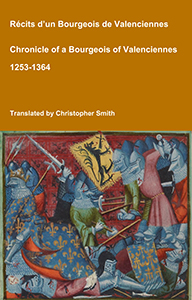
Chronicle of a Bourgeois of Valenciennes
Récits d’un bourgeois de Valenciennes aka The Chronicle of a Bourgeois of Valenciennes is a vivid 14th-century vernacular chronicle written by an anonymous urban chronicler from Valenciennes in the County of Hainaut. It survives in a manuscript that describes local and regional history from about 1253 to 1366, blending chronology, narrative episodes, and eyewitness-style accounts of political, military, and social events in medieval France, Flanders, and the Low Countries. The work begins with a chronological framework of events affecting Valenciennes and its region under rulers such as King Philip VI of France and the shifting allegiances of local nobility. It includes accounts of conflicts, sieges, diplomatic manoeuvres, and the impact of broader struggles like the Hundred Years’ War on urban life in Hainaut. Written from the perspective of a burgher (bourgeois) rather than a monastery or royal court, the chronicle offers a rare lay viewpoint on high politics and warfare, reflecting how merchants, townspeople, and civic institutions experienced the turbulence of the 13th and 14th centuries. Its narrative style combines straightforward reporting of events with moral and civic observations, making it a valuable source for readers interested in medieval urban society, regional politics, and the lived experience of war and governance in pre-modern Europe.
Available at Amazon in eBook and Paperback format.
Roger Tosny IV Lord Flamstead was appointed IV Lord Flamstead.
In 1217 Gilbert Clare 5th Earl Gloucester 4th Earl Hertford [aged 37] was created 1st Lord Glamorgan.
On 25th October 1230 Gilbert Clare 5th Earl Gloucester 4th Earl Hertford [aged 50] died. His son Richard [aged 8] succeeded 6th Earl Gloucester, 5th Earl Hertford, 8th Lord Clare, 2nd Lord Glamorgan.
On 14th July 1262 Richard de Clare 6th Earl Gloucester 5th Earl Hertford [aged 39] died. His son Gilbert [aged 18] succeeded 7th Earl Gloucester, 6th Earl Hertford, 9th Lord Clare, 3rd Lord Glamorgan. Alice or Alix Lusignan Countess Gloucester and Hertford [aged 26] by marriage Countess Gloucester, Countess Hertford.
On 7th December 1295 Gilbert "Red Earl" Clare 7th Earl Gloucester 6th Earl Hertford [aged 52] died at Monmouth Castle [Map]. He buried at Tewkesbury Abbey [Map]. His son Gilbert [aged 4] succeeded 8th Earl Gloucester, 7th Earl Hertford, 8th Lord Clare, 4th Lord Glamorgan.
Around 1483 William Redman Lord Harewood died. He was buried at Levens, Heversham. His brother Edward [aged 28] succeeded Lord Harewood. Elizabeth Huddlestone Baroness Harewood [aged 33] by marriage Lord Harewood.
William Redman Lord Harewood succeeded Lord Harewood.
In 1197 Hugh Ferrers 6th Baron Burford [aged 30] and Margaret Say 6th Baroness Burford [aged 15] were married. She by marriage Lord Lechalde. He by marriage Baron Burford Feudal.
In 1201 Walchelin Ferrers [aged 60] died. His son Hugh [aged 34] succeeded Lord Lechalde.
In 1612 Elizabeth Vere Countess Derby [aged 36] was created Lord Mann.
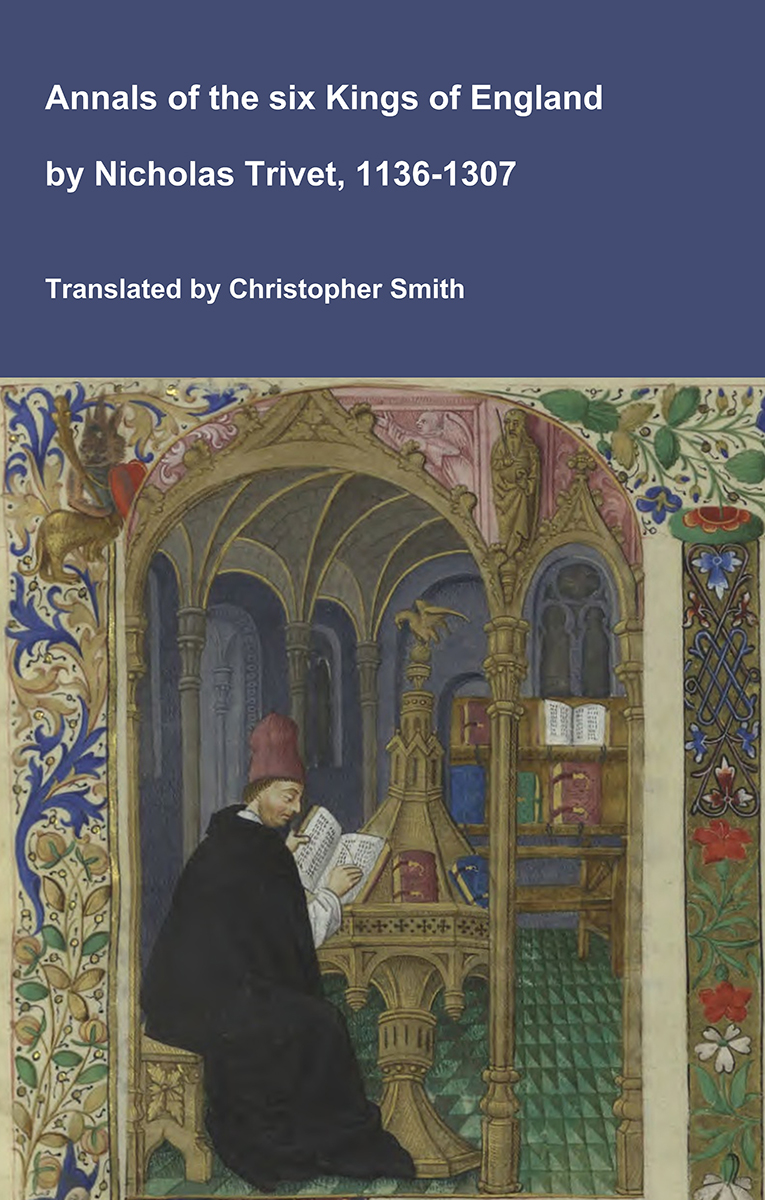
Annals of the six Kings of England by Nicholas Trivet
Translation of the Annals of the Six Kings of England by that traces the rise and rule of the Angevin aka Plantagenet dynasty from the mid-12th to early 14th century. Written by the Dominican scholar Nicholas Trivet, the work offers a vivid account of English history from the reign of King Stephen through to the death of King Edward I, blending political narrative with moral reflection. Covering the reigns of six monarchs—from Stephen to Edward I—the chronicle explores royal authority, rebellion, war, and the shifting balance between crown, church, and nobility. Trivet provides detailed insight into defining moments such as baronial conflicts, Anglo-French rivalry, and the consolidation of royal power under Edward I, whose reign he describes with particular immediacy. The Annals combines careful year-by-year reporting with thoughtful interpretation, presenting history not merely as a sequence of events but as a moral and political lesson. Ideal for readers interested in medieval history, kingship, and the origins of the English state, this chronicle remains a valuable and accessible window into the turbulent world of the Plantagenet kings.
Available at Amazon in eBook and Paperback format.
In 1627 James Stanley 7th Earl of Derby [aged 19] was appointed Lord Mann.


In 1125 Baderon Monmouth Lord Monmouth [aged 25] was appointed Lord Monmouth.
In 1176 Baderon Monmouth Lord Monmouth [aged 76] died. His son Gilbert succeeded Lord Monmouth.
Edward Powers Lord Powers was appointed Lord Powers.
In 1391 Thomas Clifford 6th Baron Clifford [aged 28] died. His son John [aged 2] succeeded 7th Baron de Clifford, 7th Lord Skipton. However, given his young age his mother's brother William Ros 6th Baron Ros Helmsley [aged 21] enjoyed the benefit of his wardship until he came of age around Sep 1411.
On 13th March 1422 John Clifford 7th Baron Clifford [aged 33] died. His son Thomas [aged 7] succeeded 8th Baron de Clifford, 8th Lord Skipton.
On 22nd May 1455 the Wars of the Roses commenced with the First Battle of St Albans. Richard Plantagenet 3rd Duke of York [aged 43] commanded with Richard "Kingmaker" Neville Earl Warwick, 6th Earl Salisbury [aged 26], Richard Neville Earl Salisbury [aged 55], Edward Brooke 6th Baron Cobham [aged 40] and Walter Strickland [aged 44].
The Lancastrians...
Edmund Beaufort 1st or 2nd Duke of Somerset [aged 49] was killed. His son Henry [aged 19] succeeded 2nd Duke Somerset, 2nd Marquess Dorset, 5th Earl Somerset, 2nd Earl Dorset. Note his father is frequently incorrectly referred to as the second Duke and Henry as the third Duke. His father's Dukedom, however, was a new creation.
Henry Percy 2nd Earl of Northumberland [aged 62] was killed. His son Henry [aged 33] succeeded 3rd Earl of Northumberland, 6th Baron Percy of Alnwick, 14th Baron Percy of Topcliffe. Eleanor Poynings Countess Northumberland [aged 33] by marriage Countess of Northumberland.
Thomas Clifford 8th Baron Clifford [aged 41] was killed. His son John [aged 20] succeeded 9th Baron de Clifford, 9th Lord Skipton. Margaret Bromflete Baroness Clifford [aged 21] by marriage Baroness de Clifford.
William Cotton [aged 45] and Richard Fortescue [aged 41] were killed.
Humphrey Stafford 1st Duke of Buckingham [aged 52] was wounded and captured.
King Henry VI of England and II of France [aged 33], John Sutton 1st Baron Dudley [aged 54] and Edmund Sutton [aged 30] were captured.
Henry Beaufort 2nd or 3rd Duke of Somerset was wounded. James Butler 1st Earl Wiltshire 5th Earl Ormonde [aged 34] and John Wenlock 1st Baron Wenlock [aged 55] fought.
Richard Cotton of Hampstall Ridware [aged 51] and his son William Cotton of Connington in Huntingdonshire [aged 27] were killed.
On 28th March 1461 one or more battles were fought at Ferrybridge and Dintingdale. Richard "Kingmaker" Neville Earl Warwick, 6th Earl Salisbury [aged 32] fought. John Radclyffe Baron Fitzwalter [aged 35] was killed.
John "Butcher" Clifford 9th Baron Clifford [aged 25] was killed. His son Henry [aged 7] succeeded 10th Baron de Clifford, 10th Lord Skipton.
William Neville 1st Earl Kent [aged 56] fought for York.
On 23rd April 1523 Henry "Shepherd Lord" Clifford 10th Baron Clifford [aged 69] died. His son Henry [aged 30] succeeded 11th Baron de Clifford, 11th Lord Skipton and High Sheriff of Westmoreland.

On 22nd April 1542 Henry Clifford 1st Earl of Cumberland [aged 49] died. He was buried at Holy Trinity Church Skipton [Map]. His son Henry [aged 25] succeeded 2nd Earl of Cumberland, 12th Baron de Clifford, 12th Lord Skipton. Eleanor Brandon Countess Cumberland [aged 23].
In January 1570 Henry Clifford 2nd Earl of Cumberland [aged 53] died. His son George [aged 11] succeeded 3rd Earl of Cumberland, 13th Baron de Clifford, 13th Lord Skipton. Being underage his wardship went to Queen Elizabeth I of England and Ireland [aged 36] who gave it to Francis Russell 2nd Earl Bedford [aged 43] whose daughter George subsequently married.
On 15th April 1136 Richard de Clare was killed. His son Gilbert [aged 21] succeeded 4th Lord Tonbridge.
In 1173 Roger Clare 2nd Earl Hertford [aged 57] died. His son Richard [aged 20] succeeded 3rd Earl Hertford, 6th Lord Clare, 6th Lord Tonbridge, 5th Lord Cardigan.
In 1295 Theobald Verdun 1st Lord Verdun [aged 47] was created 1st Lord Verdun. Margery Bohun Lady Verdun [aged 44] by marriage Lord Verdun.
Around 12th June 1297 John Verdun [aged 20] died. His brother Theobald [aged 18] succeeded 2nd Lord Verdun.
William of Worcester's Chronicle of England
William of Worcester, born around 1415, and died around 1482 was secretary to John Fastolf, the renowned soldier of the Hundred Years War, during which time he collected documents, letters, and wrote a record of events. Following their return to England in 1440 William was witness to major events. Twice in his chronicle he uses the first person: 1. when writing about the murder of Thomas, 7th Baron Scales, in 1460, he writes '… and I saw him lying naked in the cemetery near the porch of the church of St. Mary Overie in Southwark …' and 2. describing King Edward IV's entry into London in 1461 he writes '… proclaimed that all the people themselves were to recognize and acknowledge Edward as king. I was present and heard this, and immediately went down with them into the city'. William’s Chronicle is rich in detail. It is the source of much information about the Wars of the Roses, including the term 'Diabolical Marriage' to describe the marriage of Queen Elizabeth Woodville’s brother John’s marriage to Katherine, Dowager Duchess of Norfolk, he aged twenty, she sixty-five or more, and the story about a paper crown being placed in mockery on the severed head of Richard, 3rd Duke of York.
Available at Amazon in eBook and Paperback format.
On 29th July 1302 Theobald Verdun 2nd Lord Verdun [aged 23] and Maud Mortimer Lady Verdun [aged 16] were married at Wigmore, Herefordshire [Map]. She by marriage Lord Verdun. They were second cousins. She a great x 3 granddaughter of King John of England.
On 4th February 1316 Theobald Verdun 2nd Lord Verdun [aged 37] and Elizabeth Clare Lady Verdun [aged 20] were married. She by marriage Lord Verdun. She the daughter of Gilbert "Red Earl" Clare 7th Earl Gloucester 6th Earl Hertford and Joan of Acre Countess Gloucester and Hertford. They were third cousins. She a granddaughter of King Edward I of England.
On 27th July 1316 Theobald Verdun 2nd Lord Verdun [aged 37] died at Alton Castle, Staffordshire. His son Theobald [aged 9] succeeded 3rd Lord Verdun.
Robert Vipont Lord Westmoreland was appointed Lord Westmoreland.
In 1580 Philippe Carteret 2nd Seigneur Sark [aged 28] and Rachel Paulet [aged 16] were married. She by marriage Seigneur of Sark.
In 1584 Helier Carteret [aged 51] died. His son Philippe [aged 32] succeeded 2nd Seigneur of Sark.
In 1594 Philippe Carteret 2nd Seigneur Sark [aged 42] died at Sark. His son Philippe [aged 9] succeeded 3rd Seigneur of Sark.
In or before 1601 Philippe Carteret 3rd Seigneur Sark [aged 16] and Anne Dowse were married. She by marriage Seigneur of Sark. They were half third cousin once removed.
On 22nd August 1643 Philippe Carteret 3rd Seigneur Sark [aged 59] died. His son Philippe [aged 23] succeeded 4th Seigneur of Sark.
In 1672 Philippe Carteret 1st Baronet [aged 52] died. His son Philippe [aged 21] succeeded 2nd Baronet Carteret of Saint Owen in Jersey, 5th Seigneur of Sark.
Helier Carteret was created 1st Seigneur of Sark. Margaret Carteret by marriage Seigneur of Sark.