

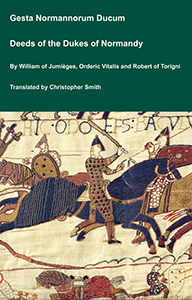
The Deeds of the Dukes of Normandy
The Gesta Normannorum Ducum [The Deeds of the Dukes of Normandy] is a landmark medieval chronicle tracing the rise and fall of the Norman dynasty from its early roots through the pivotal events surrounding the Norman Conquest of England. Originally penned in Latin by the monk William of Jumièges shortly before 1060 and later expanded at the behest of William the Conqueror, the work chronicles the deeds, politics, battles, and leadership of the Norman dukes, especially William’s own claim to the English throne. The narrative combines earlier historical sources with firsthand information and oral testimony to present an authoritative account of Normandy’s transformation from a Viking settlement into one of medieval Europe’s most powerful realms. William’s history emphasizes the legitimacy, military prowess, and governance of the Norman line, framing their expansion, including the conquest of England, as both divinely sanctioned and noble in purpose. Later chroniclers such as Orderic Vitalis and Robert of Torigni continued the history, extending the coverage into the 12th century, providing broader context on ducal rule and its impact. Today this classic work remains a foundational source for understanding Norman identity, medieval statesmanship, and the historical forces that reshaped England and Western Europe between 800AD and 1100AD.
Available at Amazon in eBook and Paperback format.
MP Anglesey is in Member Parliament.
In 1549 Richard Bulkeley was elected MP Anglesey which seat he held until 1552.
In April 1554 Richard Bulkeley was elected MP Anglesey which seat he held for a month.
In November 1554 Richard Bulkeley was elected MP Anglesey which seat he held until Jan 1555.
In 1571 Richard Bulkeley was elected MP Anglesey which seat he held until 1572.
In 1593 William Glynne (age 27) was elected MP Anglesey.

In 1734 Nicholas Bayly 2nd Baronet Bayly of Plas Newydd in Anglesey (age 25) was elected MP Anglesey.
In 1747 Nicholas Bayly 2nd Baronet Bayly of Plas Newydd in Anglesey (age 38) was elected MP Anglesey.
In 1770 Nicholas Bayly 2nd Baronet Bayly of Plas Newydd in Anglesey (age 61) was elected MP Anglesey.
In 1790 William Paget (age 20) was elected MP Anglesey.
William of Worcester's Chronicle of England
William of Worcester, born around 1415, and died around 1482 was secretary to John Fastolf, the renowned soldier of the Hundred Years War, during which time he collected documents, letters, and wrote a record of events. Following their return to England in 1440 William was witness to major events. Twice in his chronicle he uses the first person: 1. when writing about the murder of Thomas, 7th Baron Scales, in 1460, he writes '… and I saw him lying naked in the cemetery near the porch of the church of St. Mary Overie in Southwark …' and 2. describing King Edward IV's entry into London in 1461 he writes '… proclaimed that all the people themselves were to recognize and acknowledge Edward as king. I was present and heard this, and immediately went down with them into the city'. William’s Chronicle is rich in detail. It is the source of much information about the Wars of the Roses, including the term 'Diabolical Marriage' to describe the marriage of Queen Elizabeth Woodville’s brother John’s marriage to Katherine, Dowager Duchess of Norfolk, he aged twenty, she sixty-five or more, and the story about a paper crown being placed in mockery on the severed head of Richard, 3rd Duke of York.
Available at Amazon in eBook and Paperback format.

In 1794 Arthur Paget (age 22) was elected MP Anglesey.
In 1837 William Owen Stanley (age 34) was elected MP Anglesey.