

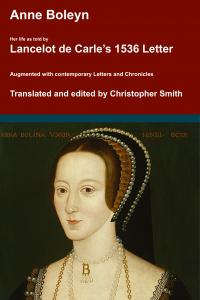
Anne Boleyn. Her Life as told by Lancelot de Carle's 1536 Letter.
In 1536, two weeks after the execution of Anne Boleyn, her brother George and four others, Lancelot du Carle, wrote an extraordinary letter that described Anne's life, and her trial and execution, to which he was a witness. This book presents a new translation of that letter, with additional material from other contemporary sources such as Letters, Hall's and Wriothesley's Chronicles, the pamphlets of Wynkyn the Worde, the Memorial of George Constantyne, the Portuguese Letter and the Baga de Secrets, all of which are provided in Appendices.
Available at Amazon in eBook and Paperback format.
MP St Germans is in Member Parliament.
In 1584 George Carew was elected MP St Germans.
In 1593 John Glanville (age 51) was elected MP St Germans.
In 1597 George Carew was elected MP St Germans.
In 1601 George Carew was elected MP St Germans.
In 1623 John Stradling 1st Baronet (age 60) was elected MP St Germans which seat he held until 1624.

In 1624 John Coke (age 60) was elected MP St Germans.
In 1625 John Coke (age 61) was elected MP St Germans.
On 4th December 1705 Edward Eliot (age 21) was elected MP St Germans at a by-election to replace Samuel Rolle who had chosen to sit for Callington. He retained the seat in 1708, 1710 and 1713.
In 1776 John Peachey 2nd Baron Selsey (age 26) was elected MP St Germans which seat he held until 1780.
Chronicle of Walter of Guisborough
A canon regular of the Augustinian Guisborough Priory, Yorkshire, formerly known as The Chronicle of Walter of Hemingburgh, describes the period from 1066 to 1346. Before 1274 the Chronicle is based on other works. Thereafter, the Chronicle is original, and a remarkable source for the events of the time. This book provides a translation of the Chronicle from that date. The Latin source for our translation is the 1849 work edited by Hans Claude Hamilton. Hamilton, in his preface, says: 'In the present work we behold perhaps one of the finest samples of our early chronicles, both as regards the value of the events recorded, and the correctness with which they are detailed; Nor will the pleasing style of composition be lightly passed over by those capable of seeing reflected from it the tokens of a vigorous and cultivated mind, and a favourable specimen of the learning and taste of the age in which it was framed.'
Available at Amazon in eBook and Paperback format.

In 1791 William Eliot 2nd Earl St Germans (age 23) was elected MP St Germans.