

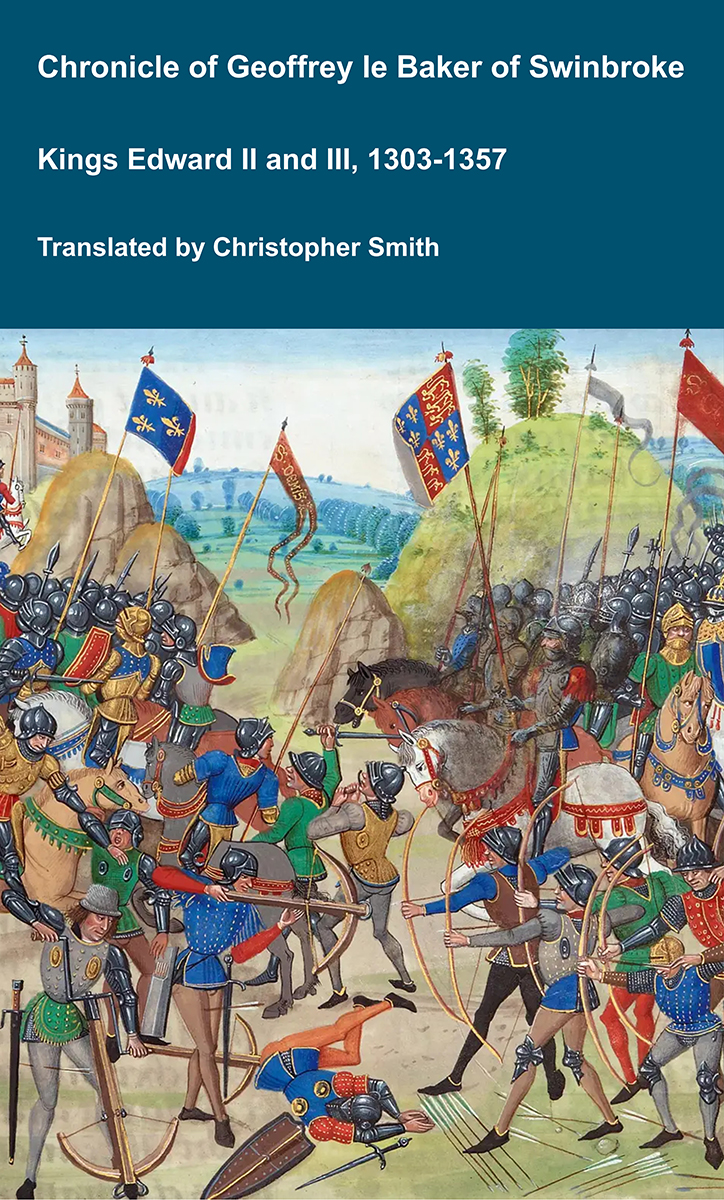
Chronicle of Geoffrey le Baker of Swinbroke
Baker was a secular clerk from Swinbroke, now Swinbrook, an Oxfordshire village two miles east of Burford. His Chronicle describes the events of the period 1303-1356: Gaveston, Bannockburn, Boroughbridge, the murder of King Edward II, the Scottish Wars, Sluys, Crécy, the Black Death, Winchelsea and Poitiers. To quote Herbert Bruce 'it possesses a vigorous and characteristic style, and its value for particular events between 1303 and 1356 has been recognised by its editor and by subsequent writers'. The book provides remarkable detail about the events it describes. Baker's text has been augmented with hundreds of notes, including extracts from other contemporary chronicles, such as the Annales Londonienses, Annales Paulini, Murimuth, Lanercost, Avesbury, Guisborough and Froissart to enrich the reader's understanding. The translation takes as its source the 'Chronicon Galfridi le Baker de Swynebroke' published in 1889, edited by Edward Maunde Thompson.
Available at Amazon in eBook and Paperback format.
MP Warwick is in Member Parliament.
In 1614 Greville Verney 15th Baron Latimer 7th Baron Willoughby (age 28) was elected MP Warwick.
In 1621 Greville Verney 15th Baron Latimer 7th Baron Willoughby (age 35) was elected MP Warwick.

In 1621 John Coke (age 57) was elected MP Warwick.
In 1659 Thomas Archer (age 39) was elected MP Warwick during the Third Protectorate Parliament.
In 1664 Fulke Greville 5th Baron Brooke (age 20) was elected MP Warwick.
In 1679 Henry Newton aka Puckering 3rd Baronet (age 60) was elected MP Warwick.

In 1681 Thomas Coventry 1st Earl Coventry (age 52) was elected MP Warwick.
In 1685 Thomas Coventry 1st Earl Coventry (age 56) was elected MP Warwick.
In 1689 William Digby 5th Baron Digby (age 27) was elected MP Warwick.
In 1727 William Bromley (age 28) was elected MP Warwick unopposed. He was re-elected in 1734, but was unseated on petition
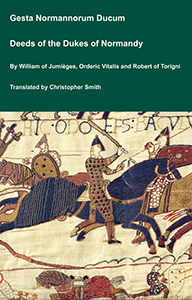
The Deeds of the Dukes of Normandy
The Gesta Normannorum Ducum [The Deeds of the Dukes of Normandy] is a landmark medieval chronicle tracing the rise and fall of the Norman dynasty from its early roots through the pivotal events surrounding the Norman Conquest of England. Originally penned in Latin by the monk William of Jumièges shortly before 1060 and later expanded at the behest of William the Conqueror, the work chronicles the deeds, politics, battles, and leadership of the Norman dukes, especially William’s own claim to the English throne. The narrative combines earlier historical sources with firsthand information and oral testimony to present an authoritative account of Normandy’s transformation from a Viking settlement into one of medieval Europe’s most powerful realms. William’s history emphasizes the legitimacy, military prowess, and governance of the Norman line, framing their expansion, including the conquest of England, as both divinely sanctioned and noble in purpose. Later chroniclers such as Orderic Vitalis and Robert of Torigni continued the history, extending the coverage into the 12th century, providing broader context on ducal rule and its impact. Today this classic work remains a foundational source for understanding Norman identity, medieval statesmanship, and the historical forces that reshaped England and Western Europe between 800AD and 1100AD.
Available at Amazon in eBook and Paperback format.
In 1735 Henry Archer (age 35) was elected MP Warwick.
In 1735 Thomas Archer 1st Baron Archer (age 39) was elected MP Warwick.
In 1762 Paul Methuen (age 38) was elected MP Warwick which seat he held until 1768.
In 1768 George Greville 2nd Earl Warwick and Brooke (age 21) was elected MP Warwick.