

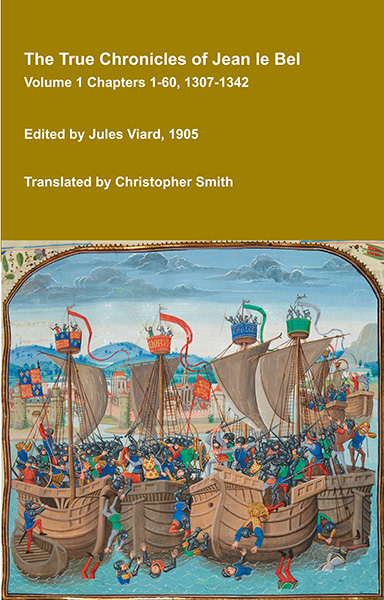
The True Chronicles of Jean le Bel Volume 1 Chapters 1-60 1307-1342
The True Chronicles of Jean le Bel offer one of the most vivid and immediate accounts of 14th-century Europe, written by a knight who lived through the events he describes, and experienced some of them first hand. Covering the early decades of the Hundred Years’ War, this remarkable chronicle follows the campaigns of Edward III of England, the politics of France and the Low Countries, and the shifting alliances that shaped medieval warfare. Unlike later historians, Jean le Bel writes with a strong sense of eyewitness authenticity, drawing on personal experience and the testimony of fellow soldiers. His narrative captures not only battles and sieges, but also the realities of military life, diplomacy, and the ideals of chivalry that governed noble society. A key source for Jean Froissart, Le Bel’s chronicle stands on its own as a compelling and insightful work, at once historical record and literary achievement. This translation builds on the 1905 edition published in French by Jules Viard, adding extensive translations from other sources Rymer's Fœdera, the Chronicles of Adam Murimuth, William Nangis, Walter of Guisborough, a Bourgeois of Valenciennes, Geoffrey le Baker of Swinbroke and Richard Lescot to enrich the original text and Viard's notes.
Available at Amazon in eBook and Paperback format.
Marquess Pembroke is in Marquessates of England Alphabetically, Marquessates of England Chronologically, Created Marchionesses of England, Extinct Marquessates of England.
Summary
1st September 1532. Queen Anne Boleyn of England [aged 31] created. See Anne Boleyn's Investiture as Marchioness of Pembroke.
19th May 1536. Henry Fitzroy 1st Duke Richmond and Somerset [aged 16] extinct. See Execution of Anne Boleyn.
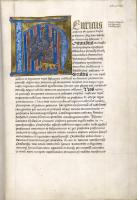
On 1st September 1532 Anne Boleyn [aged 31] was created 1st Marchioness Pembroke with Henry VIII [aged 41] performing the investiture at Windsor Castle [Map]. The Letter of Creation [Harley 303.1; see image] using the Latin 'marchionisse Penbrochie' i.e. "Marchioness of Pembroke". It isn't clear whether the Letter of Creation is a single page - we note the absence of any description of whether the title is to descend to her heir's, male, legitimate, otherwise. We also note the first letter contains Anne's emblem of a 'falcon on a stump' although Anne's falcon was white - age may have affected the colour of the Letter.
Thomas Boleyn 1st Earl Wiltshire and Ormonde [aged 55], Charles Brandon 1st Duke of Suffolk [aged 48], Thomas Howard 3rd Duke of Norfolk [aged 59], Eleanor Paston Countess Rutland [aged 37], Jean Dinteville, Archbishop Edward Lee [aged 50], Bishop John Stokesley [aged 57] were present.
Bishop Stephen Gardiner [aged 49] read the Patent of Creation.
Mary Howard Duchess Richmond and Somerset [aged 13] carried Anne's train replacing her mother Elizabeth Stafford Duchess Norfolk [aged 35] who had been banished from Court. Anne and Mary were cousins.
Charles Wriothesley [aged 24] attended.
Jean Dinteville: he was appointed Ambassador to England. Around 1532 Jean Dinteville posed for Holbein's painting The Ambassadors.
Archbishop Edward Lee: Around 1482 he was born to Richard Lee of Lee Magna. In 1531 he was appointed Archbishop of York. On 13th September 1544 he died.
Charles Wriothesley: On 8th May 1508 he was born to Thomas Wriothesley. After 24th November 1534 he was appointed Windsor Herald of Arms in Ordinary. On 25th January 1562 Charles Wriothesley died.


On 19th May 1536 Queen Anne Boleyn of England [aged 35] was beheaded at Tower Green, Tower of London [Map]. Unusually a sword was used. Her execution was witnessed by Charles Brandon 1st Duke of Suffolk [aged 52], Catherine Carey [aged 12] and Henry Fitzroy 1st Duke Richmond and Somerset [aged 16]. Marquess Pembroke extinct.
She was buried at St Peter ad Vincula Church, Tower of London [Map]. There is myth that her corpse was subsequently removed for burial at the Boleyn family church Church of St Peter and St Paul, Salle [Map] as described in Agnes Strickland's 1852 Lives of the Queens of England Volume 4. Page 212.