

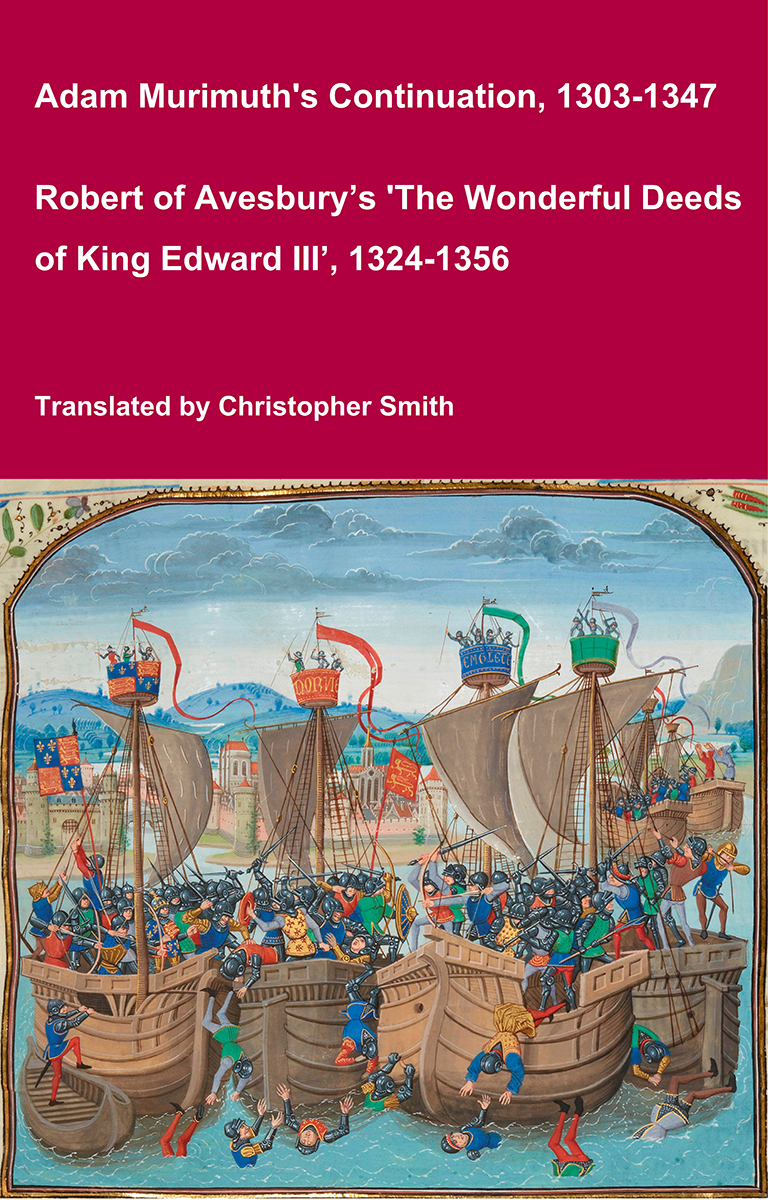
Adam Murimuth's Continuation and Robert of Avesbury’s 'The Wonderful Deeds of King Edward III'
This volume brings together two of the most important contemporary chronicles for the reign of Edward III and the opening phases of the Hundred Years’ War. Written in Latin by English clerical observers, these texts provide a vivid and authoritative window into the political, diplomatic, and military history of fourteenth-century England and its continental ambitions. Adam Murimuth Continuatio's Chronicarum continues an earlier chronicle into the mid-fourteenth century, offering concise but valuable notices on royal policy, foreign relations, and ecclesiastical affairs. Its annalistic structure makes it especially useful for establishing chronology and tracing the development of events year by year. Complementing it, Robert of Avesbury’s De gestis mirabilibus regis Edwardi tertii is a rich documentary chronicle preserving letters, treaties, and official records alongside narrative passages. It is an indispensable source for understanding Edward III’s claim to the French crown, the conduct of war, and the mechanisms of medieval diplomacy. Together, these works offer scholars, students, and enthusiasts a reliable and unembellished account of a transformative period in English and European history. Essential for anyone interested in medieval chronicles, the Hundred Years’ War, or the reign of Edward III.
Available at Amazon in eBook and Paperback format.
Marquess Suffolk is in Marquessates of England Alphabetically, Marquessates of England Chronologically, Forfeit Marquessates of England.
Summary
1444. William "Jackanapes" de la Pole 1st Duke of Suffolk [aged 47] created.
1st May 1450. William "Jackanapes" de la Pole 1st Duke of Suffolk forfeit. See Murder of William de la Pole.
1st May 1450. Son John de la Pole 2nd Duke of Suffolk [aged 7] succeeded. See Murder of William de la Pole.
27th October 1492. Son Edmund Pole 3rd Duke of Suffolk [aged 21] succeeded.
30th April 1513. Edmund Pole 3rd Duke of Suffolk forfeit. See Execution of Edmund de la Pole.
In 1444 William "Jackanapes" de la Pole 1st Duke of Suffolk [aged 47] was created 1st Marquess Suffolk. Alice Chaucer Duchess Suffolk [aged 40] by marriage Marchioness Suffolk.
Before 1st May 1450, the day he was murdered, William "Jackanapes" de la Pole 1st Duke of Suffolk [aged 53] was impeached, and sentenced to the exiled. Duke Suffolk, Marquess Suffolk, Earl Pembroke forfeit.
On 1st May 1450 William "Jackanapes" de la Pole 1st Duke of Suffolk [aged 53] was beheaded at sea whilst travelling into exile his ship having been intercepted by the Nicholas of the Tower, or by Admiral Nicholas of the Tower. His son John [aged 7] succeeded 2nd Marquess Suffolk, 5th Earl Suffolk, 5th Baron Pole. Margaret Beaufort Countess Richmond [aged 6] by marriage Marchioness Suffolk. Earl Pembroke forfeit.

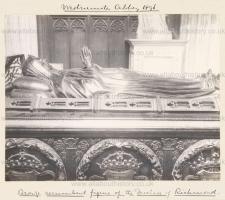
Before February 1458 John de la Pole 2nd Duke of Suffolk [aged 15] and Elizabeth York Duchess Suffolk [aged 13] were married. She by marriage Marchioness Suffolk. She the daughter of Richard Plantagenet 3rd Duke of York [aged 46] and Cecily "Rose of Raby" Neville Duchess York [aged 42]. He the son of William "Jackanapes" de la Pole 1st Duke of Suffolk and Alice Chaucer Duchess Suffolk [aged 54]. They were half third cousins. He a great x 5 grandson of King Edward I of England. She a great x 2 granddaughter of King Edward III of England.
Before 27th October 1492 John de la Pole 2nd Duke of Suffolk [aged 50] died. He was buried at Wingfield, Suffolk. His son Edmund [aged 21] succeeded 3rd Duke Suffolk, 3rd Marquess Suffolk, 6th Earl Suffolk, 6th Baron Pole.
On 30th April 1513 Edmund Pole 3rd Duke of Suffolk [aged 42] was beheaded at Tower Hill [Map] on the instruction of King Henry VIII after having been imprisoned for seven years. Duke Suffolk, Marquess Suffolk and Earl Suffolk, Baron Pole forfeit.
He, Edmund, was the son of Elizabeth York Duchess Suffolk, sister of Kings Edward IV and Richard III, and George, Duke of Clarence. He, arguably, had a better claim to the throne of England than King Henry VII if King Edward IV's children were illegitimate, and George's children barred from the succession as a consequence of George'a attainder although Anne St Leger's [aged 37] claim better since she descended from an older sister Anne.
He, Edmund, had been given to King Henry VII of England and Ireland as part of the treaty of Malus Intercursus aka Evil Treaty with the condition that he not be executed. King Henry VII in his will instructed his son King Henry VIII to have him executed; an act which attracted the criticism of Montaigne in Chapter 7 of his Essays.