

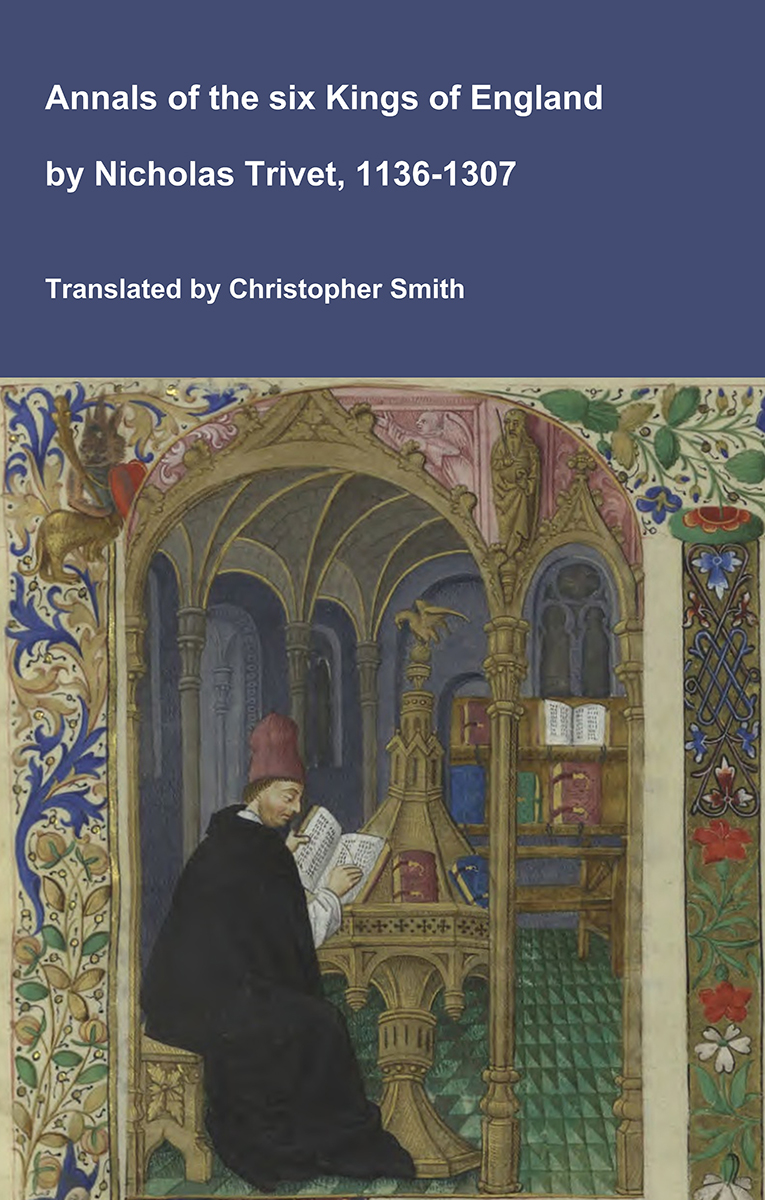
Annals of the six Kings of England by Nicholas Trivet
Translation of the Annals of the Six Kings of England by that traces the rise and rule of the Angevin aka Plantagenet dynasty from the mid-12th to early 14th century. Written by the Dominican scholar Nicholas Trivet, the work offers a vivid account of English history from the reign of King Stephen through to the death of King Edward I, blending political narrative with moral reflection. Covering the reigns of six monarchs—from Stephen to Edward I—the chronicle explores royal authority, rebellion, war, and the shifting balance between crown, church, and nobility. Trivet provides detailed insight into defining moments such as baronial conflicts, Anglo-French rivalry, and the consolidation of royal power under Edward I, whose reign he describes with particular immediacy. The Annals combines careful year-by-year reporting with thoughtful interpretation, presenting history not merely as a sequence of events but as a moral and political lesson. Ideal for readers interested in medieval history, kingship, and the origins of the English state, this chronicle remains a valuable and accessible window into the turbulent world of the Plantagenet kings.
Available at Amazon in eBook and Paperback format.
National Trust is in England.
12th January 1895. The National Trust was incorporated as the National Trust for Places of Historic Interest or Natural Beauty; still the organisation's legal name. The founders were social reformer Octavia Hill, solicitor Sir Robert Hunter and clergyman Hardwicke Rawnsley.
Wiltshire Archaeological Magazine 1913 V38 Pages 379-414. Tilshead. 4. "White Barrow [Map]." Length 255ft. (Hoare); E. and W. Opened by Hoare and Cunnington but without success, only a few pieces of stag's horns and the usual "line of black earth " being found. This barrow, with 2¾ acres of land adjoining, is now the property of the National Trust. Hoare speaks of it as having been "lately covered with a plantation," but this has long since disappeared, and the whole barrow was for some time under cultivation. In spite of this it may happily still be described as in good condition with well-defined ditches; it is now down to grass, and under its present ownership will not be ploughed again. O.M. 53 NE.; A.W. I. 91; Arch. xlii. 180.
Archaeologia Cambrensis Series 6 Volume 15 1905 Stonehenge. 22nd September 1915. Sale of Stonehenge. — Great public interest was shown in the sale by auction at Salisbury yesterday [September 21st] of the Amesbury Abbey estate, including Stonehenge. Sir Howard Frank, of Messrs. Knight, Frank and Rutley, conducted the sale, and explained that the estate came into the market in consequence of the deaths of Sir Edmund Antrobus and of his only son [Edmund Antrobus], who was killed in action last October. The estate, which has many historical associations, comprises 6,420 acres, and has an estimated rental of £5,359. It was first submitted as a whole, but as no purchaser was forthcoming it was offered in lots, of which Amesbury Abbey and grounds formed the first. This was unsold. Farms and buildings in the town of Amesbury, however, sold at good prices, and most of the property changed hands. When Stonehenge was put up for sale Sir Howard Frank asked for an opening bid of £5,000. A bid for that amount was made at once, quickly followed by an advance of £100, and £6,000 was readied within a minute. Then there was a lull. The auctioneer said the price was a poor one for Stonehenge, which could not be valued, but if there were no further offers he would accept it. Bidding recommenced and mounted to £6,600, at which the property fell to a local landowner, Mr. C. H. E. Chubb [aged 39], of Bemerton Lodge, Salisbury. After the sale Mr. Chubb said that when he went into the sale room he had no intention whatever of buying the monument. "While I was there," he added, I thought a Salisbury man ought to buy it, and that is how it was done." Asked if he had any plans for the future of Stonehenge, Mr. Chubb said that, while he intended to preserve the monument, he would do nothing for some little time, as he had to consider the position. — Times, September 22nd, 1915.
Profits Of Stonehenge. — -Mr. Chubb, the new owner of Stonehenge, will not be given legal possession for some months. Meanwhile he has formulated no plan for the future, except that he is determined to take every step to see that the stones are preserved as heretofore.
The opinion expressed locally is that Mr. Chubb has made an excellent bargain, quite apart from the historic interest attaching to Stonehenge. As the purchase price was £6,600, and the net receipts from fees paid by visitors to the enclosure average £360 per annum, the transaction, regarded in a cold commercial light, represents an investment of over 5 per cent.Times, September 23rd, 1915.
Stonehenge: Its Recent Sale And Price.- The following letter appeared in "The Times of October 6th, 1915:— Sir, — The sale by auction a few days ago of Stonehenge for the comparatively small sum of £6600 will, I think, cause regret in many quarters that the opportunity was lost of vesting this most important national monument in some public body, and of restoring to the public the access to it, free of charge, which had been enjoyed for countless centuries. It will be recollected that fourteen years ago litigation was undertaken with this object. The claim was made that two well-worn ways leading up to, and through, the outer circle of stones were obstructed by the inclosure, which was erected partly with the object of guarding the stones, but mainly for the purpose of enforcing a charge of admission of Is. a head. Those of us who were engaged in this attempt were worsted in the suit and were heavily mulcted in costs. It was not generally known, however, and could not be stated at the hearing of the suit, that at an early stage of the proceedings we offered to purchase the monument and a few acres of Down land surrounding it for the sum of £10,000, with the purpose of placing the monument under the full protection of the Ancient Monuments Act. The effect of this would be that the Government would be charged with the duty and cost of guarding and preserving the stones, and that access of the public to them would be secured, free of charge, for ever. The then owner of the property did not object to a sale, but he said that his price was £50,000. For this sum he had already offered the monument to the Government, and when it was rejected, on the ground that it was altogether exorbitant, he threatened to sell the stones to an American millionaire, who would ship them across the Atlantic. The then Chancellor of the Exchequer, to whom the offer and threat were verbally made, very properly replied that if an attempt was made to remove the monument he would send a regiment from the camp on Salisbury Plain to prevent it. In spite of this rebuff, the excessive price was insisted upon, with the result that the suit was proceeded with. Since then the admission fees have been maintained, and I am informed that the visitors to Stonehenge have been only one-fourth in number of what they used to be. The net produce from the charge for admission has averaged the last three years £320, after deducting the cost of guarding and preserving it. The fees for admission during the last half-year have been greatly reduced in consequence of the war.
"When, a few weeks ago, the intended sale of the monument was announced, I would gladly have made an effort to raise a sum for its purchase, with the object of undoing the wrong which had been done in 1901. But I found that, in view of the many claims arising out of the war, it was impossible to raise by subscription even the moderate sum which appeared to be the full commercial value of the monument, based on the admission fees.
"There remained, however, the possibility that the monument might be purchased by some public body, such as the National Trust, who would maintain the charge for admission to it until more favourable times, when it would be possible to reduce or abolish that charge. In this view, the National Trust, at my suggestion, entered into a correspondence with Messrs. Knight, Frank and Rutley, the agents for the sale of the Amesbury estate. The society had no funds at its immediate disposal for such a purpose, but among its generous supporters there would probably have been found those who would advance the purchase-money on loan on the security of the admission fees. It was necessary, however, before applying to any such friends, to know the price demanded for the monument. The society was informed by the agents that the owner could not name a price, but was prepared to entertain any offer from the National Trust above the sum of £10,000 — a price evidently based upon the offer made for it fourteen years ago. The society replied to this that, after careful consideration, they had come to the conclusion that the minimum price named by the owner was altogether excessive, particularly in view of the exceptional conditions consequent on the war, and that they were unable to make an offer of that amount or above it.
"The reply of the agents to this, on September 17th, was 'that the vendor, who is a tenant for life of the property, would not be justified in selling Stonehenge previous to the auction except at a price which was considered by us (Messrs. Knight, Frank and Rutley) to be high.' They added — 'The reserve at the auction, however, is a low one, in our view, and is thousands of pounds below the amount mentioned in our previous letter,' namely, £10,000. They suggested that the National Trust should be represented at the auction. It was thus practically admitted that the price named by the owner in the previous letter was, in the opinion of the experienced agents who advised him, too high by some thousands. The letter was received by the National Trust on Saturday, September 18th, three days before the sale by auction. It was impossible, in this short interval, to make arrangements for finding the possible purchase-money. The society, therefore, was not represented at the auction, and made no bid. The monument was bought for S6600 by a gentleman resident in the neighbourhood, who has stated that he has bought it as an investment, but with the full intention of doing his best to preserve it a promise which I doubt not he will fulfil. Not the less, however, it is to be regretted that the monument has not become the property of some public body, with the prospect of the reduction or remission of the entrance fees. I may be permitted also to point out that the price obtained at the auction, while it confirms the opinion of the agents who conducted the sale, is also striking proof that the sum offered for the monument in 1901 was most generous, and such as, in the interest of the entailed estate and of the public, should have been accepted.
I am yours faithfully,
Eversley.
Abbotsworthy House, Winchester,
October 1st.


Around 1935 Ilam Hall, Staffordshire had been sold for demolition. The demolition was well advanced when Sir Robert McDougal bought it for the National Trust, on the understanding that the remaining parts (the entrance porch and hall, the Great Hall and the service wing) be used as an International Youth Hostel.
In 1937 Geoffrey Le Mesurier Mander [aged 54] gifted Wightwick Manor, Wolverhampton to the National Trust.

3rd December 1955. Nature. Obituaries. Source
Mr. Alexander Keiller.
ALEXANDER KEILLER, who died at the end of September at the age of sixty-five, was one of the long line of distinguished amateur British archæologists which goes back to Aubrey and Stukeley. Of these perhaps the greatest was Pitt-Rivers, on whom Keiller, like him with leisure and abundant means at his disposal, admittedly modelled his own work.
While still in his early thirties, Keiller carried out a systematic survey of stone circles and allied monuments in north-east Scotland, making accurate plans and detailed descriptions of each site. A summary account of this work was presented as a paper to the British Association at its Aberdeen meeting in 1934.
In 1925, however, he embarked on the programme of excavation and field-work with which his name will be inseparably associated. He acquired and began excavations on Windmill Hill, near Avebury in north Wiltshire, and continued these annually until 1929, revealing in detail the first extensive Neolithic settlement to be explored in Britain. The material was housed in a museum in his London house, where it was at the disposal of students, and as a result the earliest Neolithic culture of southern Britain, taking its name from the type-site, was defined and clarified.
From Windmill Hill to the Avebury monuments themselves was an inevitable step, and in 1933 Keiller began a systematic excavation programme with the oxarnination of the northern part of the West Kennet Circle itself. Avenue, continuing until 1938 within the Great Circle itself. He moved his residence to Avebury Manor, and re-housed his museum within its grounds, making it and the excavated portions of the monument available to the public. He adopted a policy of imaginative but judicious conservation and, restoration of the Avebury monuments, and systematically purchased land to preserve these and their surroundings; as a result it was eventually possible for the whole area to be acquired by the National Trust and the Ancient Monuments Department of the Ministry of Works.
Keiller's outstanding contribution to contemporary British archreology was his insistence on high standards of discipline and accuracy in excavation and field-work, and his realization from the first of the value of scientific techniques as applied to archreo logical material. He early appreciated the potential ities of air photography, collaborating with Crawford in the "Wessex from the Air" survey, and even discussing with Eckener the possibility of using the Graf Zeppelin for a similar but even more ambitious scheme. At Windmill Hill he insisted on a full study of the faunal and floral remains in their archreological context. But above all it is to Keiller that we owe the inception of the systematic study of British prehistoric stone artefacts by petrographical means, which, following his lead, is now yielding information of the highest importance on manufacture and trade in the early second millennium B.C. Alec Keiller was an enthusiast in the best sense; full of ideas, stimulating and highly individual. Archæology, like other academic disciplines, can only benefit from the impact of such men.
STUART PIGGOTT [aged 45]
On 29th September 1956 Charles Chute 1st Baronet [aged 77] died. Baronet Chute of The Vyne in Hampshire extinct. He bequeathed The Vyne, Sherbourne St John [Map], to the National Trust.
On 14th September 1960 Thomas Edward Anson 4th Earl Lichfield [aged 76] died. He was buried at St Stephen's Church, Great Heywood [Map]. His grandson Thomas [aged 21] succeeded 5th Earl Lichfield, 6th Viscount Anson of Shugborough and Orgrave in Staffordshire and 6th Baron Soberton of Soberton in Hampshire. Shugborough Hall, Staffordshire [Map] passed to the National Trust in lieu of death duties.
On 18th August 1976 Roger Grey 10th Earl Stamford 6th Earl Warrington [aged 79] died unmarried at Manchester, Lancashire. He was buried at St Mark's Church, Dunham Massey [Map]. Earl Stamford and Baron Grey of Groby extinct. He left his estate of Dunham Massey, Cheshire [Map] to the National Trust.


In 1984 Belton House [Map] and most of its contents were sold by Edward John Peregrine Cust 7th Baron Brownlow [aged 48] to the National Trust for £8 million.