

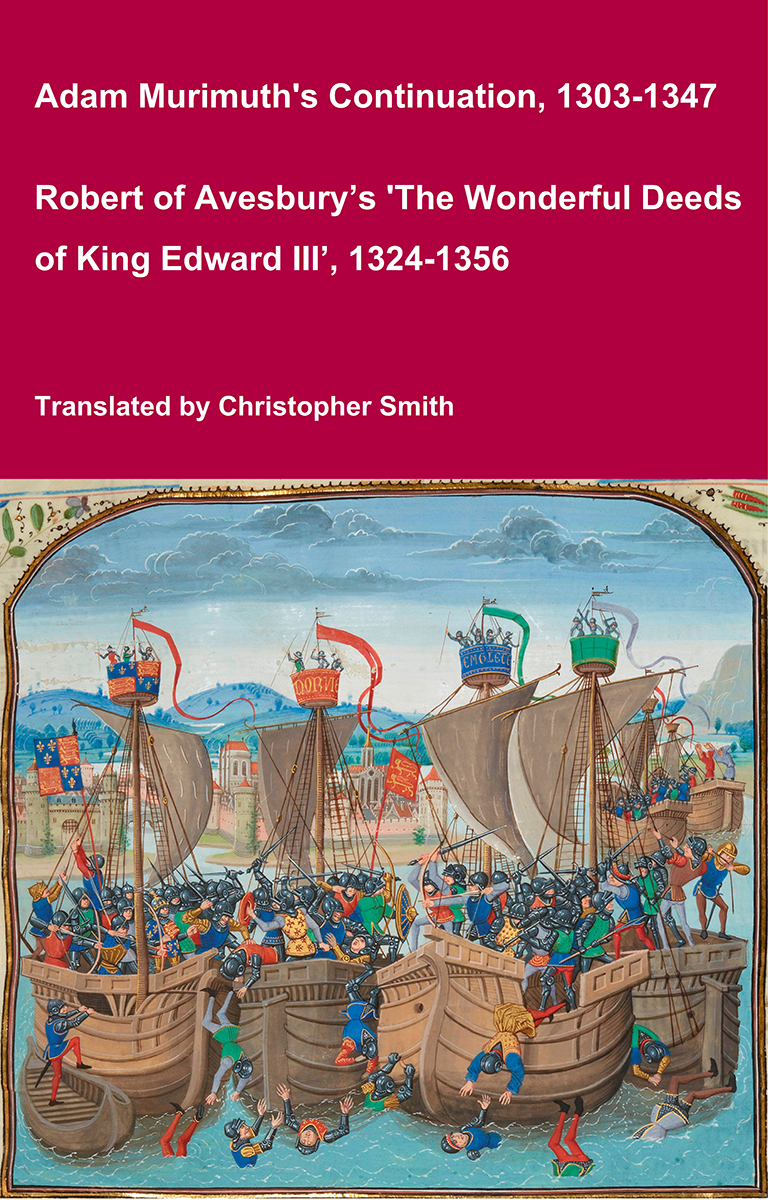
Adam Murimuth's Continuation and Robert of Avesbury’s 'The Wonderful Deeds of King Edward III'
This volume brings together two of the most important contemporary chronicles for the reign of Edward III and the opening phases of the Hundred Years’ War. Written in Latin by English clerical observers, these texts provide a vivid and authoritative window into the political, diplomatic, and military history of fourteenth-century England and its continental ambitions. Adam Murimuth Continuatio's Chronicarum continues an earlier chronicle into the mid-fourteenth century, offering concise but valuable notices on royal policy, foreign relations, and ecclesiastical affairs. Its annalistic structure makes it especially useful for establishing chronology and tracing the development of events year by year. Complementing it, Robert of Avesbury’s De gestis mirabilibus regis Edwardi tertii is a rich documentary chronicle preserving letters, treaties, and official records alongside narrative passages. It is an indispensable source for understanding Edward III’s claim to the French crown, the conduct of war, and the mechanisms of medieval diplomacy. Together, these works offer scholars, students, and enthusiasts a reliable and unembellished account of a transformative period in English and European history. Essential for anyone interested in medieval chronicles, the Hundred Years’ War, or the reign of Edward III.
Available at Amazon in eBook and Paperback format.
River Thames is in Thames Estuary.
Chronica Majora by Matthew Paris. 10th February 1236. About the same time, for two months and more, namely, in January, February, and part of March, such deluges of rain fell as had never been seen before in the memory of any one. About the feast of St. Scholastica, when the moon was new, the sea became so swollen by the river torrents which fell into it, that all the rivers, especially those which fell into the sea, rendered the fords impassable, overflowing their banks, hiding the bridges from sight, carrying away mills and dams, and overwhelming the cultivated lands, crops, meadows, and marshes. Amongst other unusual occurrences, the River Thames overflowed its usual bounds, and entered the grand palace at Westminster [Map], where it spread and covered the whole area, so that small boats could float there, and people went to their apartments on horseback. The water also forcing its way into the cellars could with difficulty be drained off. The signs of this storm which preceded it, then gave proofs of their threats; for on the day of St. Damasus, thunder was heard, and on the Friday next after the conception of St. Mary, a spurious sun was seen by the side of the true sun.
Around 1250. Newbridge, Oxfordshire [Map] is a 13th Century bridge over the River Thames one of three bridges built on the orders of King John to facilitate the wool trade; the other two being St John's Bridge Lechlade [Map] and Radcot Bridge [Map].
Chronicle of Gregory. 1440. Ande that year was the Parlyment concludyd, and ordaynyd that Lumbardys sholde goo to hoste. And that same year alyens were putte to her fynaunce to pay a certayne a year to the King. Also in the same year there were ij traytours hangyde on a payre of galowys that were made in Temys for the same purposse, be syde Syn Kateryns.
Chronicle of Gregory. 1445. And yn the same year a schippe y-namyde Grace de Dyeu1, whyche was chargyd of goode of Sprusse, sche was loste a lytylle whythe yn Temys.
Note 1. This entry somewaht confusing since the Grace Dieu had been laid up in the River Hamble around 1430 and, having been struck by lightning burned to the water-line in 1439?
Chronicle of Gregory. 5th July 1450. And uppon the morowe the Sonday at hyghe mas tyme a lette to be heddyd a man of Hampton, a squyer, the whyche was namyd Thomas Mayne. And that same evyn Londyn dyd a rysse and cam out uppon them at x [of] a the belle, beyng that tyme her captaynys the goode olde lorde Schalys [aged 53] and Mathewe Goughe. Ande from that tyme unto the morowe viij of belle they were ever fyghtynge uppon London Brygge [Map], ande many a man was slayne and caste in Temys, harnys, body, and alle; and monge the presse was slayne Mathewe Goughe and John Sutton aldyrman. And the same nyght, a-non aftyr mydnyght, the Captayneof Kentte dyde fyre the draught brygge of London; and be-fore that tyme he breke bothe Kyngys Bynche [Map] ande the Marchelsy [Map], and lete out alle the presoners that were yn them.
Chronicle of Edward Hall [1496-1548]. December 1536. This year in December was the Thames of London all frozen over wherefore the King's Majesty with his beautiful spouse Queen Jane [aged 27], rode throughout the City of London to Greenwich. And this Christmas the King by his messengers and heralds sent down into the North his general pardons to all capital offenders and shortly after came Aske [aged 36] to London, and so to the court to the King. This Aske was the chief captain of the last rebellion in the North, and now both pardoned of the King, and his grace received him into his favour and gave unto him apparel and great rewards, but as after you shall perceive Aske enjoyed not the King his new friends kindness a year and a day, and pity it was that he had any favour at all, for there lived not a veriar [?] wretch as well in person as in conditions and deeds, especially against his anointed governor and sovereign Lord.


Henry Machyn's Diary. After 4th March 1558. The (blank) day of Marche ther was never so low a nebe [an ebb tide], that men myght stand in the mydes [midst] of Tames, and myght a' gone from the brygys to Belynggatt, for the tyd kept not ys course; the wyche was never sene a-fore that tyme.
Henry Machyn's Diary. 25th April 1559. The xxv day of April, was sant Markes day, the Quen('s) [aged 25] grace supt at Beynard castyll [Map] at my lord of Penproke('s) [aged 58] P[lace,] and after supper the Quen('s) grace rowed up and downe Temes, and [a] C [100] bottes [boats] at bowte here grace, with trumpettes and drumes and flutes and gones, and sqwybes horlyng on he [high] to and fro, tyll x at nyght, or her grace depertyd, and all the water-syd st ... with a M [1000] pepull lokyng one here grace.


Henry Machyn's Diary. 1st May 1559. The furst day of May ther was ij [4] pennys [pinnaces] was dekyd with stremars, baners, and flages, and trumpetes and drumes and gones, gahyng a Mayng [going a Maying], and a-ganst the Quen('s) plasse at Westmynster, and ther they shott and thruw eges [eggs] and oregns [against] on a-gaynst a-nodur, and with sqwybes, and by chanse on fell on a bage of gune-powdur and sett dyvers men a'fyre, and so the men drue to on syd of the penus [pinnaces], and yt dyd over-swelmed the pennus [pinnaces], and mony fell in the Temes, butt, thanke be God, ther was but on man drownyd, and a C [100] bottes [boats] abowtt here, and the Quen('s) [aged 25] grace and her lordes and lades lokyng out of wyndows; thys was done by ix [4] of the cloke on May evyn last.
John Evelyn's Diary. 22nd January 1649. I went through a course of chemistry, at Sayes Court, Deptford [Map]. Now was the Thames frozen over, and horrid tempests of wind.
The History of William Marshal was commissioned by his son shortly after William’s death in 1219 to celebrate the Marshal’s remarkable life; it is an authentic, contemporary voice. The manuscript was discovered in 1861 by French historian Paul Meyer. Meyer published the manuscript in its original Anglo-French in 1891 in two books. This book is a line by line translation of the first of Meyer’s books; lines 1-10152. Book 1 of the History begins in 1139 and ends in 1194. It describes the events of the Anarchy, the role of William’s father John, John’s marriages, William’s childhood, his role as a hostage at the siege of Newbury, his injury and imprisonment in Poitou where he met Eleanor of Aquitaine and his life as a knight errant. It continues with the accusation against him of an improper relationship with Margaret, wife of Henry the Young King, his exile, and return, the death of Henry the Young King, the rebellion of Richard, the future King Richard I, war with France, the death of King Henry II, and the capture of King Richard, and the rebellion of John, the future King John. It ends with the release of King Richard and the death of John Marshal.
Available at Amazon in eBook and Paperback format.
John Evelyn's Diary. 6th September 1651. I went with my wife [aged 16] to St. Germains, to condole with Mr. Waller's [aged 45] loss. I carried with me and treated at dinner that excellent and pious person the Dean of St. Paul's, Dr. Stewart, and Sir Lewis Dives [aged 52] (half-brother to the Earl of Bristol [aged 38]) [Note. Beatrice Walcott was mother to Lewis Dyve and George Digby 2nd Earl Bristol by her first and second husbands respectively. At the time of writing, 1651, the Earl of Bristol was John Digby 1st Earl Bristol [aged 71]; a case of Evelyn writing hi sdiary retrospectively], who entertained us with his wonderful escape out of prison in Whitehall [Map], the very evening before he was to have been put to death, leaping down out of a jakes two stories high into the Thames at high water, in the coldest of winter, and at night; so as by swimming he got to a boat that attended for him, though he was guarded by six musketeers. After this, he went about in women's habit, and then in a small-coal-man's, traveling 200 miles on foot, embarked for Scotland with some men he had raised, who coming on shore were all surprised and imprisoned on the Marquis of Montrose's score; he not knowing anything of their barbarous murder of that hero. This he told us was his fifth escape, and none less miraculous; with this note, that the charging through 1,000 men armed, or whatever danger could befall a man, he believed could not more confound and distract a man's thoughts than the execution of a premeditated escape, the passions of hope and fear being so strong. This knight was indeed a valiant gentleman; but not a little given to romance, when he spoke of himself. I returned to Paris the same evening.


In 1656 Edward Ford [aged 51] was employed, with Oliver Cromwell's encouragement, and at the request of the citizens of London, in devising an engine for raising the River Thames water into all the higher streets of the city, a height of ninety-three feet. This he accomplished in a year's time, and at his own expense; and the same "rare engine" was later employed for draining mines and lands.
John Evelyn's Diary. 3rd June 1658. A large whale was taken between my land abutting on the Thames and Greenwich, Kent [Map], which drew an infinite concourse to see it, by water, horse, coach, and on foot, from London, and all parts. It appeared first below Greenwich, Kent [Map] at low water, for at high water it would have destroyed all the boats, but lying now in shallow water encompassed with boats, after a long conflict, it was killed with a harping iron, struck in the head, out of which spouted blood and water by two tunnels; and after a horrid groan, it ran quite on shore, and died. Its length was fifty-eight feet, height sixteen; black skinned, like coach leather; very small eyes, great tail, only two small fins, a peaked snout and a mouth so wide, that divers men might have stood upright in it; no teeth, but sucked the slime only as through a grate of that bone which we call whalebone; the throat yet so narrow, as would not have admitted the least of fishes. The extremes of the cetaceous bones hang downward from the upper jaw, and are hairy toward the ends and bottom within side: all of it prodigious; but in nothing more wonderful than that an animal of so great a bulk should be nourished only by slime through those grates.
John Evelyn's Diary. 1st December 1662. Having seen the strange and wonderful dexterity of the sliders on the new canal in St James' Park [Map], performed before their Majesties [Note. King Charles II of England Scotland and Ireland [aged 32] and Catherine of Braganza Queen Consort England [aged 24]] by divers gentlemen and others with skates, after the manner of the Hollanders, with what swiftness they pass, how suddenly they stop in full career upon the ice; I went home by water, but not without exceeding difficulty, the Thames being frozen, great flakes of ice encompassing our boat.
Samuel Pepys' Diary. 20th December 1665. Up, and was trimmed, but not time enough to save my Lord Bruncker's [aged 45] coach or Sir J. Minnes's [aged 66], and so was fain to walk to Lambeth, Surrey [Map] on foot, but it was a very fine frosty walke, and great pleasure in it, but troublesome getting over the River for ice. I to the Duke of Albemarle [aged 57], whither my brethren were all come, but I was not too late. There we sat in discourse upon our Navy business an houre, and thence in my Lord Bruncker's coach alone, he walking before (while I staid awhile talking with Sir G. Downing [aged 40] about the Act, in which he is horrid troublesome) to the Old Exchange [Map].


Samuel Pepys' Diary. 22nd December 1665. But I was more at a letter from my Lord Duke of Albemarle [aged 57] to-day, pressing us to continue our meetings for all Christmas, which, though every body intended not to have done, yet I am concluded in it, who intended nothing else. But I see it is necessary that I do make often visits to my Lord Duke, which nothing shall hinder after I have evened my accounts, and now the river is frozen I know not how to get to him.
Samuel Pepys' Diary. 5th January 1666. I went therefore to Mr. Boreman's for pastime, and there staid an houre or two talking with him, and reading a discourse about the River of Thames, the reason of its being choked up in several places with shelfes; which is plain is, by the encroachments made upon the River, and running out of causeways into the River at every wood-wharfe; which was not heretofore when Westminster Hall [Map] and White Hall were built, and Redriffe [Map] Church, which now are sometimes overflown with water. I had great satisfaction herein.
John Evelyn's Diary. 6th March 1667. I proposed to my Lord Chancellor [aged 58], Monsieur Kiviet's [aged 40] undertaking to wharf the whole river of Thames, or quay, from the Temple [Map] to the Tower [Map], as far as the fire destroyed, with brick, without piles, both lasting and ornamental.-Great frosts, snow and winds, prodigious at the vernal equinox; indeed it had been a year of prodigies in this nation, plague, war, fire, rain, tempest and comet.
John Evelyn's Diary. 8th June 1667. To London, alarmed by the Dutch, who were fallen on our fleet at Chatham, Kent [Map], by a most audacious enterprise, entering the very river with part of their fleet, doing us not only disgrace, but incredible mischief in burning several of our best men-of-war lying at anchor and moored there, and all this through our unaccountable negligence in not setting out our fleet in due time. This alarm caused me, fearing the enemy might venture up the Thames even to London (which they might have done with ease, and fired all the vessels in the river, too), to send away my best goods, plate, etc., from my house to another place. The alarm was so great that it put both country and city into fear, panic, and consternation, such as I hope I shall never see more; everybody was flying, none knew why or whither. Now, there were land forces dispatched with the Duke of Albemarle [aged 58], Lord Middleton [aged 59], Prince Rupert [aged 47], and the Duke [aged 33], to hinder the Dutch coming to Chatham, Kent [Map], fortifying Upnor Castle, Kent [Map], and laying chains and bombs; but the resolute enemy broke through all, and set fire on our ships, and retreated in spite, stopping up the Thames, the rest of the fleet lying before the mouth of it.
John Evelyn's Diary. 15th December 1670. It was the thickest and darkest fog on the Thames that was ever known in the memory of man, and I happened to be in the very midst of it. I supped with Monsieur Zulestein, late Governor of to the late Prince of Orange.
John Evelyn's Diary. 2nd February 1683. I made my court at St. James's [Map], when I saw the sea charts of Captain Collins [aged 40], which that industrious man now brought to show the Duke [aged 49], having taken all the coasting from the mouth of the Thames, as far as Wales, and exactly measuring every creek, island, rock, soundings, harbors, sands, and tides, intending next spring to proceed till he had finished the whole island, and that measured by chains and other instruments: a most exact and useful undertaking. He affirmed, that of all the maps put out since, there are none extant so true as those of Joseph Norden, who gave us the first in Queen Elizabeth's time; all since him are erroneous.


In December 1683 the River Thames froze for a period of six weeks during which a great Frost Fair took place on the frozen surface.
The printer Croom sold souvenir cards written with the customer's name, the date, and the fact that the card was printed on the Thames; he was making five pounds a day (ten times a labourer's weekly wage). King Charles II [aged 53] bought one.


John Evelyn's Diary. 12th May 1687. To London. Lord Sunderland [aged 45] being Lord President and Secretary of State, was made Knight of the Garter and Prime favorite. This day there was such a storm of wind as had seldom happened, being a sort of hurricane. It kept the flood out of the Thames, so that people went on foot over several places above bridge. Also an earthquake in several places in England about the time of the storm.
William of Worcester's Chronicle of England
William of Worcester, born around 1415, and died around 1482 was secretary to John Fastolf, the renowned soldier of the Hundred Years War, during which time he collected documents, letters, and wrote a record of events. Following their return to England in 1440 William was witness to major events. Twice in his chronicle he uses the first person: 1. when writing about the murder of Thomas, 7th Baron Scales, in 1460, he writes '… and I saw him lying naked in the cemetery near the porch of the church of St. Mary Overie in Southwark …' and 2. describing King Edward IV's entry into London in 1461 he writes '… proclaimed that all the people themselves were to recognize and acknowledge Edward as king. I was present and heard this, and immediately went down with them into the city'. William’s Chronicle is rich in detail. It is the source of much information about the Wars of the Roses, including the term 'Diabolical Marriage' to describe the marriage of Queen Elizabeth Woodville’s brother John’s marriage to Katherine, Dowager Duchess of Norfolk, he aged twenty, she sixty-five or more, and the story about a paper crown being placed in mockery on the severed head of Richard, 3rd Duke of York.
Available at Amazon in eBook and Paperback format.
John Evelyn's Diary. 7th January 1689. A long frost and deep snow; the Thames almost frozen over.

John Evelyn's Diary. 11th July 1689. I dined at Lord Clarendon's, it being his lady's wedding day, when about three in the afternoon there was an unusual and violent storm of thunder, rain, and wind; many boats on the Thames were overwhelmed, and such was the impetuosity of the wind as to carry up the waves in pillars and spouts most dreadful to behold, rooting up trees and ruining some houses.
John Ashton Edmund Elliot Richard Graham 1691. On Fryday, the 2d day of this Sessions, my Lord Preston [aged 41], John Ashton and Edmund Elliot, were all Arrained for High Treason, my Lord Preston was Tryed on Saturday by the name of Sir Richard Graham, Mr. Ashton on Monday. The Indictments against them consisted of Two Parts, the First of which set forth, That they had a Treasonable Design carrying on to Depose the King and Queen, and to Subvert and Alter the Government of the Kingdom of England, and to raise War and Rebellion in the same; which said Traiterous and Wicked Designs and Purposes to bring to pass, they did, on the 29th of December last, Meet and Conspire together, with several other Traitors not yet discovered, and did Compose several Treasonable Letters, Notes and Memorandums in writing, which set forth the most effectual way and means how they might Dethrone and Depose our Most Gracious Sovereign Lord and Lady the King [aged 40] and Queen [aged 28], and further describing therein how the Affairs of this Kingdom stood, and of what Strength and Force our Shipping was; as also the Fortifications of several Sea-Port-Towns within this Kingdom. The Second Part was their adhering to the Kings's Enemies: And to that end, that they might Acquaint Lewis the French King of the same, they did hire a Boat and Embarque themselves in order to Transport themselves and Pacquet of Treasonable Letters into France, agreeing to pay for their said Passages the Sum of One hundred Pound; and, in order to their Treasonable Voyage, they had made their Passage as far as below Gravesend [Map], but were then Taken by Captain Billop, who Cruised abroad to search for them.
After this the Evidence for the King being called, gave an Account particularly from Step to Step, how cunningly and subtilly they managed this horrid Conspiracy, by hiring the Smack called the Thomas and Elizabeth, to convey them secretly into France; in order to which they took Water in a Skuller at Surrey-Stairs, and went on Board the aforesaid Vessel, which lay in the River of Thames over against the Tower [Map]: From thence they set Sail down the River, till coming within the View of the George Frigate, lying in Long-reach, they desired the Master of the Smack to hide them under the Quarter-Hatches; which was done, they having some Fear of being discovered: There they remained till past that Danger, and then came up; but when they were within Sight of Gravesend [Map] they hid again, and a little below it Captain Billop came aboard them, under Pretence of Pressing the Masters two Men, who were assistants to him; but indeed his Design and real Intention was to find out those Traytors, which, upon Search, he found lying along under the Hatches; and after their being haled up he search'd them, and found a Pacquet of Treasonable Papers in Mr. Ashton's Bosom: which he with the Prisoners carried before my Lord Nottingham; who examined the Papers, and after being examined by the Cabinet Council they were committed to the Tower. The Evidence was very full and plain against them both, much to the same effect and purport: The Letters being also Read against them in Court, were adjudged to be of no less Import than High-Treason. Upon the whole they had nothing material to offer in their Defence; so after a very long hearing, they were both found Guilty of High Treason. Edmond Elliot was ordered to remain till further order.


John Evelyn's Diary. 13th January 1695. The Thames was frozen over. The deaths by smallpox increased to five hundred more than in the preceding week. The King [aged 44] and Princess Anne [aged 29] reconciled, and she was invited to keep her Court at Whitehall, having hitherto lived privately at Berkeley House [Map]; she was desired to take into her family divers servants of the late Queen; to maintain them the King has assigned her £5,000 a quarter.


John Evelyn's Diary. 25th October 1695. The Archbishop [aged 59] and myself went to Hammersmith, Middlesex [Map], to visit Sir Samuel Morland [aged 70], who was entirely blind; a very mortifying sight. He showed us his invention of writing, which was very ingenious; also his wooden calendar, which instructed him all by feeling; and other pretty and useful inventions of mills, pumps, etc., and the pump he had erected that serves water to his garden, and to passengers, with an inscription, and brings from a filthy part of the Thames near it a most perfect and pure water. He had newly buried £200 worth of music books six feet under ground, being, as he said, love songs and vanity. He plays himself psalms and religious hymns on the theorbo. Very mild weather the whole of October.
John Evelyn's Diary. 26th March 1699. After an extraordinary storm, there came up the Thames a whale which was fifty-six feet long. Such, and a larger of the spout kind, was killed there forty years ago (June 1658). That year died Cromwell.
John Evelyn's Diary. 15th November 1699. There happened this week so thick a mist and fog, that people lost their way in the streets, it being so intense that no light of candles, or torches, yielded any (or but very little) direction. I was in it, and in danger. Robberies were committed between the very lights which were fixed between London and Kensington on both sides, and while coaches and travelers were passing. It began about four in the afternoon, and was quite gone by eight, without any wind to disperse it. At the Thames, they beat drums to direct the watermen to make the shore.
Putney Bridge [Map] is a bridge over the River Thames. The first bridge, slightly downstream from the current position, was opened on 29th November 1729 being the only bridge between, upstream, Kingston Bridge [Map] and, downstream, London Bridge [Map]. The bridge was badly damaged by the collision of a river barge in 1870 after which it was repaired but subsequently demolished for replacement.

Around 1746. Canaletto [aged 48]. The City of Westminster from River Thames near the York Water Gate, York House [Map] with Westminster Bridge [Map] under construction.

Around 1747. Canaletto [aged 49]. View across the River Thames to Westminster Abbey [Map] and Westminster Hall [Map].
The Deeds of the Dukes of Normandy
The Gesta Normannorum Ducum [The Deeds of the Dukes of Normandy] is a landmark medieval chronicle tracing the rise and fall of the Norman dynasty from its early roots through the pivotal events surrounding the Norman Conquest of England. Originally penned in Latin by the monk William of Jumièges shortly before 1060 and later expanded at the behest of William the Conqueror, the work chronicles the deeds, politics, battles, and leadership of the Norman dukes, especially William’s own claim to the English throne. The narrative combines earlier historical sources with firsthand information and oral testimony to present an authoritative account of Normandy’s transformation from a Viking settlement into one of medieval Europe’s most powerful realms. William’s history emphasizes the legitimacy, military prowess, and governance of the Norman line, framing their expansion, including the conquest of England, as both divinely sanctioned and noble in purpose. Later chroniclers such as Orderic Vitalis and Robert of Torigni continued the history, extending the coverage into the 12th century, providing broader context on ducal rule and its impact. Today this classic work remains a foundational source for understanding Norman identity, medieval statesmanship, and the historical forces that reshaped England and Western Europe between 800AD and 1100AD.
Available at Amazon in eBook and Paperback format.

Around 1747. Canaletto [aged 49]. Westminster Bridge [Map], with the Lord Mayor's Procession on the Thames.
1747. Walton on Thames Bridge [Map] is a bridge over the River Thames first opened in 1747.
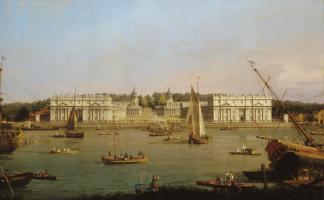
Around 1752. Canaletto [aged 54]. Greenwich Hospital [Map] from the North Bank of the Thames.
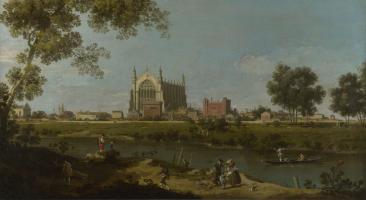
Around 1754. Canaletto [aged 56]. View across the River Thames to Eton College [Map] with the new Eton College Chapel [Map] visible in white stone and the original Tudor buildings in red brick.
1st June 1759. Kew Bridge [Map] is a bridge over the River Thames. The original bridge was constructed before 1759. The first bridge was built by Robert Tunstall of Brentford who previously owned the ferry on the site. The bridge was inaugurated on 1 June 1759 by the Prince of Wales [aged 20] driving over it with his mother [aged 39] and a number of other royals, and was opened to the public three days later.


Richmond Bridge [Map] is a bridge over the River Thames opened in September 1777.
1789. Swinford Bridge, Oxfordshire [Map] is a bridge over the River Thames in Oxfordshire which opened in 1789.
On 29th June 1794 George Waldegrave 5th Earl Waldegrave [aged 9] drowned whilst swimming in the River Thames near Eton [Map]. His brother John [aged 8] succeeded 6th Earl Waldegrave, 7th Baron Waldegrave Chewton Somerset, 10th Baronet Waldegrave of Hever Castle.
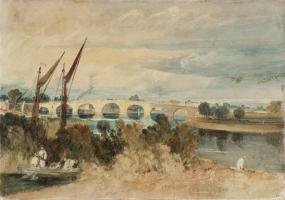
1805. Joseph Mallord William Turner [aged 29]. Kew Bridge [Map] and the River Thames, with Brentford Eyot in the Foreground and Strand-on-Green Seen through the Arches: Low Tide. From the Thames sketchbooks c.1804-14.
Hammersmith Bridge [Map] is a bridge on the River Thames designed by Joseph Bazalgette [aged 8] opened on 6th October 1827.

Kingston Bridge [Map] is a bridge over the River Thames opened on 17th July 1828 by the future Queen [aged 35] then Duchess of Clarence.
Annals of the six Kings of England by Nicholas Trivet
Translation of the Annals of the Six Kings of England by that traces the rise and rule of the Angevin aka Plantagenet dynasty from the mid-12th to early 14th century. Written by the Dominican scholar Nicholas Trivet, the work offers a vivid account of English history from the reign of King Stephen through to the death of King Edward I, blending political narrative with moral reflection. Covering the reigns of six monarchs—from Stephen to Edward I—the chronicle explores royal authority, rebellion, war, and the shifting balance between crown, church, and nobility. Trivet provides detailed insight into defining moments such as baronial conflicts, Anglo-French rivalry, and the consolidation of royal power under Edward I, whose reign he describes with particular immediacy. The Annals combines careful year-by-year reporting with thoughtful interpretation, presenting history not merely as a sequence of events but as a moral and political lesson. Ideal for readers interested in medieval history, kingship, and the origins of the English state, this chronicle remains a valuable and accessible window into the turbulent world of the Plantagenet kings.
Available at Amazon in eBook and Paperback format.
Cliveden, Buckinghamshire [Map] is an estate and house on the banks of the River Thames.
Lechlade Bridge [Map] is over the River Thames.
Gildas. 11. The first of these martyrs, St. Alban, for charity's sake saved another confessor who was pursued by his persecutors, and was on the point of being seized, by hiding him in his house, and then by changing clothes with him, imitating in this the example of Christ, who laid down his life for his sheep, and exposing himself in the other's clothes to be pursued in his stead. So pleasing to God was this conduct, that between his confession and martyrdom, he was honoured with the performance of wonderful miracles in presence of the impious blasphemers who were carrying the Roman standards, and like the Israelites of old, who trod dry-foot an unfrequented path whilst the Ark of the Covenant stood some time on the sands in the midst of Jordan; so also the martyr, with a thousand others, opened a path across the noble river Thames, whose waters stood abrupt like precipices on either side; and seeing this, the first of his executors was stricken with awe, and from a wolf became a lamb; so that he thirsted for martyrdom, and boldly underwent that for which he thirsted. The other holy martyrs were tormented with divers sufferings, and their limbs were racked in such unheard of ways, that they, without delay, erected the trophies of their glorious martyrdom even in the gates of the city of Jerusalem. For those who survived, hid themselves in woods and deserts, and secret caves, waiting until God, who is the righteous judge of all, should reward their persecutors with judgment, and themselves with protection of their lives.
Windsor, Berkshire [Map] and Eton [Map] are separated by the River Thames.
Goring, Oxfordshire [Map] is on the left bank of the River Thames in the Goring Gap between the Berkshire Downs and Chiltern Hills.
Bisham Abbey [Map] is on the south bank of the River Thames.
Taplow, Buckinghamshire [Map] is on the River Thames.
Chiswick Bridge [Map] is a bridge over the River Thames.
Marlow Bridge [Map] is over the River Thames.
Hampton Court Bridge [Map] is a bridge on the River Thames.
Chronicle of Abbot Ralph of Coggeshall
The Chronicle of Abbot Ralph of Coggeshall (Chronicon Anglicanum) is an indispensable medieval history that brings to life centuries of English and European affairs through the eyes of a learned Cistercian monk. Ralph of Coggeshall, abbot of the Abbey of Coggeshall in Essex in the early 13th century, continued and expanded his community’s chronicle, documenting events from the Norman Conquest of 1066 into the tumultuous reign of King Henry III. Blending eyewitness testimony, careful compilation, and the monastic commitment to record-keeping, this chronicle offers a rare narrative of political intrigue, royal power struggles, and social upheaval in England and beyond. Ralph’s work captures the reigns of pivotal figures such as Richard I and King John, providing invaluable insights into their characters, decisions, and the forces that shaped medieval rule. More than a simple annal, Chronicon Anglicanum conveys the texture of medieval life and governance, making it a rich source for scholars and readers fascinated by English history, monastic authorship, and the shaping of the medieval world.
Available at Amazon in eBook and Paperback format.
Battersea Bridge [Map] is a bridge over the River Thames.
Survey London Volume 4 Chelsea Part II. The Site of Beaufort House [Map].
In the whole history of Chelsea, a history which is indeed famous, so many notable men and women has this little village known-the chief interest has centred about Beaufort House [Map]. From those early days in the 16th century, when it was the well-loved home of Sir Thomas More, until the 18th, when it was the seat of the Duke of Beaufort, it yielded to no other house in importance, not to King Henry VIII's manor house in Cheyne Walk, nor to the Earl of Shrewsbury's mansion, nor to the old manor house with which it shared the dignity of a proprietary chapel in the old Church. It did not carry with it the lordship of the manor, but its property was extensive, including practically the frontage of the Thames between Milman Street and Church Street, and its gardens stretched northwards as far as the King's Road [Map].


Radcot Bridge [Map] is two adajcent bridges over the River Thames.
Wallingford, Oxfordshire [Map] is on the River Thames.
Chertsey Bridge [Map] is on the River Thames.
Henley Bridge [Map] is over the River Thames.
Twickenham Bridge [Map] is a bridge over the River Thames.
Gildas. 3. The island of Britain, situated on almost the utmost border of the earth, towards the south and west, and poised in the Divine balance, as is said, which supports the whole world, stretches out from the southwest towards the North Pole, and is eight hundred miles long and two hundred broad, except where the headlands of sundry promontories stretch farther into the sea. It is surrounded by the ocean, which forms winding bays, and is strongly defended by this ample and, if I may so call it, impassable barrier, save on the south side, where the narrow sea affords a passage to Belgic Gaul. It is enriched by the mouths of two noble rivers, the Thames and the Severn, as it were two arms, by which foreign luxuries were of old imported, and by other streams of less importance. It is famous for eightand-twenty cities, and is embellished by certain castles, with walls, towers, well-barred gates, and houses with threatening battlements built on high, and provided with all requisite instruments of defence. Its plains are spacious, its hills are pleasantly situated, adapted for superior tillage, and its mountains are admirably calculated for the alternate pasturage of cattle, where flowers of various colours, trodden by the feet of man, give it the appearance of a lovely picture. It is decked, like a man's chosen bride, with divers jewels, with lucid fountains, and abundant brooks wandering over the snowwhite sands; with transparent rivers, flowing in gentle murmurs, and offering a pledge of sweet slumber to those who recline upon their banks, whilst it is irrigated by abundant lakes, which pour forth cool torrents of refreshing water.
Cricklade, Wiltshire [Map] is on the River Thames.
The River Churn is a tributary of the River Thames that rises at Seven Springs [Map] in Gloucestershire. Some consider this to be the source of the River Thames since its is further from the mouth of the Thames than the official source Thameshead. The River Churn joins the River Thames near Cricklade.
Thameshead, Gloucestershire [Map] is considered to the source of the River Thames although the head of the River Churn at Seven Springs [Map] is further away from the mouth of the Thames than Thameshead, Gloucestershire [Map].
Abbot John Whethamstede’s Chronicle of the Abbey of St Albans
Abbot John Whethamstede's Register aka Chronicle of his second term at the Abbey of St Albans, 1451-1461, is a remarkable text that describes his first-hand experience of the beginning of the Wars of the Roses including the First and Second Battles of St Albans, 1455 and 1461, respectively, their cause, and their consequences, not least on the Abbey itself. His text also includes Loveday, Blore Heath, Northampton, the Act of Accord, Wakefield, and Towton, and ends with the Coronation of King Edward IV. In addition to the events of the Wars of the Roses, Abbot John, or his scribes who wrote the Chronicle, include details in the life of the Abbey such as charters, letters, land exchanges, visits by legates, and disputes, which provide a rich insight into the day-to-day life of the Abbey, and the challenges faced by its Abbot.
Available at Amazon in eBook and Paperback format.
The River Coln rises near Whittington, Gloucestershire [Map] and Brockhampton, Gloucestershire [Map] from where it flows through Andoversford, Gloucestershire [Map] and Withington, Gloucestershire [Map], Cassey Compton, Gloucestershire [Map], Colne St Denis, Gloucestershire [Map], Coln Rogers, Gloucestershire [Map] to Bibury, Gloucestershire [Map], from where it flows to Coln St Aldwyns, Gloucestershire [Map] then Fairford, Gloucestershire [Map] after which it joins the River Thames a kilometre west of Lechlade Bridge [Map].
The River Cray joins the River Thames at Dartford, Kent [Map].
The River Darent joins the River Thames at Dartford, Kent [Map].
The River Hogsmill rises at Ewell, Surrey [Map] from where it flows to Kingston Upon Thames, Surrey [Map] where it joins the River Thames.

1851 to 1852. John Everett Millais 1st Baronet [aged 21]. "Ophelia". Hamlet Act IV Scene 7 Part IV in which Queen Gertrude describes Ophelia's death to Laertes. Millais painted the scene near Tolworth, Surrey [Map] using the River Hogsmill. Elizabeth Siddal [aged 21] modelled in a bath-tub at 7 Gower Street, Camden [Map]. The initials PRB bottom right next to his signature. See Ophelia by John Everett MIllais.
The River Lea rises near Leagrave, Bedfordshire [Map] after which it travels through Wheathampstead, Hertfordshire [Map], Hertford, Hertfordshire [Map], Ware, Hertfordshire [Map], Broxbourne, Hertfordshire [Map], Waltham Cross, Hertfordshire [Map], Tottenham [Map] before joining the River Thames at Leamouth, Essex [Map].
