

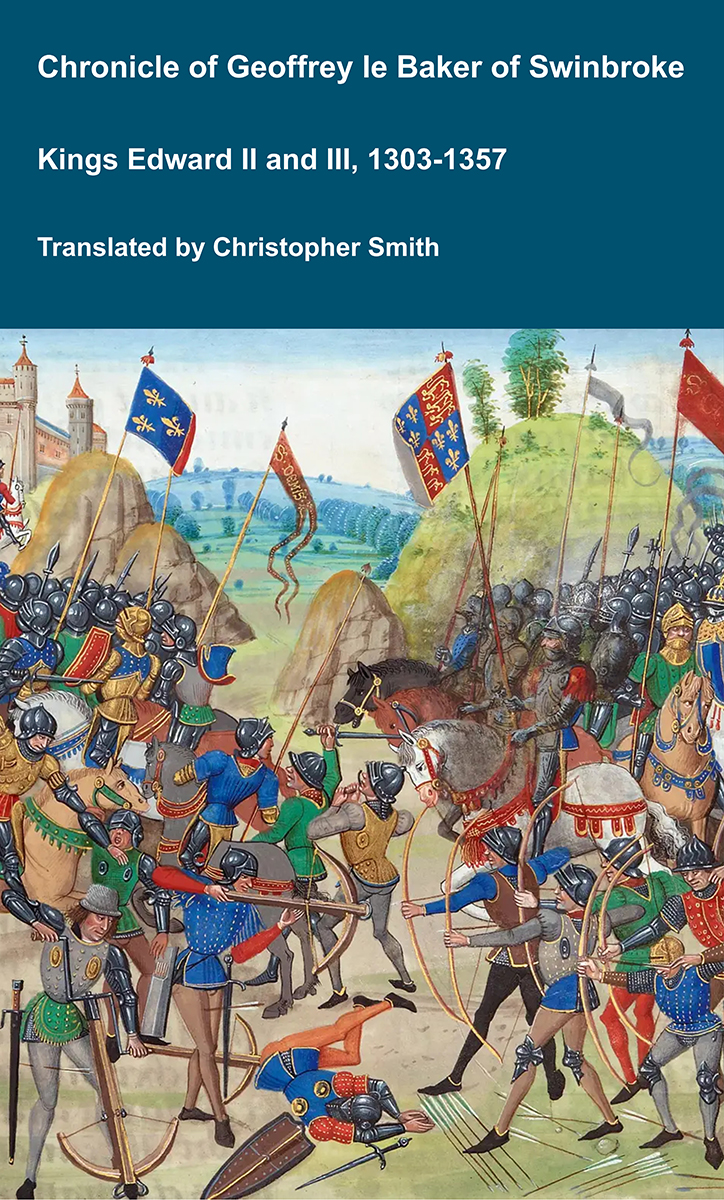
Chronicle of Geoffrey le Baker of Swinbroke
Baker was a secular clerk from Swinbroke, now Swinbrook, an Oxfordshire village two miles east of Burford. His Chronicle describes the events of the period 1303-1356: Gaveston, Bannockburn, Boroughbridge, the murder of King Edward II, the Scottish Wars, Sluys, Crécy, the Black Death, Winchelsea and Poitiers. To quote Herbert Bruce 'it possesses a vigorous and characteristic style, and its value for particular events between 1303 and 1356 has been recognised by its editor and by subsequent writers'. The book provides remarkable detail about the events it describes. Baker's text has been augmented with hundreds of notes, including extracts from other contemporary chronicles, such as the Annales Londonienses, Annales Paulini, Murimuth, Lanercost, Avesbury, Guisborough and Froissart to enrich the reader's understanding. The translation takes as its source the 'Chronicon Galfridi le Baker de Swynebroke' published in 1889, edited by Edward Maunde Thompson.
Available at Amazon in eBook and Paperback format.
Royal Household is in Court Positions.
1236 Marriage of Henry III and Eleanor of Provence
1421 Coronation of Catherine of Valois
18 Apr 1540 Thomas Cromwell created Earl of Essex and Great Chamberlain
Patent Rolls. 28th July 1461. Westminster Palace [Map]. Appointment, during good behaviour, of John Howard [aged 36] knight, as one of the king's carvers, receiving 40lyearly, viz 20l from the far of the town of Ipswich, co Suffolk, ad 20l from the issues of the counties of Norfolk and Suffolk. By p.s.
Richard Woodville was appointed Chamberlain to John Lancaster 1st Duke Bedford.
In 1407 John Tiptoft 1st Baron Tiptoft was appointed Chief Butler of England.
On 24th February 1421 Catherine of Valois [aged 19] was crowned Queen Consort England at Westminster Abbey [Map] by Archbishop Henry Chichele [aged 58]. Robert Willoughby 6th Baron Willoughby [aged 36] was appointed Chief Butler of England. James I [aged 26] attended, and was honoured by sitting immediately on the queen's left at the coronation banquet.
Edward etc To alle maner oure officers true liegemene & subgettes & to every of them hering or seeing these oure lettres greting Forsomoche as we by thadvyse of oure most entierly beloved Oncle the duc of Gloucestre protector of this oure Realme have appoynted oure fulle trusty & Righte welbeloved Cousynethe lord Lovelle [aged 27] vicount Lovelle to occupie thoffice of Chieff Botiller of England during oure pleasure with alle Fees profites & alle other thinges thereunto belonging and to have the same in as ample wise & maner as Anthony Erle Ryvers or any other had or occupied theseid office in tyme past Wetherefore wolle & streitely charge you alle and every of you that unto oure seid Cousyne or sucheas heshalle assigne or depute in the seid office ye be at alle tymes helping aiding & assisting in every thing as it shalle apperteyne as ye & every of you wolle eschewe oure grevouse displeasure at youre perilles yovene under oure signet at oure Toure of Londone the xix day of Maij anno proprio primo [19th March 1483]
Close Rolls Edward IV Edward V Richard III 1476-1485. 14th August 1483 Francis Lovell 1st Viscount Lovell [aged 27] was appointed Chief Butler of England. King Richard III of England [aged 30]. Westminster Palace [Map]. Grant for life to the king's kinsman Francis Lovell, knight, Viscount Lovel, the king's chamberlain, of the office of Chief Butler of England, void by the death of Anthony, late earl Rivers, receiving fees of 100l yearly from the customs and prises of wines and other issues of his office, with all other profits. By p.s.
In 1521 John Hussey 1st Baron Hussey of Sleaford [aged 56] was appointed Chief Butler of England.
Chronica Majora by Matthew Paris. 20th January 1236. There were assembled at the king's [aged 28] nuptial festivities such a host of nobles of both sexes, such numbers of religious men, such crowds of the populace, and such a variety of actors, that London, with its capacious bosom, could scarcely contain them. The whole city was ornamented with flags and banners, chaplets and hangings, candles and lamps, and with wonderful devices and extraordinary representations, and all the roads were cleansed from mud and dirt, sticks, and everything offensive. The citizens, too, went out to meet the king and queen [aged 13], dressed out in their ornaments, and vied with each other in trying the speed of their horses. On the same day, when they left the city for Westminster, to perform the duties of butler to the king (which office belonged to them by right of old, at the coronation), they proceeded thither dressed in silk garments, with mantles worked in gold, and with costly changes of raiment, mounted on valuable horses, glittering with new bits and saddles, and riding in troops arranged in order. They carried with them three hundred and sixty gold and silver cups, preceded by the king's trumpeters and with horns sounding, so that such a wonderful novelty struck all who beheld it with astonishment. The archbishop of Canterbury [aged 61], by the right especially belonging to him, performed the duty of crowning, with the usual solemnities, the bishop of London assisting him as a dean, the other bishops taking their stations according to their rank. In the same way all the abbats, at the head of whom, as was his right, was the abbat of St. Alban's (for as the Protomartyr of England, St. Alban, was the chief of all the martyrs of England, so also was his abbat the chief of all the abbats in rank and dignity), as the authentic privileges of that church set forth. The nobles, too, performed the duties, which, by ancient right and custom, pertained to them at the coronations of kings. In like manner some of the inhabitants of certain cities discharged certain duties which belonged to them by right of their ancestors. The earl of Chester [aged 29] carried the sword of St. Edward, which was called "Curtein", before the king, as a sign that he was earl of the palace, and had by right the power of restraining the king if he should commit an error. The earl was attended by the constable of Chester [aged 44], and kept the people away with a wand when they pressed forward in a disorderly way. The grand marshal of England, the earl of Pembroke [aged 39], carried a wand before the king and cleared the way before him both, in the church and in the banquet-hall, and arranged the banquet and the guests at table. The Wardens of the Cinque Ports carried the pall over the king, supported by four spears, but the claim to this duty was not altogether undisputed. The earl of Leicester [aged 28] supplied the king with water in basins to wash before his meal; the Earl Warrenne performed the duty of king's Cupbearer, supplying the place of the earl of Arundel, because the latter was a youth and not as yet made a belted knight. Master Michael Belet was butler ex officio; the earl of Hereford [aged 32] performed the duties of marshal of the king's household, and William Beauchamp [aged 51] held the station of almoner. The justiciary of the forests arranged the drinking cups on the table at the king's right hand, although he met with some opposition, which however fell to the ground. The citizens of London passed the wine about in all directions, in costly cups, and those of Winchester superintended the cooking of the feast; the rest, according to the ancient statutes, filled their separate stations, or made their claims to do so. And in order that the nuptial festivities might not be clouded by any disputes, saving the right of any one, many things were put up with for the time which they left for decision at a more favourable opportunity. The office of chancellor of England, and all the offices connected with the king, are ordained and assized in the Exchequer. Therefore the chancellor, the chamberlain, the marshal, and the constable, by right of their office, took their seats there, as also did the barons, according to the date of their creation, in the city of London, whereby they each knew his own place. The ceremony was splendid, with the gay dresses of the clergy and knights who were present. The abbat of Westminster sprinkled the holy water, and the treasurer, acting the part of sub-dean, carried the Paten. Why should I describe all those persons who reverently ministered in the church to God as was their duty? Why describe the abundance of meats and dishes on the table & the quantity of venison, the variety of fish, the joyous sounds of the glee-men, and the gaiety of the waiters? Whatever the world could afford to create pleasure and magnificence was there brought together from every quarter.
 Become a Member via our Buy Me a Coffee page to read more.
In 1540 Richard Manners [aged 31] was appointed Cupbearer.
After August 1614 George Villiers 1st Duke of Buckingham [aged 21] was appointed Cupbearer to King James I of England and Ireland and VI of Scotland [aged 48].
In 1650 Charles Lyttelton 3rd Baronet [aged 22] was appointed Cupbearer to King Charles II of England Scotland and Ireland [aged 19] while the King was in exile.


William of Worcester's Chronicle of England
William of Worcester, born around 1415, and died around 1482 was secretary to John Fastolf, the renowned soldier of the Hundred Years War, during which time he collected documents, letters, and wrote a record of events. Following their return to England in 1440 William was witness to major events. Twice in his chronicle he uses the first person: 1. when writing about the murder of Thomas, 7th Baron Scales, in 1460, he writes '… and I saw him lying naked in the cemetery near the porch of the church of St. Mary Overie in Southwark …' and 2. describing King Edward IV's entry into London in 1461 he writes '… proclaimed that all the people themselves were to recognize and acknowledge Edward as king. I was present and heard this, and immediately went down with them into the city'. William’s Chronicle is rich in detail. It is the source of much information about the Wars of the Roses, including the term 'Diabolical Marriage' to describe the marriage of Queen Elizabeth Woodville’s brother John’s marriage to Katherine, Dowager Duchess of Norfolk, he aged twenty, she sixty-five or more, and the story about a paper crown being placed in mockery on the severed head of Richard, 3rd Duke of York.
Available at Amazon in eBook and Paperback format.

Around 1509 William Fitzwilliam 1st Earl of Southampton [aged 19] was appointed King's Cupbearer.
Before 1483 Ralph Hastings was appointed Knight of the Body to King Edward IV of England [aged 40].
Around 1483 John Conyers [aged 72] was appointed Knight of the Body to King Richard III of England [aged 30].
Before September 1483 Marmaduke Constable [aged 26] was appointed Knight of the Body to King Richard III of England [aged 30].
Before May 1486 Marmaduke Constable [aged 29] was appointed Knight of the Body to King Henry VII of England and Ireland [aged 29].
In 1516 Philip Boteler [aged 24] was appointed Knight of the Body to King Henry VIII of England and Ireland [aged 24].
Henry Willoughby was appointed Knight of the Body to King Henry VII of England and Ireland.
Henry Willoughby was appointed Knight of the Body to King Henry VIII of England and Ireland.
In December 1558 John Astley [aged 51] was appointed Master of the Jewel House. Katherine "Kat" Champernowne [aged 56] was appointed Chief Lady of the Bedchamber.
Before 15th January 1569 Catherine Carey [aged 45] was appointed Chief Lady of the Bedchamber to Queen Elizabeth I of England and Ireland [aged 35].


Before 1572 Katherine Carey Countess Nottingham [aged 21] was appointed First Lady of the Bedchamber to Queen Elizabeth I of England and Ireland [aged 38].
After 19th October 1670 Flower Backhouse Countess Clarendon was appointed First Lady of the Bedchamber to Queen Anne of England Scotland and Ireland [aged 5] her niece.


John Evelyn's Diary. 31st March 1661. This night, his Majesty [aged 30] promised to make my wife [aged 26] Lady of the Jewels (a very honorable charge) to the future Queen (but which he never performed).
On 22nd April 1689 Elizabeth Butler Countess Derby [aged 29] was appointed Principal Lady in Waiting to Mary Stewart II Queen England Scotland and Ireland [aged 26] as well as Groom of the Stool and Mistress of the Robes attracting a salary of £1200 per annum (£800 and £400 respectively).


Chronicle of Walter of Guisborough
A canon regular of the Augustinian Guisborough Priory, Yorkshire, formerly known as The Chronicle of Walter of Hemingburgh, describes the period from 1066 to 1346. Before 1274 the Chronicle is based on other works. Thereafter, the Chronicle is original, and a remarkable source for the events of the time. This book provides a translation of the Chronicle from that date. The Latin source for our translation is the 1849 work edited by Hans Claude Hamilton. Hamilton, in his preface, says: 'In the present work we behold perhaps one of the finest samples of our early chronicles, both as regards the value of the events recorded, and the correctness with which they are detailed; Nor will the pleasing style of composition be lightly passed over by those capable of seeing reflected from it the tokens of a vigorous and cultivated mind, and a favourable specimen of the learning and taste of the age in which it was framed.'
Available at Amazon in eBook and Paperback format.
Patent Rolls. 7th May 1461. Middleham Castle [Map]. Appointment for life of the said earl [aged 32], as great chamberlain of England, with the accustomed fees. By other latters patent.
On 19th December 1526 John de Vere 15th Earl of Oxford [aged 55] was appointed Lord Great Chamberlain.

On 18th April 1540 Thomas Cromwell [aged 55] was created 1st Earl Essex and appointed Lord Great Chamberlain.
In September 2022 Rupert Carrington 7th Baron Carrington [aged 73] was appointed Lord Great Chamberlain as a consequence of the rotation of the office between three families.

In 1721 John Campbell 2nd Duke Argyll [aged 40] was appointed Lord Steward of the Household.

On 15th August 1802 George Legge 3rd Earl Dartmouth [aged 46] was appointed Lord Steward of the Household.
In 1563 Queen Elizabeth [aged 29]appointed Dorothy Stafford [aged 36] Mistress of the Robes.
Samuel Pepys' Diary. 26th July 1662. Thence to Mrs. Sarah, and there looked over my Lord's lodgings, which are very pretty; and White Hall garden and the Bowling-ally (where lords and ladies are now at bowles), in brave condition. Mrs. Sarah told me how the falling out between my Baroness Castlemaine's [aged 21] and her Lord was about christening of the child lately1, which he would have, and had done by a priest: and, some days after, she had it again christened by a minister; the King [aged 32], and Lord of Oxford, and Duchesse of Suffolk, being witnesses: and christened with a proviso, that it had not already been christened. Since that she left her Lord, carrying away every thing in the house; so much as every dish, and cloth, and servant but the porter. He is gone discontented into France, they say, to enter a monastery; and now she is coming back again to her house in Kingstreet. But I hear that the Queen [aged 23] did prick her out of the list presented her by the King;2 desiring that she might have that favour done her, or that he would send her from whence she come: and that the King was angry and the Queen discontented a whole day and night upon it; but that the King hath promised to have nothing to do with her hereafter. But I cannot believe that the King can fling her off so, he loving her too well: and so I writ this night to my Lady to be my opinion; she calling her my lady, and the lady I admire. Here I find that my Lord hath lost the garden to his lodgings, and that it is turning into a tennis-court. Hence by water to the Wardrobe to see how all do there, and so home to supper and to bed.
Note 1. The boy was born in June at Baroness Castlemaine's house in King Street. By the direction of Lord Castlemaine, who had become a Roman Catholic, the child was baptized by a priest, and this led to a final separation between husband and wife. Some days afterwards the child was again baptized by the rector of St. Margaret's, Westminster [Map], in presence of the godparents, the King, Aubrey De Vere [aged 35], Earl of Oxford, and Barbara, Countess of Suffolk [aged 40], first Lady of the Bedchamber to the Queen and Baroness Castlemaine's aunt. The entry in the register of St. Margaret's [Map] is as follows: "1662 June 18 Charles Palmer Ld Limbricke, s. to ye right honorble Roger Earl of Castlemaine by Barbara" (Steinman's "Memoir of Barbara, Duchess of Cleveland", 1871, p. 33). The child was afterwards called Charles Fitzroy, and was created Duke of Southampton in 1674. He succeeded his mother in the dukedom of Cleveland in 1709, and died 1730.
Note 2. By the King's command Lord Clarendon [aged 54], much against his inclination, had twice visited his royal mistress with a view of inducing her, by persuasions which he could not justify, to give way to the King's determination to have Baroness Castlemaine's of her household.... Lord Clarendon has given a full account of all that transpired between himself, the King and the Queen, on this very unpleasant business ('Continuation of Life of Clarendon,' 1759, ff. 168-178). Steinman's Memoir of Duchess of Cleveland, p. 35. The day at length arrived when Baroness Castlemaine's was to be formally admitted a Lady of the Bedchamber. The royal warrant, addressed to the Lord Chamberlain [aged 61], bears date June 1, 1663, and includes with that of her ladyship, the names of the Duchess of Buckingham [aged 24], the Countesses of Chesterfield and Bath [aged 22], and the Countess Mareshall. A separate warrant of the same day directs his lordship to admit the Countess of Suffolk as Groom of the Stole and first Lady of the Bedchamber, to which undividable offices she had, with the additional ones of Mistress of the Robes and Keeper of the Privy Purse, been nominated by a warrant dated April 2, 1662, wherein the reception of her oath is expressly deferred until the Queen's household shall be established. We here are furnished with the evidence that Charles would not sign the warrants for the five until Catherine had withdrawn her objection to his favourite one. Addenda to Steinman's Memoir of Duchess of Cleveland (privately printed), 1874, p. i.
Become a Member via our Buy Me a Coffee page to read more.
On 22nd April 1689 Elizabeth Butler Countess Derby [aged 29] was appointed Principal Lady in Waiting to Mary Stewart II Queen England Scotland and Ireland [aged 26] as well as Groom of the Stool and Mistress of the Robes attracting a salary of £1200 per annum (£800 and £400 respectively).
The London Gazette 25486. St. James's Palace, June 27, 1885. The Queen [aged 66] has been pleased to appoint the Duchess of Buccleuch [aged 48] to be Mistress of the Robes, in the room of the Duchess of Roxburghe [aged 30], resigned
From 1913 to 1925 Winifred Anna Dallas-Yorke Duchess Portland [aged 49] was Mistress of the Robes to Alexandra of Denmark Queen Consort England [aged 68].


In 1913 Winifred Anna Dallas-Yorke Duchess Portland [aged 49] was appointed Mistress of the Robes to Queen Alexandra [aged 68].
Chronicle of a Bourgeois of Valenciennes
Récits d’un bourgeois de Valenciennes aka The Chronicle of a Bourgeois of Valenciennes is a vivid 14th-century vernacular chronicle written by an anonymous urban chronicler from Valenciennes in the County of Hainaut. It survives in a manuscript that describes local and regional history from about 1253 to 1366, blending chronology, narrative episodes, and eyewitness-style accounts of political, military, and social events in medieval France, Flanders, and the Low Countries. The work begins with a chronological framework of events affecting Valenciennes and its region under rulers such as King Philip VI of France and the shifting allegiances of local nobility. It includes accounts of conflicts, sieges, diplomatic manoeuvres, and the impact of broader struggles like the Hundred Years’ War on urban life in Hainaut. Written from the perspective of a burgher (bourgeois) rather than a monastery or royal court, the chronicle offers a rare lay viewpoint on high politics and warfare, reflecting how merchants, townspeople, and civic institutions experienced the turbulence of the 13th and 14th centuries. Its narrative style combines straightforward reporting of events with moral and civic observations, making it a valuable source for readers interested in medieval urban society, regional politics, and the lived experience of war and governance in pre-modern Europe.
Available at Amazon in eBook and Paperback format.
Samuel Pepys' Diary. 9th May 1660. Up very early, writing a letter to the King, as from the two Generals of the fleet, in answer to his letter to them, wherein my Lord do give most humble thanks for his gracious letter and declaration; and promises all duty and obedience to him. This letter was carried this morning to Sir Peter Killigrew [aged 67]1, who came hither this morning early to bring an order from the Lords' House to my Lord, giving him power to write an answer to the King. This morning my Lord St. John [aged 61] and other persons of honour were here to see my Lord, and so away to Flushing [Map]. After they were gone my Lord and I to write letters to London, which we sent by Mr. Cook, who was very desirous to go because of seeing my wife before she went out of town. As we were sitting down to dinner, in comes Noble with a letter from the House of Lords to my Lord, to desire him to provide ships to transport the Commissioners to the King, which are expected here this week. He brought us certain news that the King was proclaimed yesterday with great pomp, and brought down one of the Proclamations, with great joy to us all; for which God be praised. After dinner to ninepins and lost 5s. This morning came Mr. Saunderson [aged 74]2, that writ the story of the King, hither, who is going over to the King. He calls me cozen and seems a very knowing man. After supper to bed betimes, leaving my Lord talking in the Coach with the Captain.
Note 1. Sir Peter Killigrew, Knight, of Arwenack, Cornwall, was known as "Peter the Post", from the alacrity with which he despatched "like wild fire" all the messages and other commissions entrusted to him in the King's [aged 29] cause. His son Peter [aged 26], who succeeded his uncle as second baronet in 1665, was M.P. for Camelford in 1660.
Note 2. Afterwards Sir William Sanderson, gentleman of the chamber, author of the "History of Mary Queen of Scots, James I., and Charles I". His wife, Dame Bridget [aged 56], was mother of the maids.
Become a Member via our Buy Me a Coffee page to read more.
Before 1676 Bridget Tyrrell [aged 71] was appointed Mother of the Maids.
John Evelyn's Diary. 11th July 1675. In this journey, went part of the way Mr. James Graham [aged 26] (since Privy Purse to the Duke [aged 41]), a young gentleman exceedingly in love with Mrs. Dorothy Howard [aged 24], one of the maids of honor in our company. I could not but pity them both, the mother not much favoring it. This lady was not only a great beauty, but a most virtuous and excellent creature, and worthy to have been wife to the best of men. My advice was required, and I spoke to the advantage of the young gentleman, more out of pity than that she deserved no better match; for, though he was a gentleman of good family, yet there was great inequality.


From 1391 to 1398 Bishop Guy Mone Aka Mohun was appointed Receiver of the Chamber.
In 1404 Roger Leche of Chatsworth [aged 43] was appointed Treasurer of the Royal Household.
In 1406 John Tiptoft 1st Baron Tiptoft was appointed Treasurer of the Royal Household.
In 1422 William Phelip [aged 39] was appointed Treasurer of the Royal Household.
In May 1431 John Tyrrell [aged 49] was appointed Treasurer of the Royal Household.
In 1439 Roger Fiennes [aged 54] was appointed Treasurer of the Royal Household.
In 1458 Thomas Tuddenham [aged 56] was appointed Treasurer of the Royal Household. He was buried at Austin Friars.
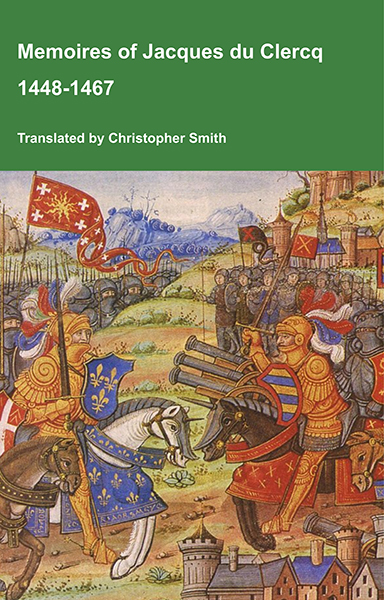
This is a translation of the 'Memoires of Jacques du Clercq', published in 1823 in two volumes, edited by Frederic, Baron de Reissenberg. In his introduction Reissenberg writes: 'Jacques du Clercq tells us that he was born in 1424, and that he was a licentiate in law and a counsellor to Philip the Good, Duke of Burgundy, in the castellany of Douai, Lille, and Orchies. It appears that he established his residence at Arras. In 1446, he married the daughter of Baldwin de la Lacherie, a gentleman who lived in Lille. We read in the fifth book of his Memoirs that his father, also named Jacques du Clercq, had married a lady of the Le Camelin family, from Compiègne. His ancestors, always attached to the counts of Flanders, had constantly served them, whether in their councils or in their armies.' The Memoires cover a period of nineteen years beginning in in 1448, ending in in 1467. It appears that the author had intended to extend the Memoirs beyond that date; no doubt illness or death prevented him from carrying out this plan. As Reissenberg writes the 'merit of this work lies in the simplicity of its narrative, in its tone of good faith, and in a certain air of frankness which naturally wins the reader’s confidence.' Du Clercq ranges from events of national and international importance, including events of the Wars of the Roses in England, to simple, everyday local events such as marriages, robberies, murders, trials and deaths, including that of his own father in Book 5; one of his last entries.
Available at Amazon in eBook and Paperback format.
In 1525 William Fitzwilliam 1st Earl of Southampton [aged 35] was appointed Treasurer of the Royal Household to King Henry VIII of England and Ireland [aged 33].
Francis Knollys was appointed Treasurer of the Royal Household to King Henry VIII of England and Ireland.
In 1375 Guichard d'Angle 1st Earl Huntingdon was appointed Tutor to Richard II.

Before 1806 Bishop Joseph Allen [aged 35] was appointed Tutor to John Charles Spencer 3rd Earl Spencer [aged 23] which post he held until 1836.
Charles Nassau Thomas Vice Chamberlain to the Prince was appointed Vice Chamberlain to the Prince of Wales.