

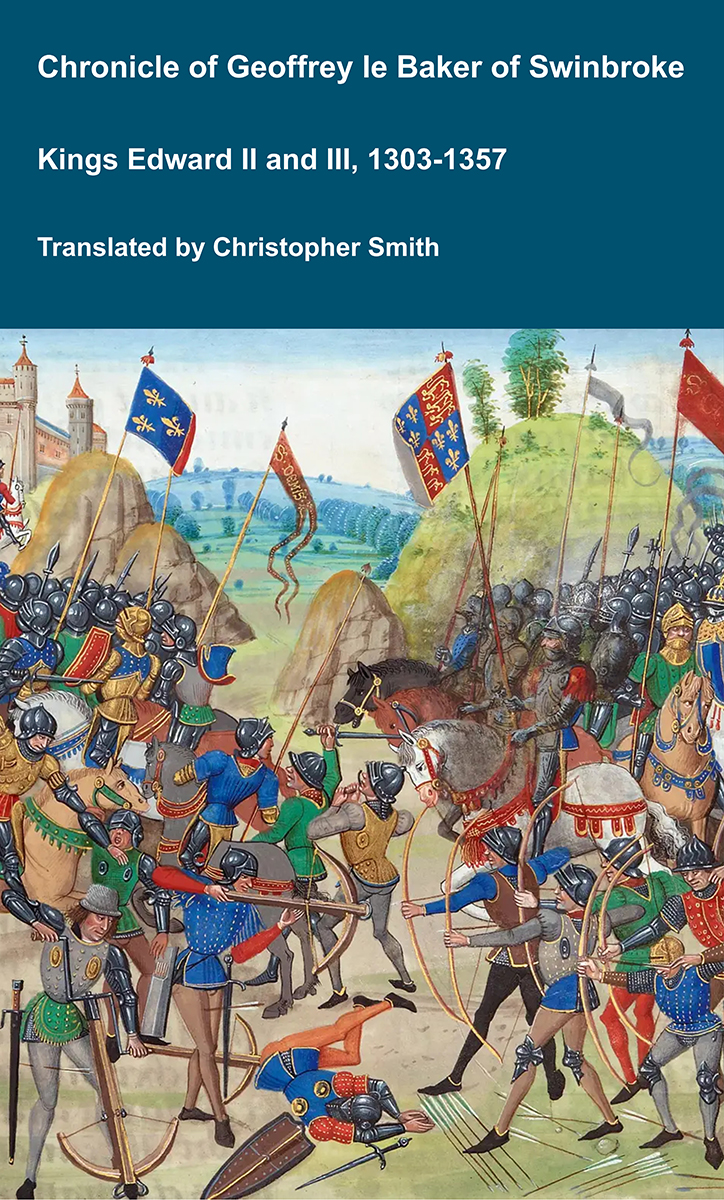
Chronicle of Geoffrey le Baker of Swinbroke
Baker was a secular clerk from Swinbroke, now Swinbrook, an Oxfordshire village two miles east of Burford. His Chronicle describes the events of the period 1303-1356: Gaveston, Bannockburn, Boroughbridge, the murder of King Edward II, the Scottish Wars, Sluys, Crécy, the Black Death, Winchelsea and Poitiers. To quote Herbert Bruce 'it possesses a vigorous and characteristic style, and its value for particular events between 1303 and 1356 has been recognised by its editor and by subsequent writers'. The book provides remarkable detail about the events it describes. Baker's text has been augmented with hundreds of notes, including extracts from other contemporary chronicles, such as the Annales Londonienses, Annales Paulini, Murimuth, Lanercost, Avesbury, Guisborough and Froissart to enrich the reader's understanding. The translation takes as its source the 'Chronicon Galfridi le Baker de Swynebroke' published in 1889, edited by Edward Maunde Thompson.
Available at Amazon in eBook and Paperback format.
Savigniac is in Religious Buildings by Order.
Around 1130 Combermere Abbey [Map] was founded by Hugh Malbank, Baron of Nantwich, confirmed in 1130 by Ranulf Gernon 4th Earl Chester (age 31) who was one of the witnesses of its foundation charter. Other witnesses included Hugh Malbank's son, William, and Roger de Clinton, the Bishop of Coventry. The original grant included the manor of Wilkesley, comprising two Domesday manors worth 18 shillings pre-Conquest; the villages of Dodcott, Lodmore and Royal; land at Burleydam; a mill and fishery at Chorley; and woods at Brentwood, Light Birchwood and Butterley Heyes. The Abbey originally belonged to the Savigniac order, which merged with the Cistercian order by 1147.