

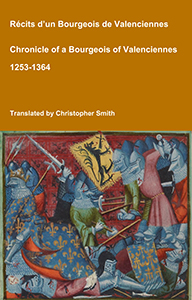
Chronicle of a Bourgeois of Valenciennes
Récits d’un bourgeois de Valenciennes aka The Chronicle of a Bourgeois of Valenciennes is a vivid 14th-century vernacular chronicle written by an anonymous urban chronicler from Valenciennes in the County of Hainaut. It survives in a manuscript that describes local and regional history from about 1253 to 1366, blending chronology, narrative episodes, and eyewitness-style accounts of political, military, and social events in medieval France, Flanders, and the Low Countries. The work begins with a chronological framework of events affecting Valenciennes and its region under rulers such as King Philip VI of France and the shifting allegiances of local nobility. It includes accounts of conflicts, sieges, diplomatic manoeuvres, and the impact of broader struggles like the Hundred Years’ War on urban life in Hainaut. Written from the perspective of a burgher (bourgeois) rather than a monastery or royal court, the chronicle offers a rare lay viewpoint on high politics and warfare, reflecting how merchants, townspeople, and civic institutions experienced the turbulence of the 13th and 14th centuries. Its narrative style combines straightforward reporting of events with moral and civic observations, making it a valuable source for readers interested in medieval urban society, regional politics, and the lived experience of war and governance in pre-modern Europe.
Available at Amazon in eBook and Paperback format.
Sheriff of London is in Sheriff.
In 1 Rowland Hill was appointed Sheriff of London.
In 1422 William Estfield was appointed Sheriff of London.
In 1453 Thomas Cooke was appointed Sheriff of London.
In 1475 Edmund Shaa (age 39) was appointed Sheriff of London.
In 1503 Henry Keble was appointed Sheriff of London.
In 1509 George Monoux (age 44) was elected Sheriff of London.
In 1510 John Milbourne was elected Sheriff of London.
In 1511 Thomas Murfyn was elected Sheriff of London.
In 1518 John Alleyn was elected Sheriff of London.
The History of William Marshal was commissioned by his son shortly after William’s death in 1219 to celebrate the Marshal’s remarkable life; it is an authentic, contemporary voice. The manuscript was discovered in 1861 by French historian Paul Meyer. Meyer published the manuscript in its original Anglo-French in 1891 in two books. This book is a line by line translation of the first of Meyer’s books; lines 1-10152. Book 1 of the History begins in 1139 and ends in 1194. It describes the events of the Anarchy, the role of William’s father John, John’s marriages, William’s childhood, his role as a hostage at the siege of Newbury, his injury and imprisonment in Poitou where he met Eleanor of Aquitaine and his life as a knight errant. It continues with the accusation against him of an improper relationship with Margaret, wife of Henry the Young King, his exile, and return, the death of Henry the Young King, the rebellion of Richard, the future King Richard I, war with France, the death of King Henry II, and the capture of King Richard, and the rebellion of John, the future King John. It ends with the release of King Richard and the death of John Marshal.
Available at Amazon in eBook and Paperback format.
In 1525 Ralph Dodmer was appointed Sheriff of London.
In 1527 William Holles (age 56) was appointed Sheriff of London.
In 1528 Ralph Warren (age 42) was appointed Sheriff of London.

In 1540 Alderman Martin Bowes (age 43) was appointed Sheriff of London.
In 1543 Richard Dobbs was elected Sheriff of London.
In 1544 Andrew Judde (age 51) was elected Sheriff of London.
In 1547 Thomas White (age 55) was appointed Sheriff of London.
In 1548 William Locke (age 62) was appointed Sheriff of London.
In 1552 William Garrard (age 45) was elected Sheriff of London.
In 1553 John Maynard (age 44) was elected Sheriff of London.
In 1554 William Chester (age 45) was elected Sheriff of London.
In 1555 John White was appointed Sheriff of London.
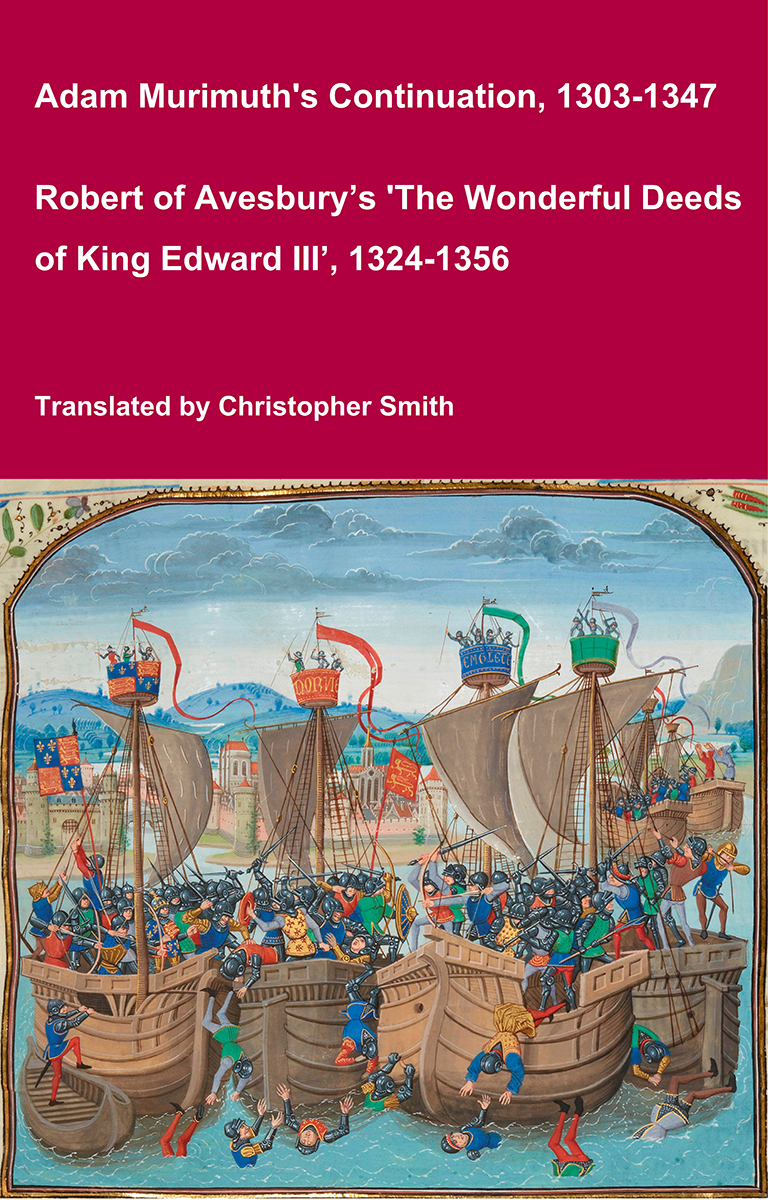
Adam Murimuth's Continuation and Robert of Avesbury’s 'The Wonderful Deeds of King Edward III'
This volume brings together two of the most important contemporary chronicles for the reign of Edward III and the opening phases of the Hundred Years’ War. Written in Latin by English clerical observers, these texts provide a vivid and authoritative window into the political, diplomatic, and military history of fourteenth-century England and its continental ambitions. Adam Murimuth Continuatio's Chronicarum continues an earlier chronicle into the mid-fourteenth century, offering concise but valuable notices on royal policy, foreign relations, and ecclesiastical affairs. Its annalistic structure makes it especially useful for establishing chronology and tracing the development of events year by year. Complementing it, Robert of Avesbury’s De gestis mirabilibus regis Edwardi tertii is a rich documentary chronicle preserving letters, treaties, and official records alongside narrative passages. It is an indispensable source for understanding Edward III’s claim to the French crown, the conduct of war, and the mechanisms of medieval diplomacy. Together, these works offer scholars, students, and enthusiasts a reliable and unembellished account of a transformative period in English and European history. Essential for anyone interested in medieval chronicles, the Hundred Years’ War, or the reign of Edward III.
Available at Amazon in eBook and Paperback format.
In 1558 Richard Champion (age 63) was elected Sheriff of London.
In 1560 Christopher Draper (age 50) was elected Sheriff of London. See Henry Machyn's Diary 01 Aug 1560.
In August 1560 Thomas Lodge (age 51) was elected Sheriff of London.
In 1562 William Allen (age 47) was elected Sheriff of London.
Before 10th April 1567 Richard Lambert was appointed Sheriff of London.
In 1568 John Oliph was appointed Sheriff of London.
In 1581 William Webbe was appointed Sheriff of London.
In 1584 Stephen Slaney was appointed Sheriff of London.
In 1600 Thomas Smythe (age 42) was elected Sheriff of London.
In 1602 Thomas Cambell (age 66) was elected Sheriff of London.
In 1604 Thomas Myddelton of Chirk (age 54) was elected Sheriff of London.
Chronicle of Walter of Guisborough
A canon regular of the Augustinian Guisborough Priory, Yorkshire, formerly known as The Chronicle of Walter of Hemingburgh, describes the period from 1066 to 1346. Before 1274 the Chronicle is based on other works. Thereafter, the Chronicle is original, and a remarkable source for the events of the time. This book provides a translation of the Chronicle from that date. The Latin source for our translation is the 1849 work edited by Hans Claude Hamilton. Hamilton, in his preface, says: 'In the present work we behold perhaps one of the finest samples of our early chronicles, both as regards the value of the events recorded, and the correctness with which they are detailed; Nor will the pleasing style of composition be lightly passed over by those capable of seeing reflected from it the tokens of a vigorous and cultivated mind, and a favourable specimen of the learning and taste of the age in which it was framed.'
Available at Amazon in eBook and Paperback format.
In 1611 Edward Barkham (age 41) was appointed Sheriff of London.
In 1614 John Gore (age 53) was elected Sheriff of London but did not take office until 1615.
In 1625 Thomas Westrow was appointed Sheriff of London.
Before 3rd November 1625 Ellis Crispe (age 63) was elected Sheriff of London. He died shortly after his election.
In 1628 William Acton 1st Baronet (age 58) was elected Sheriff of London.
In 1629 Edmund Wright was elected Sheriff of London.
In 1630 Anthony Abdy (age 50) was elected Sheriff of London.
In 1630 Edmund Wright was elected Sheriff of London.
In 1638 Isaac Penington (age 54) was elected Sheriff of London.
In 1645 John Kendrick was elected Sheriff of London.
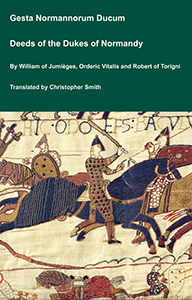
The Deeds of the Dukes of Normandy
The Gesta Normannorum Ducum [The Deeds of the Dukes of Normandy] is a landmark medieval chronicle tracing the rise and fall of the Norman dynasty from its early roots through the pivotal events surrounding the Norman Conquest of England. Originally penned in Latin by the monk William of Jumièges shortly before 1060 and later expanded at the behest of William the Conqueror, the work chronicles the deeds, politics, battles, and leadership of the Norman dukes, especially William’s own claim to the English throne. The narrative combines earlier historical sources with firsthand information and oral testimony to present an authoritative account of Normandy’s transformation from a Viking settlement into one of medieval Europe’s most powerful realms. William’s history emphasizes the legitimacy, military prowess, and governance of the Norman line, framing their expansion, including the conquest of England, as both divinely sanctioned and noble in purpose. Later chroniclers such as Orderic Vitalis and Robert of Torigni continued the history, extending the coverage into the 12th century, providing broader context on ducal rule and its impact. Today this classic work remains a foundational source for understanding Norman identity, medieval statesmanship, and the historical forces that reshaped England and Western Europe between 800AD and 1100AD.
Available at Amazon in eBook and Paperback format.
In 1646 Thomas Foote 1st Baronet (age 48) was appointed Sheriff of London.
In 1658 Anthony Bateman (age 42) was appointed Sheriff of London.
In 1663 Richard Ford (age 49) was elected Sheriff of London.
John Evelyn's Diary. 26th September 1672. I carried with me to dinner my Lord H. Howard (age 44) (now to be made Earl of Norwich and Earl Marshal of England) to Sir Robert Clayton's (age 43), now Sheriff of London, at his new house, where we had a great feast; it is built indeed for a great magistrate, at excessive cost. The cedar dining room is painted with the history of the Giants' War, incomparably done by Mr. Streeter (age 51), but the figures are too near the eye.


In 1675 John Lethieullier Merchant (age 42) was appointed Sheriff of London.
In 1687 Basil Firebrace 1st Baronet (age 35) was elected Sheriff of London.
In 1704 Willam Humphreys 1st Baronet was appointed Sheriff of London.
In 1704 John Buckworth 1st Baronet (age 41) was elected Sheriff of London.
In 1710 George Thorold 1st Baronet (age 44) was elected Sheriff of London.
In 1710 Francis Eyles 1st Baronet was elected Sheriff of London.
Henrici Quinti, Angliæ Regis, Gesta, is a first-hand account of the Agincourt Campaign, and subsequent events to his death in 1422. The author of the first part was a Chaplain in King Henry's retinue who was present from King Henry's departure at Southampton in 1415, at the siege of Harfleur, the battle of Agincourt, and the celebrations on King Henry's return to London. The second part, by another writer, relates the events that took place including the negotiations at Troye, Henry's marriage and his death in 1422.
Available at Amazon in eBook and Paperback format.
In 1711 Thomas Dunk Ironmonger was appointed Sheriff of London.
In 1720 John Eyles 2nd Baronet (age 37) was appointed Sheriff of London.
In 1723 Edward Bellamy was appointed Sheriff of London.
In 1727 Thomas Lombe (age 41) was elected Sheriff of London.
In 1743 Charles Egleton was appointed Sheriff of London.
In 1754 Samuel Fludyer (age 50) was elected Sheriff of London.
In 1754 Matthew Blakiston 1st Baronet (age 52) was elected Sheriff of London.
In 1764 Thomas Harley (age 33) was appointed Sheriff of London.
In 1783 Robert Taylor (age 69) was appointed Sheriff of London.
In 1785 James Sanderson 1st Baronet (age 43) was elected Sheriff of London.
In 1804 William Domville 1st Baronet (age 61) was appointed Sheriff of London.
In 1809 Matthew Wood 1st Baronet (age 40) was appointed Sheriff of London.
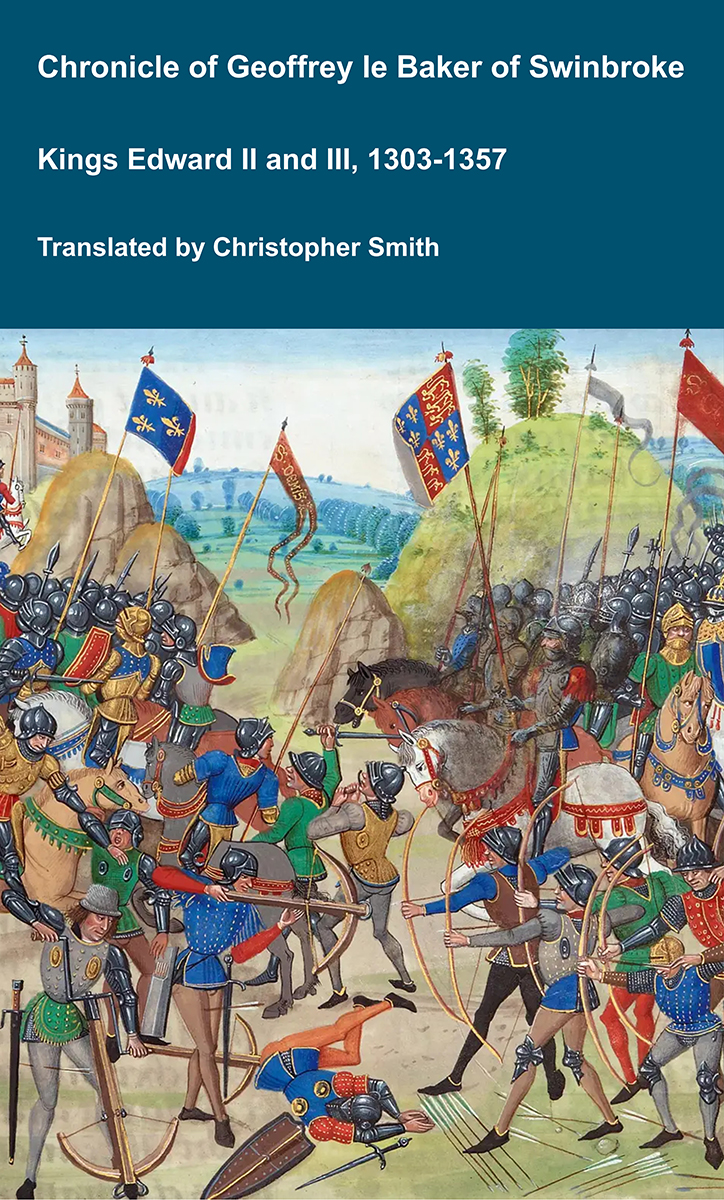
Chronicle of Geoffrey le Baker of Swinbroke
Baker was a secular clerk from Swinbroke, now Swinbrook, an Oxfordshire village two miles east of Burford. His Chronicle describes the events of the period 1303-1356: Gaveston, Bannockburn, Boroughbridge, the murder of King Edward II, the Scottish Wars, Sluys, Crécy, the Black Death, Winchelsea and Poitiers. To quote Herbert Bruce 'it possesses a vigorous and characteristic style, and its value for particular events between 1303 and 1356 has been recognised by its editor and by subsequent writers'. The book provides remarkable detail about the events it describes. Baker's text has been augmented with hundreds of notes, including extracts from other contemporary chronicles, such as the Annales Londonienses, Annales Paulini, Murimuth, Lanercost, Avesbury, Guisborough and Froissart to enrich the reader's understanding. The translation takes as its source the 'Chronicon Galfridi le Baker de Swynebroke' published in 1889, edited by Edward Maunde Thompson.
Available at Amazon in eBook and Paperback format.

In 1855 Colonel William Anderson Rose (age 34) was elected Sheriff of London.
In 1869 Joseph Causton (age 54) was elected Sheriff of London.
In 1899 William Purdie Treloar 1st Baronet (age 55) was elected Sheriff of London.
In 1558 Alderman Richard Mallory was appointed Sheriff of London.
Richard Rich was appointed Sheriff of London.
John Machell was appointed Sheriff of London.