

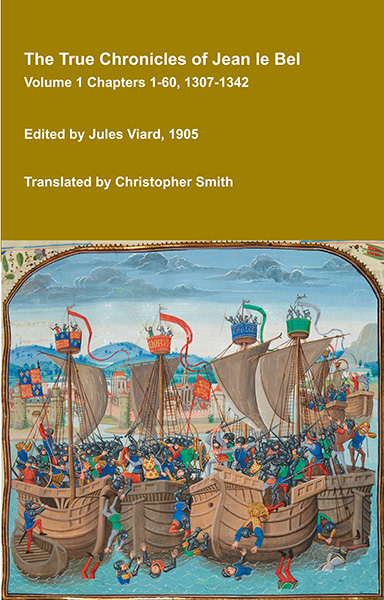
The True Chronicles of Jean le Bel Volume 1 Chapters 1-60 1307-1342
The True Chronicles of Jean le Bel offer one of the most vivid and immediate accounts of 14th-century Europe, written by a knight who lived through the events he describes, and experienced some of them first hand. Covering the early decades of the Hundred Years’ War, this remarkable chronicle follows the campaigns of Edward III of England, the politics of France and the Low Countries, and the shifting alliances that shaped medieval warfare. Unlike later historians, Jean le Bel writes with a strong sense of eyewitness authenticity, drawing on personal experience and the testimony of fellow soldiers. His narrative captures not only battles and sieges, but also the realities of military life, diplomacy, and the ideals of chivalry that governed noble society. A key source for Jean Froissart, Le Bel’s chronicle stands on its own as a compelling and insightful work, at once historical record and literary achievement. This translation builds on the 1905 edition published in French by Jules Viard, adding extensive translations from other sources Rymer's Fœdera, the Chronicles of Adam Murimuth, William Nangis, Walter of Guisborough, a Bourgeois of Valenciennes, Geoffrey le Baker of Swinbroke and Richard Lescot to enrich the original text and Viard's notes.
Available at Amazon in eBook and Paperback format.
Society of Antiquaries of London is in Societies.
See: Fellow of the Society of Antiquaries of London, President of the Society of Antiquaries of London, Secretary of the Society of Antiquaries of London, Society of Antiquaries of London Publications, Vice-President of the Society of Antiquaries of London.
In 1726 George Lynn [aged 19] joined the Society of Antiquaries of London.
In 1815 Charles Alfred Stothard [aged 28] was appointed historical draughtsman to the Society of Antiquaries of London, who sent him to Bayeux to make coloured drawings of the tapestry for publication in the series Vetusta Monumenta.
Georgian Memoirs. The first number of Mr. Stothard's work was received with the applause it merited, and obtained for him distinguished reputation, both as an artist and an antiquary. His time was now occupied in making various excursions in search of monumental antiquities; and, during the summer of 1815, he proceeded as far northward as the Picts' Wall, in order to make drawings for Lyson's Magna Britannia. In the same year, he was appointed historical draughtsman to the Society of Antiquaries; and, in 1816, he was deputed by that body to commence his elaborate and faithful drawings from the celebrated tapestry preserved at Bayeux, in France. He left England, for that purpose, in September; and, after having visited Paris, proceeded, upon a tour of investigation, to Chinon, and discovered, in the adjacent abbey of Fontevraud [Map], those interesting effigies of the Plantagenet race, the existence of which, after the Revolution, had become matter of doubt. He found the abbey converted into a prison; and, in a cellar belonging to it, were deposited the effigies of Henry the Second, his queen, Eleanor of Guienne, Richard the First, and Isabella of Angouleme, the queen of John. The chapel, in which these figures were placed, previously to the Revolution, had been destroyed; and, since their removal to the cellar, they were exposed to continual injury from the prisoners, who came there, twice a day, to draw water at the well. From these effigies Mr. Stothard made several accurate and beautiful drawings; and succeeded, after much labour and difficulty, in discovering the painting upon their surface. Whilst upon a visit to the abbey of L'Espan, near Mons, which he found converted into a barn, he discovered, under a quantity of wheat, the effigy of Berengaria, queen of Richard the First. At Mons, he also discovered the beautiful enamelled tablet of Geoffrey Plantagenet, which he considered the earliest specimen of what is termed a sepulchral brass, and of armorial bearings, depicted decidedly as such.
In 1842 Albert Way [aged 36] was appointed Director of the Society of Antiquaries of London which position he held until 1846.

In 1858 John Peter Boileau 1st Baronet [aged 63] was elected Vice-President of the Society of Antiquaries of London on the recommendation of Philip Stanhope 5th Earl Stanhope [aged 52] which office he held until 1863 (with one break).
In 1718 Peter Le Neve [aged 56] was elected President of the Society of Antiquaries of London.
In 1750 Charles Lennox 2nd Duke Richmond [aged 48] became President of the Society of Antiquaries of London.
In 1754 Hugh Willoughby 15th Baron Willoughby of Parham was elected President of the Society of Antiquaries of London.
In 1765 Bishop Charles Lyttelton [aged 51] was appointed President of the Society of Antiquaries of London.
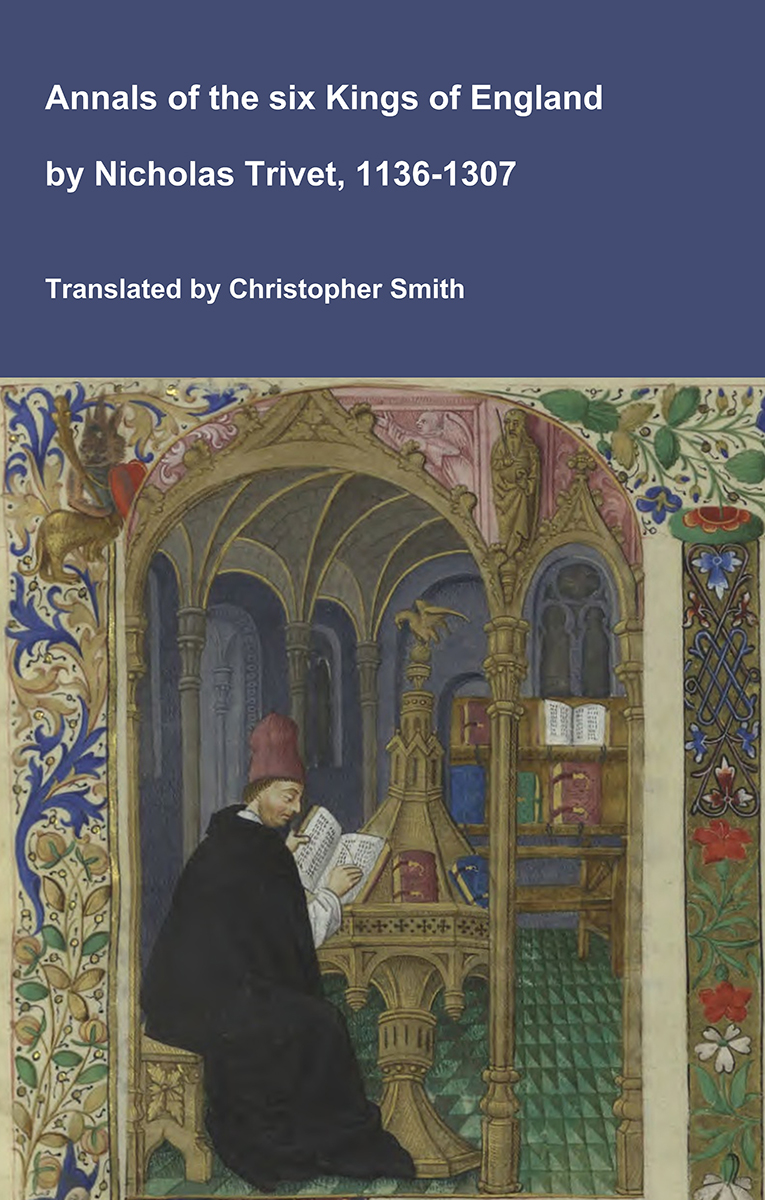
Annals of the six Kings of England by Nicholas Trivet
Translation of the Annals of the Six Kings of England by that traces the rise and rule of the Angevin aka Plantagenet dynasty from the mid-12th to early 14th century. Written by the Dominican scholar Nicholas Trivet, the work offers a vivid account of English history from the reign of King Stephen through to the death of King Edward I, blending political narrative with moral reflection. Covering the reigns of six monarchs—from Stephen to Edward I—the chronicle explores royal authority, rebellion, war, and the shifting balance between crown, church, and nobility. Trivet provides detailed insight into defining moments such as baronial conflicts, Anglo-French rivalry, and the consolidation of royal power under Edward I, whose reign he describes with particular immediacy. The Annals combines careful year-by-year reporting with thoughtful interpretation, presenting history not merely as a sequence of events but as a moral and political lesson. Ideal for readers interested in medieval history, kingship, and the origins of the English state, this chronicle remains a valuable and accessible window into the turbulent world of the Plantagenet kings.
Available at Amazon in eBook and Paperback format.
In 1846 Philip Stanhope 5th Earl Stanhope [aged 40] was appointed President of the Society of Antiquaries of London.
In 1897 Harold Arthur Lee Dillon 17th Viscount Dillon [aged 52] was appointed President of the Society of Antiquaries of London which office he held until 1904.
In 1718 William Stukeley [aged 30] was elected Secretary of the Society of Antiquaries of London.
In 1814 Henry Ellis [aged 36] was appointed Secretary of the Society of Antiquaries of London. During his forty year tenure he only missed two meetings.
In 1727 Henry Hare 3rd Baron Coleraine [aged 33] was elected Vice-President of the Society of Antiquaries of London.